

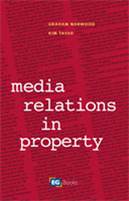
I wrote this book in conjunction with Graham Norwood (a leading residential property journalist) and it focuses on the role of media relations within the marketing of residential or commercial property and related services to the property and commercial sector and it is to be published by EG Books in March 2006. Here’s the blurb:
PR gets a bad press. Especially in the property industry. Yet we live in an increasingly media-driven world and cannot afford to ignore such a powerful communications tool.
Media relations – when done properly – is a vital tool helping property companies to build shareholder value through stronger brands, develop reputations that drive a flow of new work and help sell and let properties faster and at a fraction of the cost of other marketing techniques.
This practical and comprehensive book – peppered with real case studies and comments from numerous people within the property industry – aims to demystify ‘the black art of PR’. It explains what it is and what it isn’t, and what it can and cannot achieve. It looks at how good media relations can help developers, surveyors, architects, agents and those on the periphery of the industry – whether in a large or small organisation, the commercial or residential market, a PR professional or a complete beginner.
Review of Media Relations in Property
Click here (£) for a review of the book, published in Professional Marketing magazine in summer 2006, written by Georgina Power of Cushman & Wakefield:
“As Peter Bill, Editor of Estates Gazette, says in his foreword: “This is an alarmingly good book”.
Media Relations in Property should be on the bookshelves of all marketing people – and PRs in need of a refresher –not just in the property sector, but also within the broader professional services, whether law firms, accountancy or architecture, given that the same principles would apply.
The strength of Media Relations in Property is the extent that the authors have researched their topic – both on the commercial and residential sides of the market. Some might argue why the two sit together, but it makes for a more interesting read.
Part of the success of the book – which in reality is a textbook that reads like a thriller – has to do with the fact that Graham Norwood is a journalist and Kim Tasso is a marketing expert.
In the index is a list of the 250 or so people, companies, media and institutions which are quoted – an interesting read in itself. In the front, the list of contents makes it easy to dip in and out of whatever sections take your fancy.
The key sections are under the titles of: Media Relations –Why is it Important?; PR Structures for Property Organisations; What Journalists Want and How You Can Provide It: Reactive PR – Direct Contact with Journalists; Proactive PR – Promoting your Key Messages; and Measuring Effectiveness and Results.
The type of PR referred to in the book encompasses the broader sense of the term, in other words not just media relations, although obviously media relations does provide the key focus. It also takes into consideration the importance of investor relations, international communications, community relations, lobbying, client and customer relations and recruitment marketing.
The book provides a good definition of what PR actually is: “Building up and keeping good relations between an organisation and the public, or an organisation and its employees, so that people know and think well of what the organisation is doing.” I would also argue that it is not sufficient for those that you want to communicate with to think “well” of your organisation – a specific reputation needs to be sculpted, built and subsequently communicated to specific groups that is appropriate to the nature of your organisation and to the direction that it is heading, which in turn should fit in with the needs of your key clients. Being an easy read, this is a book that you can digest on the bus, although it is so crammed with information that once you have read it through you will be wanting to refer back to the relevant pages as and when needed – it won’t be a book that you want to lend out to others!
While Media Relations in Property covers the depth and breadth of the basics of PR, which is what it sets out to do, the rather small section on the ‘internet and weblogs’ does make one want to know the authors’ views on how they see the future of PR going in today’s globalised world – an idea for another book or article?
This is a much-needed book looking at the staggering results of a survey especially carried out of 40 of Britain’s most prolific residential property writers – “all but one regarded most residential PRs as providing inaccurate material, not being sensitive to deadlines or printing schedules when delivering information or contacting journalists.” Given that, Media Relations in Property may also prove an important read for those recruiting PRs as well!”
Topics covered in Media Relations in Property
- The strategic aims and benefits of good media relations
- Promoting good media relations practice throughout your organisation.
- An overview of property opportunities across the UK media
- Understanding journalists and what they want
- The dos and don’ts of working with the media
- Developing a media relations plan
- How to hire in-house PR professionals and PR consultants
- The cost of media relations programmes
- Managing enquiries from the media (including the unwelcome ones)
- Identifying good stories and getting them published
- Guidance on numerous proactive media relation techniques
- Analysis of good and bad press releases
- Measuring media relations effectiveness and ROI
- Useful sources of information
The two authors represent both sides of the story – the marketing/PR professional on the one hand and the seasoned journalist on the other. The authors bring together a range of skills and experience from these and other perspectives.
Contents and chapters of Media Relations in Property
Preface by Peter Bill
Foreword
1. Introduction
Why media relations is important to companies and people in the property sector
Why media relations is an important part of the marketing/business development mix
2. How to organise for PR – External consultants and in-house professionals
3. Understanding journalists and knowing what they want
4. Reactive PR – Responding to enquiries from journalist
5. Proactive PR – How to use various tools and approaches to maximise positive coverage
6. Measuring effectiveness and results
7. Useful information sources
Glossary
Graham Norwood’s biography
Graham writes on the residential property market for a range of UK newspapers including the Sunday Times, The Daily Telegraph, The Observer and The Independent as well as three international editions of The Wall Street Journal.
He is also a contributor on property and personal finance issues to magazines including Vanity Fair, GQ, The Tatler, Homes Overseas, What House?, What Mortgage? And What Investment? He regularly writes for property industry publications too, including Estates Gazette and Show House.
He has also written for the Guardian Unlimited and the Channel 4 Homes web sites. Until 2000, he was a journalist with the BBC.
Further information is on his web site at www.grahamnorwood.info.
Kim Tasso’s biography
Kim is a management and marketing professional who works with professional services firms – surveyors, lawyers and accountants. She has held marketing director roles in major property consultancies and Non-Executive Director roles in property businesses. She also holds a press card from the Chartered Institute of Journalists (CIOJ), wrote a monthly column in Estates Gazettes and has published other books. Early in her career she managed the international press office of a global technology company.
Kim’s property clients are listed here: Property – Kim Tasso
The other book she had published by Estates Gazette is: Growing your property partnership – Plans, Promotion and People