
Legal and accountancy firm delegates joined me for a MBL workshop on “The art and Science of Selling Professional Services”. We spent a significant amount of time exploring the various sales cycles in delegate firms – and how best to support fee-earners through complex (multiple players and decision makers) consultative and insight selling sales journeys. Art and science of selling – Plan for different sales journeys
Adapt to different sales journeys
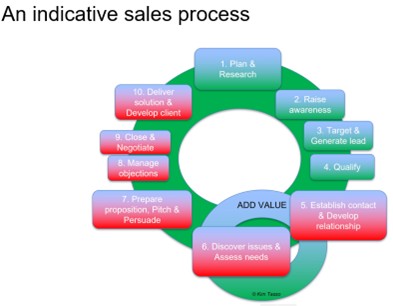
Professional selling focuses first on the client needs rather than what we might be trying to promote or sell. We also saw how the rapport and relationship development activities precede any exploration of client needs or potential opportunities.
We considered the potential buyer journeys for individual and corporate buyers. And how those journeys might also be different for various professional services (e.g. transactional, litigation, ongoing support, specific projects). Mapping the client journey in professional services – Kim Tasso
Lawyers, accountants and surveyors like to work with processes. And marketing and sales processes are no different. Clarity around likely sales journeys will give fee-earners confidence and maintain motivation and momentum.
In Complex sales processes made simple I focus on the 6Cs: co-ordinate, connect, conversations that add value, curiosity, consistent habits and conversion
By reflecting the different sales journeys, fee-earners will be able to manage their expectations about what can realistically be achieved in the short, medium and long term.
Build selling and sales cycles into the firm’s culture
Humans are rational beings. They will do what they are targeted and measured on doing. Some firms still have only billable hour targets. So there are no mechanisms to complete and record non-chargeable time in marketing, business development and selling.
The firm’s culture has to encourage a business development mindset. To help fee-earners transition from a technical expert role into a relationship manager and business developer role. The demands and skills of these roles are different.
The firm’s culture needs to recognise and reward good business development behaviours – in terms of performance reviews, financial recompense and career progression.
And there needs to be the necessary organisational mechanisms to support selling. For example:
- Strategies and plans on goals and targets
- Partners with responsibility for driving business development
- Marketing activities to build reputation (brand), awareness, engagement and leads
- Resources and time to support fee-earners throughout marketing and sales cycles
- Training, toolkits and ongoing support
- Regular time in meetings to discuss aims and progress
- Plans to co-ordinate activities for major clients and referrers
- Systems to monitor progress and results
Set clear aims and targets for sales journeys
The firm or team’s marketing and business development strategy should set out the aims – measurable goals with a timescale on what is to be achieved. This might be in terms of funnel activity (connections, leads, meetings, relationships, opportunities or referrals) and also in terms of results anticipated (volume or value).
The strategy and plan should also define the markets or segments of interest. And ideally list out the named target organisations or personas of the ideal clients. Fee-earners might need help from MBD professionals in translating team targets into personal targets.
And there needs to be a balance between:
- Prospective and new clients
- Existing clients (both account management and cross-selling initiatives may be relevant)
- Third party referrers and intermediaries (especially important for those in many transactional and dispute areas)
Naturally, there needs to be systems in place to help fee-earners monitor and measure their progress and outcomes. And for management to consolidate the various funnels so that an overview of the firm’s pipeline can be monitored. To avoid gaps where people have insufficient work and to plan recruitment so that there is adequate capacity to complete work.,
Support fee-earners through the sales cycle
Once fee-earners have aims and targets in their personal plans, they are likely to need support from their team leaders, their colleagues and the MBD professionals throughout the sales cycle,
They are also likely to need help in:
- Education and training in the relevant marketing, relationship management and sales skills and processes
- Maintain systems where they can access information about the firm’s clients, projects, skills and materials to support effective marketing and selling activities
- Research and intelligence support in identifying suitable target associations, communities, organisations and individuals
- Appropriate awareness, personal brand and awareness raising activities to appeal to the target audience and position themselves effectively
- Toolkits and templates to help them respond to enquiries, leads and other interactions to progress the relationship and potential sale
- Support in preparing for client interactions and meetings – in nurturing relationships and in identifying opportunities and establishing the next steps
- Coaching and support to assess, pursue and convert active opportunities
- Help in shaping messages, value propositions and pitches and tenders
Each fee-earner should then be clear about what they are expected to do and achieve. They may then need to collaborate with their colleagues and be supported by MBD teams in constructing a practical plan for what they need to do and when.
Integrate marketing and sales journeys
In some firms there is a disconnect between marketing campaigns and subsequent sales activities.
Marketing campaigns must be designed and executed with the end in mind. They must look beyond creating engagement and leads. Marketing campaigns need to pre-plan the follow up sales activity that will be needed to develop relationships, identify opportunities and convert prospects into clients.
Marketers must consider how they equip fee-earners to pursue qualified leads effectively – harnessing and repurposing marketing content into insights that can be used to fuel subsequent sales conversations. It needs to be seamless.
(Please note this blog post by on the end of the sales funnel – supporting the view that marketing and sales journeys are varied and complex) The Marketing Funnel is Dead | Natterjack Marketing (Lindsay Gray, Founder and CEO Natterjack, 14th November 2025)
Reflect different fee-earner approaches in sales journeys
Fee-earners have different strengths and communication preferences. As do clients.
Some fee-earners will prefer to make contact directly through networking, telephone calls or emails. Others might prefer to raise awareness and make initial contact through digital and social channels.
Some fee-earners will leverage their existing network of referrers and clients. Other fee-earners may use conference talks and seminars to initiate conversations. Others may rely more on the firm’s thought leadership and the leads it generates.
There is no one-size-fits-all. Don’t shoe-horn fee-earners into a process and approach that doesn’t feel comfortable to them. Fee-earners should be encouraged to work together to deploy their particular skills and talents to support the sales efforts or the teams.
Collate best practice in optimising the sales cycle
Most firms will have fee-earners who are good at meeting prospective clients, forming strong relationships, exploring their needs, pitching solutions and converting opportunities. Whilst this journey can vary significantly, some fee-earners will be adept at moving clients through the sales cycle as professionally, efficiently and effectively as possible.
Interview these exemplars and capture their insights, expertise and best practice. It will be reassuring and motivating for those not currently active in selling to see what good looks like. And they will appreciate the opportunity to learn from the lived experience of their respected colleagues. Best practice case studies are a great source of learning and training materials.
Develop psychological and practical skills for the sales journey
There was a lot of debate about the essential skills for selling. I argued for high levels of emotional intelligence which support effective interpersonal communication which is a pre-requisite for building trust and relationships that facilitate sales conversations. An introduction to emotional intelligence (EQ) and empathy (Video)
We reviewed research on a variety of other skills which included:
- Analysis
- Collaboration
- Commerciality
- Communication and conversation
- Confidence
- Curiosity
- Educating
- Emotional Intelligence (and empathy)
- Influence and persuasion
- Listening
- Negotiating
- Networking
- Non-Verbal Communication
- Nurturing
- Planning
- Presenting
- Problem-solving
- Questioning
- Relationship building
- Research
- Resilience
- Storytelling
What are soft skills? And why are they so important? (Video)
Book launch: Essential soft skills for lawyers – some research findings
Better Business Relationships – The building blocks
Create a simple sales cycle planner
We saw how important it was to get into the habit of allocating a specific amount of time each week to marketing, business development and sales. (Rainmaking best practice in professional services firms (Selling).
A comprehensive CRM system allows accurate recording, tracking and sharing of prospect and client information. However, many firms do not have such a system. There might also be cultural issues that limit the likelihood of fee-earners using such systems and sharing their data.
So fee-earners need to develop a simple sales planner to remember which prospects and opportunities are being pursued – and their planned next steps.
There is value in creating a simple sales planner that shows the:
- organisations
- individuals in each organisation Selling Basics – Detectives and DMUs (Video)
- stage in the sales process (e.g. connecting, developing, exploring, pitching, negotiating etc)
- next planned action
Key delegate takeaways on art and science of selling professional services
Image
- Categorisation of prospects
- BD and sales planner
- Content pillar planner
- Group of people working together
Idea
- Structure and discipline
- Committing time and gathering ideas into a clear strategy
- Consider indirect channels and strategy as well as more direct strategies
- Culture of a firm can have a huge effect on the likelihood of fee-earners putting aside time for BD tasks
Action
- Create an internal training plan to support junior fee-earners understand how they contribute to sales
- Weekly repeat calendar invite for BD planning
- Review materials on CRM CRM – Applications, systems and fee-earner engagement
- Build a marketing and sales campaign plan 10 steps to create a business development campaign
- Ensure fee-earners understand the importance of meeting face-to-face
- Encourage staff to deliver corporate gifts in person
Selected delegate poll results
How do you feel about selling?
25% Unconfident
50% Neither confident nor unconfident
25% Confident
How would you rate your selling abilities?
100% Average
Is your role mostly:
25% Supporting those who sell
75% Client-facing selling
What is the main thing stopping you from selling?
50% Lack of time
25% Lack of targets
25% Lack of support
Are you mostly trying to sell to:
50% Small and medium sized businesses (SMB)
50% Combination of large organisations, SMB, NFP, public sector, individuals
Typically, how long does it take from first contact to receiving the instruction/contract?
100% It varies a lot
Which do you think is the highest priority for you?
25% Strategic marketing and planning
25% Tactical marketing/communications (lead generation)
50% Referrer management
What’s your current BD approach?
25% Contact book
25% Digital/social media
50% Collaborator
How do you generally reach out to your targets?
25% Direct (telephone or email)
75% Through a mutual connection
How helpful is your CRM/client and prospect database in shaping marketing and sales strategies?
25% Not at all helpful
25% OK
25% Essential – I rely on it
25% Something else
To what extent is your marketing and selling activity integrated?
50% In some areas – it could be better
50% OK
Is your approach to networking/selling/BD more:
50% Cast the net wide – reach out to lots of people
50% Targeted – aim at specific prospects/targets
Analysis – where do you think the majority of your clients/work comes from?
25% Digital (web, emails and social media)
75% External referrals/specific organisations
Do you have a list of targets, suspects, prospects, potential clients or potential opportunities?
75% Yes – informally in my head
25% It’s complicated
How well do you know the services provided by your firm (product knowledge)
50% I know some well
50% Really well – I’m a great ambassador
Where is your lowest score:
33% Implementation
67% Application (discipline and motivation)
Do you think your personality is mostly: dog, cat and bear personalities – Better business relationships
33% Dog
67% Cat
How would you rate your commercial thinking skills:
25% 6
50% 8
25% 9
How much time do you spend preparing for a prospect meeting?
75% 0 – 60 minutes
25% 60 – 120 minutes
How much of what we hear do we retain: Active Listening (Video)
33% 0 – 25%
67% 26% – 50%
Which aspect of client sales meetings do you most need to improve?
25% Build rapport and relationship
75% Identify how to add value
Which do you think is the most important selling skill now?
50% Targeting and planning
25% Listening and asking questions
25% Persuading and negotiating
How good do you think your firm is at measuring sales progress and success?
33% Poor
67% OK
Are your sales targets and measures linked to your reward systems?
50% Yes – in general terms of contribution for appraisals
50% Yes – there is a bonus system
Related links on sales and selling in professional services
Tendering and pitching – Key ideas and actions – Kim Tasso November 2025
Arup and GHD pitch automation and AI October 2025
Sales processes and skills – MBD support for the nurturing gap? October 2025
Cross-selling and referrer management – Past, present and future September 2025
Mapping the client journey in professional services – Kim Tasso August 2025
CRM – Applications, systems and fee-earner engagement July 2025
Key Account Management (KAM) – Start small, Be strategic June 2025
LinkedIn personal branding for women in real estate – Kim Tasso June 2025
Book Review: Strategic Tendering for Professional Services April 2025
Telephone skills – Focus on the caller’s needs – Kim Tasso April 2025
Buy in – Influence and Persuasion Toolbox – Kim Tasso March 2025
Transition from technical expert to adviser March 2025
International business negotiation – The Majalis approach January 2025
Book review: “Now we’re talking” by Sarah Rozenthuler January 2025
Book review: Unleash the power of storytelling by Rob Biesenbach November 2024
Complex sales processes made simple October 2024
Business Development Coaching Insights – Kim Tasso September 2024
Pitching and tendering – Manage objections – Kim Tasso August 2024
You’re not listening – What you’re missing June 2024
Negotiating skills – Balancing task and relationship April 2024
Private client commercial conversations March 2024
What is Socratic questioning? (Questioning skills) February 2024
Why are questions so important? (Questioning skills) February 2024
Sales Targeting Toolbox for Professional Services Firms February 2024
Book review: Sales Mind – 48 tools to help you sell January 2024
Rainmaking best practice in professional services firms (Selling) November 2023
Selling challenges in professional services (kimtasso.com) November 2023
Telephone call challenges: Emotions, data, selling and follow up (kimtasso.com) October 2023
Referrer Management – Capacity and Capability (kimtasso.com) October 2023
Cultivate a cross-selling culture (kimtasso.com) March 2023
Connected leadership – How professional relationships (kimtasso.com) March 2023
Soft skills for tough barristers (Reflection, Self-Coaching, Change, EQ January 2023
Sales processes and selling skills for targeting and meetings (kimtasso.com) October 2022
Book Review: Smarter selling – Next generation sales strategies (kimtasso.com) May 2022
Classic management book reviews – The McKinsey way, Good to great (kimtasso.com) May 2022
Practical sales tips: Reach out and Follow up (kimtasso.com) October 2021
Four themes in the art of selling – Integrating marketing and sales (kimtasso.com) September 2021
Hope is not a strategy – the 6 keys to winning the complex sale (kimtasso.com) September 2021
Selling Basics – Detectives and DMUs (Video) and recommended books (kimtasso.com) October 2021
Book review – Great networking by Alisa Grafton (kimtasso.com) July 2021
Beating Six Barriers to KAM and Training (Kim Tasso) June 2021
Never split the difference: Negotiating by Chris Voss May 2021
Selling Basics – Detectives and DMUs (Video) October 2020
Six themes on cross-selling and referrer management workshop highlights (kimtasso.com) September 2020
Selling basics – Targeting with rabbits, deer and elephants (Video) (kimtasso.com) August 2020
Book launch: Essential soft skills for lawyers – some research findings July 2020
Better Business Relationships – The building blocks June 2020
Pitching and Tenders – Nine top tips and client feedback (June 2019) (kimtasso.com) July 2019
Selling insights for fabulous first meetings (kimtasso.com) March 2017
Insight selling – building on consultative selling models (kimtasso.com) March 2017