
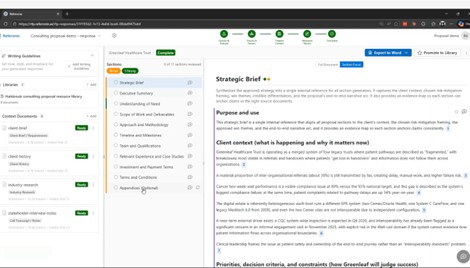
Many firms are experimenting with and using AI to support efficient and effective development of bids, proposals and tenders. I last wrote about AI pitch automation at Arup and GHD in October 2025 Arup and GHD pitch automation and AI. And had considered how Bidwells used AI in producing case studies late in 2023 Lessons from digital marketing webinars (June 2023). So it was interesting to meet with Richard Sloggett | LinkedIn of Marvellous Bear – AI Technology Leadership & Consultancy to see a brief demo of his AI pitch system. System review – Referonix AI pitch automation system.
I was particularly interested to see the embedded business development and proposal development processes. A key feature for me was the system’s embedded sales knowledge. This will support those who are not familiar with sales processes and techniques. I have often observed that too many proposal processes miss out the critical stage of developing a sales strategy and a persuasive and differentiating value proposition. Malcolm McDonald on value propositions – How to develop them.
Stages of Referonix AI pitch automation system
By default, Referonix uses the playbook approach embedded within the Shipley Proposal process (see below). However, it is customisable so you can tailor it to follow your own proposal process or reflect the processes of different teams. The system takes users through six steps – from source material to submission-ready proposal:
- Upload some material for focus and context
- For example: the client’s brief, client history, transcripts of client conversations, stakeholder interview notes, copies of similar proposals
- Add some knowledge sources to extend the context
- This might include industry or sector research, competitor information, your pricing strategy
- You can also pull information from an embedded library that you have populated with frequently used materials or approved templates
- AI builds the proposal strategy
- I particularly liked this feature as often the sales strategy development is omitted from proposal and bid processes
- The system generates a narrative arc with material on: client pain points, client opportunities, client priorities, client constraints, different analyses and win themes
- The system also highlights where there are gaps in context information or knowledge provided which prompts you to explore and provide other sources. So it helps drive the pitch research process (we’ve come a long way: Selling – research in the pitch process)
- All of the points in the proposal strategy are linked back to the relevant source materials you have loaded into the system. So this makes it easy to navigate the reasons for the strategy
- The system provides a framing rationale for your proposal, a storyboard of the sections and clear understanding of the client need
- You approve the strategy
- You get to review and amend the chosen sections which might include:
- Strategic brief
- Executive summary
- Understanding of need
- Scope of work and deliverables
- Approach and methodology
- Timeline and milestones
- Team and qualifications
- Relevant experience and case studies
- Investment and payment terms
- Terms and conditions
- Appendices (optional)
- You get to review and amend the chosen sections which might include:
- AI generates the proposal (with citations)
- You review, refine and export
- The system generates a proposed workflow of how to tackle the refining and editing
- Multiple people can review the document (see a suggested review process below)
- All changes are tracked and timed in an audit trail
- You can start comments and conversations within the system to consider specific points
- You tick the sections when reviews are complete
- Your completed document is generated (at present the system does not produce slide decks as there are other tools to do this)
There’s a “human-in-the-loop” at every stage. Nothing reaches the client without your approval.
Yes, you can build libraries of your most frequently used materials. At present, the system doesn’t integrate with other systems such as HR systems where CVs are kept or marketing systems where case studies and client testimonials are stored. Although the developers are keen to know if there are specific requirements in this area.
The system uses Cloud Computing Services | Microsoft Azure. And I was advised that your data is stored on UK based systems. Data is encrypted at rest and in transit and is never used to train AI models.
They are still trialling the system. One consultancy reported that they were saving six hours per proposal.
They’re still finalising the pricing through the pilot phase, so the figures on the website are indicative (ranging from $199 pcm for a small team to $499 pcm).
Referonix is based on the Shipley Proposal Process
The US Shipley proposal process is a structured, seven-phase business development lifecycle designed to improve win rates for competitive bids, particularly in government contracting. It emphasizes customer-centricity, compliance, and strategic “colour team” reviews to ensure proposals are compelling, compliant, and persuasive.
Shipley Core Principles
- Customer-Centric: Focus on the client’s needs, not just your company’s capabilities.
- Compliance: Ensure 100% compliance with all RFP requirements.
- Discriminators: (Differentiation) Highlight why your solution is better than the competition.
- Benefits First:Structure paragraphs to lead with benefits rather than features
Shipley breaks business development into distinct, manageable phases:
- Phase 0: Market Segmentation – Identifying the marketplace and market segments to compete in
- Phase 1: Long-Term Positioning – Understanding customers and competitors to position the company before an RFP exists
- Phase 2: Opportunity Assessment – Deciding whether to pursue a specific opportunity (Bid/No-Bid decision)
- Phase 3: Capture Planning – Developing a strategy to influence the customer and win the bid
- Phase 4: Proposal Planning – Creating an outline, compliance matrix, and schedule (often includes a Blue Team review)
- Phase 5: Proposal Development – Writing and reviewing the proposal (Pink/Red Team reviews)
- Phase 6: Post-Submittal Activities – Handling Best and Final Offers (BAFOs) and post-submission meetings
Underlying proposal process from Shipley Proposal Guide – 50+ Topics & Best Practices for Winning Proposals covers:
- Proposal Strategy
- Customer Focus
- Outlining
- Proofreading and Revising
- Storyboards and Mockups
- Task Order Proposals
- Grant Proposals
- Active/Passive Voice
- Bid/No-Bid Decisions
- Compliance and Responsiveness
- Page and Document Design
- Virtual Team Management
Colour team reviews are business development milestones at which experts and managers work to improve the win potential of pursuits.
- Define your organization’s colour team review points
- Select appropriate reviewers and methods for each colour team review
- Follow a consistent process for each colour team review
- Conduct a Blue Team review to assess the capture plan and strategy
- Conduct a Black Hat Review to predict competitors’ likely solutions and strategies
- Conduct a Pink Team review to verify compliance and execution of your win strategy
- Conduct a Red Team review to predict how your proposal will be scored and make improvements to it
- Conduct a Green Team review to approve pricing
- Conduct a Gold Team review to confirm your proposal incorporates the necessary changes from Red and Green Teams and is ready for the Proposal Submittal Decision
- Conduct a White Hat review to record lessons learned and make process improvements
Related articles on tenders, pitches, bids and proposals
client feedback playbook – How professional services firms January 2026
Tendering and pitching – Key ideas and actions – Kim Tasso November 2025
Arup and GHD pitch automation and AI October 2025
Wise words from a writing workshop – Kim Tasso October 2025
CIM’s hype-free guide to AI agents for marketers – Kim Tasso September 2025
Perfect Pitch Process – Don’t just parachute in the fee-earners May 2025
Pitching – Focus on the client’s needs (Let the client do the talking) May 2025
Book Review: Strategic Tendering for Professional Services April 2025
Pitching and tendering – Manage objections – Kim Tasso August 2024
You’re not listening – What you’re missing June 2024
Pitches, tenders and proposals – Efficiency (systems) May 2024
Book review: Sales Mind – 48 tools to help you sell (kimtasso.com) January 2024
Pitching, differentiation and competitor analysis (kimtasso.com) June 2023
Pitch points from a pitching and tendering training workshop (kimtasso.com) April 2023
PM Conference Report 2022: Strategy implementation (kimtasso.com) November 2022
Pitching insights – Qualification, Branding and Following up (kimtasso.com) October 2022
Five Spice Girl lessons from a pitching workshop (May 2022) (kimtasso.com) May 2022
Pitching and tendering – Focus, differentiation and less is more (April 2022) (kimtasso.com) April 2022
An introduction to presentation skills – Easy as ABC (Video) (kimtasso.com) March 2022
Insights on pitching – Online, virtual, productivity, confidence (kimtasso.com) December 2021
pitch insights – M&BD adding value, pitch processes, knowledge base (kimtasso.com) October 2021
Practical sales tips: Reach out and Follow up (kimtasso.com) October 2021
Non-Verbal Communication (NVC) – the basics (Video) (kimtasso.com) August 2021
Seven pitching themes – specialisation, engagement, research, content (kimtasso.com) May 2021
Perfect pitches – Five key points (Video) Kim Tasso February 2021
Pitch Points – Five thoughts from a pitching and tendering workshop (kimtasso.com) January 2021
marketing case study – Transformational change in Savills’ bid processes (kimtasso.com) November 2020
Soft skills – Boost your self-confidence and confidence (Video) (kimtasso.com) October 2020
The growth of MarTech in professional services – an overview (kimtasso.com) March 2020
Pitching and Tenders – Nine top tips and client feedback (June 2019) (kimtasso.com) July 2019
Winning pitch presentations – tips for competitive tendering (kimtasso.com) May 2017
strategic tendering (kimtasso.com) May 2017
Selling – research in the pitch process (kimtasso.com) October 2016
perfect pitches and tenders in professional services (kimtasso.com) October 2015