
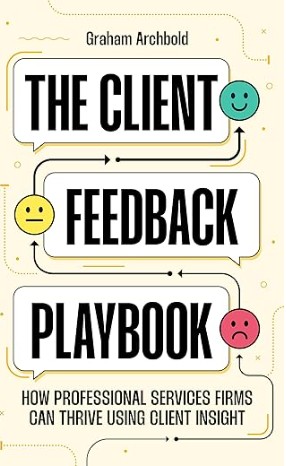
Client listening, research and insight are the lifeblood of professional services marketing. Because marketing is about anticipating and meeting client needs profitably. And client research is required for just about everything including: needs analysis, strategic planning, marketing planning, branding, key account management (KAM), targeting, service delivery, client experience management, pitching and selling. And, of course, how we measure marketing effectiveness. I’ve known author Graham Archbold | LinkedIn for many years. He is a veteran of professional services client research having worked at Nisus since 2007 and established his own consultancy practice Chorus Insight: CX | Brand | Pulse in 2022. He has conducted more than a thousand one-to-one research interviews. In this book he provides a wealth of straightforward, practical insight and common sense advice on all aspects of establishing and enhancing client listening, feedback and research programmes. It is a must-read for those involved in professional services marketing and business development. Book review: The client feedback playbook – How professional services firms can thrive using client insight by Graham Archbold
Overview of The Client Feedback Playbook
The topic of client research is close to my heart. I’ve designed and conducted client research programmes since 1997 – within legal, accountancy and property firms. Sometimes to establish key account management (KAM) programmes and at other times for Client Experience Management (CEM) and client service initiatives. One of my first posts on the topic was published in 2002 We have never done any client research – where do we start?
Graham’s comprehensive and practical introduction and “how to” guide will be invaluable to professional services marketing and business development teams. Whether you are starting on client research for the first time or looking to improve existing systems, Graham’s deep knowledge of professional service firms shines through. The book could also be read by senior managers and fee-earners. Whilst our fee-earners are on the frontline and in touch with clients everyday – they rarely have the curiosity, time and discipline to ask for and share valuable feedback.
Graham takes a systemic approach – looking at how client research and feedback integrate with operations and strategy within the firm. For example, he touches on: information systems, team management, internal communications, client service, key account management and growth. He mentions the use of artificial intelligence (AI) in client research although this is a fast-moving area undergoing significant change. I would give a special mention to chapter 5 on how to conduct a client feedback interview – it is incredibly rich in information and provides lots of practical advice.
If the author produces a revised edition in the future, I hope he addresses not just looking at the trends of the majority, but looking at exceptions, critical incidents and outliers – as potential weak signals. And some information on how TrustPilot, Google Reviews and similar measures fit into the picture would be valuable.
Contents of The Client Feedback Playbook
This short (183 pages) but comprehensive 2025 book covers:
- Introduction to client feedback in professional services
- The strategic, operational and financial benefits
- Getting buy-in form the firm’s key stakeholders
- Choosing the right research approach and methods
- How to conduct in-depth personal interviews
- How to design and deploy online surveys
- Analysis and reporting: Organising and communicating actionable insights
- Closing the loop and continuous improvement
- Research ethics, data protection and the MRS
- Conclusion: Converting insight into profit and going beyond client feedback
At the end of each chapter is a helpful summary of takeaways – allowing you to skim read for an overview or refresh. There are also cartoons, diagrams and illustrative tables to aid understanding.
1.Introduction to client feedback in professional services
In increasingly competitive markets, client feedback is more important than ever. A properly structured client feedback programme confers a competitive advantage. It allows firms to take a holistic view of relationships (from decision-makers to influencers and buyers Selling Basics – Detectives and DMUs (Video)) – piecing together information from different sources and mapping out client journeys (Mapping the client journey in professional services – Kim Tasso).
The idea is to move from ad-hoc, nice-to-have fireside chats to “always on” business insight. A client listening programme is “a set of related measures or activities with a particular long term aim”. Voice of the Client (VoC) is a constant function in a business supporting client experience (CX) and client retention.
Many client feedback programmes fail because they are sporadic. Operating with a collective amnesia – partly due to professional services firms succeeding despite a lack of market research, positioning and strategic promotion. The biggest mistake is not creating a financial link with success – Return on Investment (ROI). The second mistake is relying on overly manual or time intensive processes that sit with people who have more pressing priorities. The third is not having senior leadership buy in.
Professional services require a different approach to B2C (business-to-consumer) programmes. In B2C, sampling matters and you want a statistically representative sample from which to extrapolate insights to the whole buyer population. In B2B it is the value of relationships rather than volume that matters. The Pareto principle typically applies – so rather than taking samples you focus on the most valuable client relationships. This requires co-ordinated cultural commitment.
Furthermore, there is rarely a single buyer at clients – you need to obtain feedback from both C-suite and operational staff. This requires different service levels and communication as well as research approaches.
2.The strategic, operational and financial benefits
This chapter contains all the information you need to build a business case to win support for your client feedback initiative.
Research reveals changing client needs and wants and the behavioural drivers behind purchase decisions that fuel excellence in service delivery. Feedback is key to diagnosing operational and strategic problems, identifying opportunities and motivating teams to raise standards and improve performance.
Feedback programmes remind clients of your successful track record together and reinforces their loyalty. So feedback programmes help retain and grow good clients and identify undesirable ones to offload. Soliciting feedback can lead to new business too (a nod to cross-selling). It supports follow up and account reviews. It also assists with compiling competitor intelligence – where your firm might be ahead or behind other providers.
There’s value in creating a separate forum outside of service delivery – it may reveal otherwise unknown threats and opportunities. It supports marketing message refinement and sales value propositions – and can inform and support bids and pitches
Feedback can help you make strategic and operational improvements. It can direct strategic decision-making and objective setting. It reveals which client segments are most or least satisfied. And helps you keep eye on the horizon – monitoring client service performance and satisfaction and spotting future trends and needs.
There’s mention of headline metrics such as CSAT (Customer Satisfaction Score), CES (Customer Effort Score) and NPS (Net Promoter Score – Client satisfaction benchmarks – How do you measure up?). See also this post about an online satisfaction assessment tool in professional services: Performance management in the professions
Feedback programmes can enhance the firm’s culture and brand. How can a firm claim to be client focused yet have no structured and operational mechanisms for gathering feedback and actioning changes? A firm needs evidence to support such claims.
Programmes provide motivational feedback to staff. And may be used in testimonials. And feedback supports innovation in developing new products and services (see also Future Marketing Manager – New product development)
3.Getting buy-in from the firm’s key stakeholders
This section focuses on fostering a feedback culture and building buy-in to the business case for client feedback programmes.
The author supports getting leadership on board but suggest being selective about your champions. Encourage the CEO to set out a strategic plan that prioritises the understanding, measuring and improving of client experience.
It touches on internal politics suggesting that sometimes you need a champion who is not in the highest leadership position as they may have too many competing demands on their time. But make it someone who is already established and credible in the firm (perhaps a divisional or territory leader). Possibly a future Managing Partner – an experienced practitioner who is stepping back from fee-earning work and wants to make a broader contribution to the business.
Of the techniques to get the leadership alignment needed, the best way is to run a pilot. This minimises the risk of the project being affected by barriers such as an inadequate CRM and allows you to test out the approach and types of questions that resonate. It may allow you to show opportunities or threats in key clients – thus achieving a show and tell win.
You need to calculate the prospective return on investment (ROI). Publicly available statistics are available via HBR and other business publications that emphasise how leaders in client experience outperform the market. There’s a suggestion to calculate the Client Lifetime Value (CLV) of a basket of between 10 and 100 typical clients. Or identify where you have a known problem and work out the likely churn if the problem were to continue unrecognised.
Articulate a vision (linked to the firm’s strategy) and set a clear purpose and achievable short (engagement) and long-term objectives. Set a turnaround time for acknowledging and acting upon feedback
Spread the word throughout the firm with a scheduled internal communications campaign. Include a short presentation at partners’ conferences and the firm’s AGM – and provide a recorded version. Stress the benefits and encourage leaders to cascade the ideas through their teams. Post regularly on internal communications channels (e.g. intranet, noticeboards, Teams and Slack channels etc). Obtain help from colleagues to promote collaboration – tap into internal networks and ensure automated connections between the client database and client feedback software.
Seek help from external consultants (I’ve listed some of the leading research firms in the professional services sector here: Client satisfaction benchmarks – How do you measure up?) External consultants can help you speed through the learning curve, lend authority and impartiality and may provide access to benchmarking information.
There’s some advice on how to deal with common objections – most commonly: “Clients are too busy to engage”, “I know my clients so well, there isn’t a need for feedback”, “The feedback will only highlight problems that can’t be fixed” and “we’ve already asked for case studies for directories and testimonials” (see also: Pitching and tendering – Manage objections – Kim Tasso). And there’s a reminder to stress the confidentiality of the process.
The author addresses the three most common reasons why programmes fail: no clear owner, too little change results and a lack of visibility across the firm.
4.Choosing the right research approach and methods
There’s some wise advice: “We shouldn’t let perfect be the enemy of good”
This chapter walks you gently through some research jargon e.g. inductive (no assumptions) and deductive (already know about some issues) and qualitative (words) and quantitative (numbers).
Then it explores the choice of personal interviews and running online surveys – pointing out that it makes sense to start with personal interviews. It also considers other methods of gathering data – secondary research sources, public review sites, focus groups and informal feedback.
It addresses the challenges of surveying decision makers, influencers and end users – noting that it is commercial not academic research. And suggests avoiding pandering to the opinions of the most senior points of contact at the client organisations.
Choose a headline metric. There are clear explanations of CSAT (5, 7 or 10 points), CES (from a 2010 Harvard Business Review article) and NPS (loyalty and recommendation measure created by Bain & Co – see Client satisfaction benchmarks – How do you measure up?)
Then obtain a benchmark and set objectives. Start with relationship surveying (to analyse touch points such as onboarding and handover) before post-transaction analysis
5. How to conduct in-depth personal interviews
Be sensitive to time. And regard the interview as part of the client experience.
The relationship partner isn’t the best person to conduct a feedback interview. And avoid anyone who is involved in day-to-day delivery of service – you need detachment and someone who is unlikely to get defensive. And avoid the senior or managing partner or any other member of the C-suite. Use someone from the firm who is independent and credible. Some firms use BD specialists.
Avoid contacting or interviewing more than one person at a time – personal interviews should be one-to-one.
Obtain a briefing in advance from the appropriate person at the firm to learn the basics: history of the relationship, range of services used, proportion of work undertaken by the firm (and competitors used), what the organisation does, personal quirks etc. This is effectively a mini SWOT analysis of the commercial and interpersonal relationship to identify any particular difficulties (e.g. I refer to these as critical incidents which might be positive or negative). Ensure you understand the interviewee’s role and responsibilities – and any additional questions to ask beyond the standard list.
There are suggestions for other information to obtain before the interview. And nudges to consider the web site, Google searches and LinkedIn posts and interactions.
To obtain better insights, don’t make video or audio recordings of the interview (although I’ve noticed increasingly researchers are using AI to record and analyse interviews). The author explains the practical and psychological reasons to avoid recordings: to promote ease (people behave differently when being recorded) and verbatim transcripts aren’t always clear and may miss non-verbal cues and confidentiality. A good interviewer will capture 80-90% od what the interviewee says.
There’s guidance on how to introduce yourself and begin the interview. Stress the purpose and benefits to the interviewee and outline a specific agenda. It may help to script your introduction to get started. Explain independence and the opportunity to reword or redact anything they say.
There’s advice on the duration of interview and context. And suggestions to use a questionnaire and typed notes – and to have some scoring questions and some requiring free form comments.
There’s further advice on how to lead and pace interviews for the best results. Adopt a professional and friendly tone, be alert to the interviewee’s thoughts and process, notice if they appear to be holding back or want to say something extra.
Make being interviewed an engaging, stimulating and useful experience – like a natural conversation. You may have to jump around the questions to follow the person being interviewed – they may wish to speak about topics out of sequence. The interviewer is an interlocutor – they will regard your reaction to their answers, body language and contributions. But the interviewer must not talk too much (no more than 20%) – they are primarily there to listen. Don’t lead them and don’t go native – the interviewer is an impartial intermediary to collect nuggets and insights. The interviewer must recognise, explore and understand. And don’t try to force front-end rapport – let it build by showing empathy.
Use probing questions to clarify and expand. – the author talks about different types of questions (see Why are questions so important? (Questioning skills) and the value in asking for examples – e.g. “How does that compare with a competitor?) or return to a question later or rephrase it
Keep your tone positive and constructive. Be prepared to deal with technology problems and other interruptions (e.g. have draft emails ready for such eventualities). There’s also advice on how to handle interviews that aren’t going to plan e.g. the client dropping a bombshell or trusting your instincts to ask: “What should we really be talking about?”
Wrap up the interview with clarity and confidence. Summarise your understanding. Check you have a fair reflection of what they’ve said. Ask them about their priorities for change.
There’s best practice guidance for producing clear and actionable interview transcripts. The author suggests preparing transcripts as soon after the interview as possible so it is fresh in your mind. He advises three sweeps: 1. Go through it and tidy up. 2. From a higher mental gear – check you’ve captured critical points correctly and removed irrelevant parts 3. Proofread. Always produce an executive summary (all the key points on one page) – as the transcript is likely to be several pages and a few thousand words long. Organise the transcript as a SWOT or in relevant sections such as buying decisions, service experience, competitor comparisons and financials. Use the summary to flag what appeared between the lines. Write recommendations that lead to immediate business transformation and flag what needs further investigation.
6. How to design and deploy online surveys
The author comments that surveys are an out-of-date technology but still work – and are good for emotional release.
Make your survey questions easy to answer. Especially your opening ones which should require minimum effort from respondents. Use plain and simple language and your brand voice.
Different types of question influence engagement and completion times. He suggests you start with closed ratings questions as abandonment rates are highest at the first question. Use open ended questions near the end.
Different types of ratings questions are explored: semantic (excellent – poor), numeric (1 – 5), Likert (strongly agree etc), frequency (always – never) and rank (put items into order). He talks about thorny issues such as whether to have a midpoint.
He advises using demographic data from your CRM. As it is frustrating when respondents have to provide information that you already have. There are comments about question routing for a slick respondent experience.
Target participants need heads-up contact before the survey itself goes out – ideally from their primary point of contact. Encourage the usual partner contact to email. And ensure the email is persuasive (i.e. a compelling opportunity worth investing time in). Ensure emails pass security and sniff tests (answer why me and why now?). As an incentive, explain how scores and comments will be used. If there are sector specific questions, offer to share anonymous findings.
There’s advice on email subject lines. And tips to increase the chances of your email survey being opened and completed (e.g. create urgency by including closing dates).
Always send a reminder request (or two) but nagging is counterproductive. The bulk of responses are from your initial email but a sizeable number from reminders – the law of diminishing returns applies. He offers a rule of thumb – a mailing followed by two reminders with a week’s interval. And vary the copy used in the emails.
Be prepared to deal with questions and enquiries as a result of the email and the survey. Also be prepared to expediate any bad news or problem cases – perhaps with conditional alerts in survey software that trigger an email or provide options for those respondents who have an urgent or major issue. Monitor replies and completions with the aim to improve response rates
(You might find it helpful to see automated AI-powered survey tools – primarily used for thought leadership – such as System review: CogniClick for instant, personalised research)
7. Analysis and reporting: Organising and communicating actionable insights
You need to analyse and report at an aggregated level and it’s not just about the software. The author explains the different types of data that can be collected – unstructured and structured.
Categorical data can’t be measured numerically but can be classified into sets – and then tally the counts of each category (descriptive and ranked). Quantifiable data can be continuous or discrete.
Suggestions to convert open-ended answers into themes by coding the comments. In professional services there tends to be more nuance to the text outputs we gather. Identify the main themes and group (and code) comments accordingly. MECE (Mutually Exclusive, Collectively Exhaustive) management codes can be created around 20 to 30 distinct themes.
Steps to analysis:
- Statement
- Comparison (which reveals patterns) and
- Regression (using statistical techniques to reveal correlations and connections).
Driver analysis can be used to reduce client churn. And focus less on things that cause dissatisfaction and more emphasis where there is evidence of clients spending larger amounts.
Choose data visualisations based on audience and objectives. Track trends over time with line, area and bar charts (for comparisons). There’s also material on scatter and bubble charts, box plots, stacked bar charts, pie charts and word clouds.
Create interactive dashboards for self-service reporting but limit who has access. Customise reports for different audiences – frontline, management and board.
Benchmark performance against your own standards and competitors. There’s a brief exploration of comparisons with different industries and also cultural biases. And a helpful diagram showing how to convert research findings into actionable recommendations.
Share some of “what you said, what we did” analysis with clients
I was surprised that there was no mention of critical incident analysis. And there could be more material about AI tools here – which are improving all the time.
8. Closing the loop and continuous improvement
“Criticism may not be agreeable, but it is necessary. It fulfils the same function as pain in the human body. It calls attention to an unhealthy state of things”. Winston Churchill
This chapter explores the emotional process of dealing with critical feedback – denial, deflation and acceptance (see also: Giving feedback in professional relationships – Kim Tasso an article for Counsel magazine for barristers). There’s a useful model for managing detractor feedback: Make amends, switch players or offboard.
Identify, deconstruct and share the best practices from positive feedback. Recognise that gap management is key to closing-the-loop. Use the ‘five whys’ to inform account, operational and strategic change.
Supply your board with a continuous stream of high quality insight – that is easily digestible and easy to interpret. Focus on big changes one at a time (see Change fatigue, change process and change communication). Insist that client feedback be on the agenda at all conference, AGMs and other strategy events. Use feedback in appraisals to motivate and inform management. But don’t link feedback and compensation as it corrupts behaviour.
9. Research ethics, data protection and the MRS
- You have a responsibility to undertake research ethically
- Be transparent about your research purposes and how data is to be used and shared
- Don’t share data for any other purpose than internal improvement
- Don’t assume that feedback can be used as a testimonial
- Be open, honest and accurate in your data collection
- You are responsible for data protection including encryption and storage
- Erasing data is harder than you think – but participants have the right tot be forgotten
- Make attribution a condition of participation to avert anonymity headaches
10. Conclusion: Converting insight into profit and going beyond client feedback
Implementing feedback is difficult but worthwhile. It is still a nascent discipline. Plan to expand and enhance the feedback function.
Related research resources – professional services case studies
There are many case studies to show how law, accountancy and property firms have used client research and feedback to fuel strategic and marketing success. Here are some of the most recent:
Business Development (MBD) property firm case studies December 2025
Strategic marketing case study – Brand at Mishcon de Reya November 2025
Marketing and Business Development (MBD) law firm case studies November 2025
Marketing and Business Development (MBD) accountancy firm case studies November 2025
Marketing case studies – Digital thought leadership campaigns February 2025
Marketing and BD case studies in legal, accountancy, consultancy April 2024
Case studies: Marketing and Business Development at law November 2023
Professional services marketing/BD case studies August 2023
Being more strategic – Case studies and insights (Ireland May 2023) June 2023
Training
PM Forum is introducing a new half day online training workshop featuring Claire Rason | LinkedIn of About | Client Talk | Coaching, Training & Client Listening – a leading firm in client research in professional services.
Details of the course: Unlocking Client Insights: Turning Feedback into Strategic Advantage – PM Forum (first presentation on 3rd March 2026)
Market Research qualifications
You may be interested in market research qualifications – these are available from Chartered Institute of Marketing, Cambridge Marketing College and Market Research Society.
Market Research Executive Apprenticeship | Cambridge Marketing College (Level 4)
3-cim-level-6-award-in-commercial-intelligence-2024-module-specification-v20.pdf (Level 6)
4-cim-level-6-award-in-customer-journey-optimisation-2024-module-specification-v20.pdf (Level 6)
MRS Advanced Certificate in Market and Social Research Practice | Market Research Society
Related posts on market research, client research and client insight in professional services
Marketing and Business Development (MBD) accountancy firm case studies November 2025
Sales processes and skills – MBD support for the nurturing gap? October 2025
Referrer Management: Improve knowledge of your referrers September 2025
Strategic analysis – PWC’s UK Legal Services Market Report 2025 September 2025
Highlights from the 2025 Professional Growth Summit – Kim Tasso May 2025
Pitching – Focus on the client’s needs (Let the client do the talking) May 2025
Mapping the client journey in professional services – Kim Tasso April 2025
Book Review: Strategic Tendering for Professional Services April 2025
Marketing case studies – Digital thought leadership campaigns February 2025
Political, Practice and Marketing Trends February 2025
Future Marketing Manager – New product development March 2024
Private client commercial conversations March 2024
International Marketing Benchmark 2024 from Meridian West February 2024
Case studies: Marketing and Business Development at law November 2023
Selling challenges in professional services November 2023
Book review: The Strategy Book by Max McKeown November 2023
System review: CogniClick for instant, personalised research October 2023
Professional services benchmark and accountancy profession September 2023
Managing Partners’ Forum – Highlights September 2023
Context and curiosity drive commerciality and pricing September 2023
Managing Partners’ Forum Strategy Summit July 2023
Key Account Management (KAM) – Research companies June 2023
Pitching, differentiation and competitor analysis June 2023
Research update on the most in-demand soft skills May 2023
Referrer management – Grading, Research, Discipline, Storytelling April 2023
Annual International Marketing Benchmark – PM Forum and Meridian West January 2023
Thought leadership campaigns: Arcadis, JLL and Remit December 2022
Be more strategic – PESTLE, Positioning and Plans December 2022
Nine Marketing and Business Development trends in 2021 December 2021
Law Society Research Report – Future Worlds 2050 July 2021
Seven pitching themes – specialisation, engagement, research, content May 2021
Law firm analysis – MHA Legal Benchmarking Annual Report 2020 January 2021
Executive Engagement Strategies by Bev Burgess August 2020
Marketing basics – Marketing audits with onions and pestles August 2020
Innovation in Marketing August 2020
Book launch: Essential soft skills for lawyers – some research findings July 2020
Pitching and Tenders – Nine top tips and client feedback (June 2019) July 2019
Commerciality – Finance, pricing, innovation and research May 2019
Advanced Marketing Management: Principles, skills and tools May 2019
Property marketing case study – Integrated campaign on farmland value April 2019
Environmental analysis and planning – Future of Jobs Report 2018 February 2019
Effective marketing – a discussion with managing partners January 2019
Client Experience Management (CEM) – Research into the client journey July 2018
Client satisfaction benchmarks – How do you measure up? May 2018
Performance management in the professions May 2018
Legal market research – Nisus law firm brand and service report October 2017
Legal market research – LexisNexis Bellwether report 2017 June 2017
Marketing planning in a nutshell – simple and complex plans June 2017
Mobile apps in law firms – legal market research June 2017
Client Experience Management CEM Two research reports April 2017
accountancy marketing case study – Haines Watts April 2017
Selling – research in the pitch process October 2016
Legal market research – LexisNexis Bellwether report 2016 June 2016
Legal market research – The 2016 NatWest Financial Benchmarking Report – Kim Tasso May 2016
Law Society legal market research 2016 – The future of legal services – Kim Tasso April 2016
Three important legal sector research results – Kim Tasso January 2016
Legal market research – The Lawyer’s in-house attitudes survey September 2015
improving referrer management in the professions March 2015
Instant mobile market research for lawyers, accountants, surveyors November 2013
UK business growth prospects – Haines Watts and Grant Thornton November 2013
Legal marketing case study – Withy King solicitors research and media June 2013
Legal marketing case study – Thomson Snell & Passmore May 2013
Digital PR case study – BDO accountants April 2013
The pricing of family law services – An overview – Kim Tasso March 2013
Understanding General Counsel – Four recent reports January 2013
How do I run an internal marketing focus group (e.g. a sector group)? December 2006
We have never done any client research – where do we start? – Kim Tasso August 2002