
This is an important book on building and managing complex B2B (business-to-business) relationships to support sales and selling. But rather than taking a broad view of the entire sales process, it concentrates on the systematic development of a complex web of stakeholder relationships across large and complex decision-making units. As well as winning new clients, it contains valuable insights into pitching, project management and key account management (KAM). It’s detailed and practical – and valuable to both those with the relationships and the business development professionals supporting them. Whilst not its focus, the book is suitable for professional services firms. Book review: Building B2B Relationships – How to identify, map and develop key relationships to win more business by Ryan O’Sullivan.
Overview of “Building B2B Relationships”
The author of this 220 page, 2025 book recognises the critical importance of client and stakeholder relationships (and the creation of trust) in complex B2B sales where there are many players both at the client and within the firm. And rather than focus on the overall sales process or selling skills, it focuses on the critical (and difficult) task of gathering, managing and leveraging the data about relationships in large, complex B2B relationships.
It’s an important book because it provides a detailed and practical answer to questions such as “How do I build firm-wide relationships with target clients?” and “How can MBD professionals support the business development process for their fee-earners?”
This book is quite an achievement. It is based on a doctoral thesis so it’s evidence-based. But it is down-to-earth and incredibly practical. We are screened from detailed academic musings to see a clear process with actionable insights. It shows a data-driven relationship management process – encapsulating the client’s decision-making processes – in the pre-sales, sales and service delivery processes. You just need to add in the communications skills and motivation.
It will be useful to fee-earners who want to know how they develop and manage a complex web of relationships in both new client acquisition and existing client development. It even offers a business development and client experience management perspective during client project management and service delivery. And it will enlighten younger and less experienced business development professionals who want to know how they can contribute to the firm’s and fee-earners’ day-to-day client relationship management processes.
It opens the curtain on the backstage area of business development. It shows clearly a major component of the BD and sales process that is often hidden but essential. It’s hard, often thankless, work that is often not undertaken with enough diligence – sales enablement and support.
The book highlights the necessity of high quality, up-to-date data and information systems. Although the author offers practical ideas on how to use simple spreadsheet tools in the absence of sophisticated CRMs. It shows how to convert the data in a CRM into a vital business tool. The book will also help business development professionals focused on pitch and tender support, cross-selling and key account management (KAM). So it’s a valuable training resource.
The author’s deep experience in selling major contracts in the tech sector shines through. And this is reflected in the detailed case studies. But it is relatively easy to see how the ideas would translate into large legal, accounting, consultancy and property services projects. 10 senior executives from organisations including KPMG, PWC, Deloitte and Accenture provide introductions to each chapter. There are endorsements for the book written by those at CLA accounting, Deloitte, Infosys and academics in professional practices sales transformation.
The book also provides an important lesson in just how much effort is required behind the scenes and how long it takes for major deals to happen. It’s counted in years not months. Another important theme is the critical importance of adding value to every client interaction – even if that spans to hundreds of meetings during the long sales cycle. I still wonder how many professional service firms are mentally prepared for that kind of long term, sustained effort and investment.
There are times when some of the material is a little bit repetitive. But I guess that ensures comprehensive coverage if readers dip in and out. The obvious gap – and not within the book’s remit – is what happens during client conversations. That’s covered in books that focus on client communications, relationship management and sales techniques. My own book (Better Business Relationships) and other professional sales books achieve that. There’s a list below.
Main sections of Building B2B Relationships:
- What are trusted relationships and why do they matter? (50 pages)
- An overview of how to build and execute a relationship map. (Pages 55 – 123)
- Putting the relationship-mapping process into action. (Pages 129 to 219)
Building relationship maps – The process at a glance
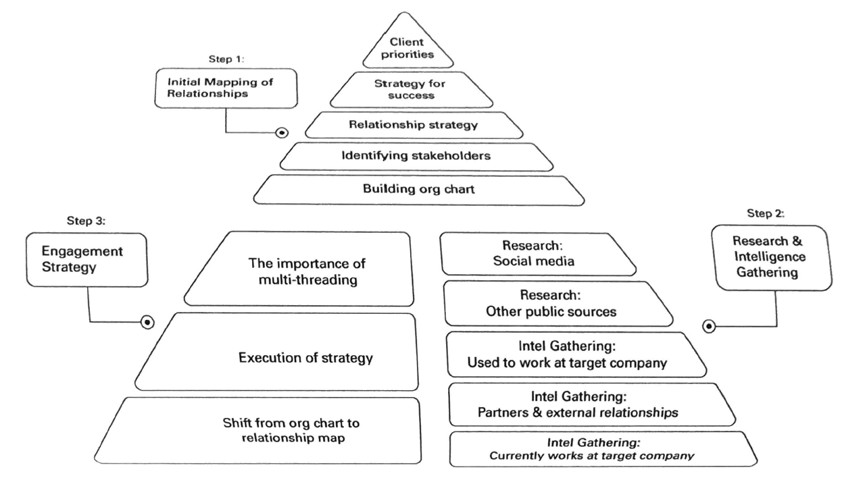 1. Initial mapping of relationships
- Understand and align to client priorities
- Develop a strategy for success
- Think about the relationship strategy for this deal
- Start identifying stakeholders
- Build an organisation chart
2. Research and gather intelligence
-
- Desktop research on stakeholder’s social media channels
- Other public sources of insight
- People who used to work at the organisation
- Talk to partners and other external parties
- Talk to people currently working at the organisation
3. Develop an engagement strategy
-
- Multi-thread the process
- Execution of engagement strategy
- From one-dimensional organisational chart to a relationship map
There are sequential cases following the typical business development process:
- Key deals – Initial deal with a client (convince)
- Key projects – focus shifts to delivering an exceptional outcome for the client (deliver)
- Major clients – where clients are part of a strategic account programme (extend)
The author – Ryan O’Sullivan
The author is a university guest lecturer. He has an impressive sales track record for major deals (over $50m) and has won awards for deal of year and salesperson of year. He spent seven years of his doctorate research exploring the contributing factors that determine good B2B relationships.
He works at #1 Relationship Intelligence Platform | Introhive – a system used extensively by professional services firms such as Baker Tilly, Colliers, Freshfields, Grant Thornton, Howard Kennedy, Kingsley Napley, Knight Frank, Simmons & Simmons and Womble Bond Dickinson.
Key ideas in “Building B2B Relationships”
The book is about the systematic process of identifying, mapping and cultivating key relationships within a consultative selling approach.
Introduction: The value of relationships in B2B business development
The author starts with the basics – the value of relationships in B2B business development.
Why are strong B2B relationships important?
- Trust
- Evidence of commitment to client’s business
- Help parties navigate difficulties
- Results in Win:Win for all parties
- Survive adversity of economic downturns (business resilience)
- Spark innovation and creativity
- Enhance client satisfaction, loyalty and retention
- Lower cost to service
- Shorter sales cycle
- Higher sales
- Support cross-selling
- Greater share of customer spend
- Word-of-mouth advertising
- Propensity to pay more
- Ultimately, increased profitability
Indicators of high-quality relationships:
- Length of relationship
- Growing revenue from a particular client
- Expansion into different parts of the client organisation
- Progression in the complexity of work
- Awards or accolades for work with the client
- Referrals from the client
Three objectives of relationship building (three reasons for a meeting):
- Gather research and intelligence – to build better insights into a client’s business
- Ask for help with an introduction to someone else they know
- Engage directly with decision makers or someone relevant to you
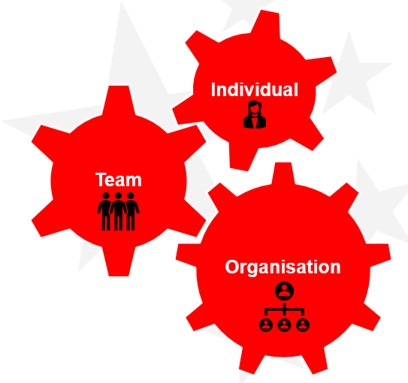
It introduces the concept of relationship capital – relationships are an asset that you own and that you build. Both at both an individual and organisational level. There are three types of business relationship: transactional, facilitative and integrative. There’s some theory of how relationships work: Social exchange theory we might know it as reciprocity. We need to give something of value – a fair return gained from effort spent to maintain the relationship. There’s also an overview of how trust builds between individuals (the relationship lifecycle).
The key skills required are: Be armed with relevant market insights and openness and curiosity to meet new people (see What is curiosity and why is it important in business relationships? (Video)). During initial interactions there needs to be mutual disclosure. We size each other up and decide whether to invest time in the relationship. During the first meaningful interactions you need to demonstrate knowledge linked to their priorities, a peer-to-peer conversation that’s not overly selling and no clash of personalities. We must arrive at meetings prepared (having conducted diligent research and intelligence) – understand the client’s issues, listen carefully and start creating a compelling solution.
The author offers a definition of trust – ability, integrity and benevolence. And the factors to build trust between organisations:
- Capability to deliver
- Cultural fit
- Partnership mentality
- Components of trust: quality, governance (project management methodology) and problem-solving
- Ability to deliver successful projects and deliver tangible business outcomes
- Personal gain for client: personal satisfaction, career enhancement and replicating success
Introducing relationship mapping – what it is, its origins and why it is important
There’s a good visual representation of the connections between individuals across various layers of organisation – the real key players in each team that supports a one-firm approach.
The author considers two disciplines: social network analysis and stakeholder theory
Social network analysis – Advanced application of ONA (Organisational Network Analysis) which was originally devised by Jacob Morena. The objective is to identify key opinion leaders. A sociogram shows the lines between dots – indicating directional flow, strength of relationship and distance. There’s mention of Travers and Milgram’s concept of “six degrees of separation”.
Stakeholder theory – Edward Freeman said we need to consider the interests of all stakeholders. They need to be identified and categorised according to their level of importance and power. Then we need to develop strategies to engage with them. (see Ten top takeaways on stakeholder engagement and buy in)
The starting point of a relationship map is the organisation chart. The internal sociogram of your own organisation and its relationship with a particular client. The aim is to control the controllables by analysing the strengths and weaknesses across the relationships.
You build a relationship map to win key deals in order to:
- Identify the key decision makers (see Selling Basics – Detectives and DMUs (Video))
- Influence the key decision makers
- Gain insights into the competitive landscape
- Understand the organisational culture
- Know which market and industry trends are important
- Understand the decision-making criteria
- Know about the allocation of budget
- Understand the timing of the deal
- Negotiate contracts
Relationship mapping to deliver key projects:
- Identify key stakeholders
- Identify stakeholders’ project priorities
- Improve project communication
- Maintain client satisfaction and retention
Relationship mapping to grow key accounts:
- Monitor and adapt to C-suite priorities
- Know about key role changes and reorganisations
- Understand external partner eco-systems and cross-function collaboration (i.e. avoid silos)
- Develop and deliver a strong value proposition
- Manage risk
Overview of how to build and executive relationship maps
There are three processes here: 1. Initial identification and mapping of key stakeholders 2. Conduct effective desktop research and 3. Design processes to engage with key stakeholder and others who can help with intelligence
Step 1 – Initial mapping of relationships
1a. Understand client priorities at different levels: industry, organisation, regional, service line, team and individual. Once the client sees that you understand their priorities, the rapport building processes and trust starts to form. This leads to more open communication and opportunities to provide value-adding insights such as relevant case studies. It positions you as a trusted adviser and enhances credibility. It allows proactive problem-solving by anticipating future needs and helping you shape bespoke solutions.
1b. Develop the strategy for success. It mentions Dixon and McKenna’s book “The JOLT effect” which says that nearly half of lost sales are due to the buyer’s fear of making a mistake. Consider your internal team and their ability to integrate into the client organisation. Understand the competitive environment to create a compelling business case. Develop specific business metrics, KPIs and other ROI metrics that might be needed. Also prepare to handle objections. And identify the people that can enable you to get the insight you need. Effectively, develop the relationship strategy to ensure success
1c. Refine the relationship strategy. Think about which relationships are for intelligence gathering, asking for an introduction or directly talking to a decision-maker
1d. Identify stakeholders. Learn who’s interested or affected by the deal and create an initial list. Then determine their role and responsibility and categorise them. Assess their influence and impact by using:
- Published lists of board and leadership teams
- Existing knowledge – what have you done, with whom and what happened. This is internal detective work using your CRM or relationship intelligence software like Introhive
Update stakeholder details – name, job title, geographic location, relationship holder and relationship quality (strong, weak, negative, unknown). Assess their decision-making power (decider, recommender, evaluator, influencer, unknown) and allegiances (support, detractor, neutral)
1e. Build an organisation chart. Use Google Sheets or Excel (the also mentions Lucid charts, Organimi, Hundred Handshakes and Altify). Convey the hierarchy.
Step 2 – Desktop research and intelligence gathering
The author helpfully summarises research sources:
- Secondary
- Market and industry reports (Gartner, Forrester, major consulting firms like McKinsey, Deloitte)
- Online databases
- Organisation web sites (include annual reports, media releases)
- Socal media
- Primary
- Observations and interviews
- Partner ecosystem (other people who’ve worked with the organisation, industry experts)
There’s a helpful checklist to consider client priorities. Then to develop a strategy for success which includes: anticipating objections and concerns, mitigating risks, tailoring value propositions, defining a strategy for success, assessing competitive intelligence, knowing decision-making timelines and process and defining a negotiation strategy.
2a. Desk top research using social media – Focus on tenure (time in role and with organisation), Use social selling to review recent activity on LinkedIn, X and YouTube profiles and understand topics of interest. Assess first and second degree connections and conduct a personal relationship audit. The author uses the analogy of “panning for gold” in sorting through the myriad of first, second and third degree contacts. There are mentions of LinkedIn Sales Navigator to support this process.
2b. Desktop research using other public sources – For example: web site profiles, speaking engagements, published articles, news reports.
2c. Intelligence gathering from former employees (those that used to work at the target organisation). There’s lots of practical LinkedIn tips. And mentions of LinkedIn Sales Navigator “Team link” (There’s a case study of JLL using this tool here: Marketing and BD case studies in legal, accountancy, consultancy). There are lots of research tips in the book – with this in mind you might also look at client feedback playbook – How professional services firms
2d. Intelligence gathering from partners and other external relationships. Assess go-to-market suppliers/partners and those of other clients to collect partner ecosystem information. Talk to people internally and to external intermediaries (there are many posts about referrer management – see, for example: Referrer Management: Improve knowledge of your referrers))
2e. Intelligence gathering from others currently working at the target organisation. As this yields the most insight it justifies the most effort. Your former staff (alumni) who now work at target organisation (there’s an interesting case study of this at Bird & Bird Employee Communications and Alumni Programmes). This is positioned as internal detective work using the CRM, “tribal” knowledge and tools such as Introhive. (The author refers often to the decision-making unit. Here’s my version Selling Basics – Detectives and DMUs (Video))
Capture all data, build stakeholder profiles and present it to others internally including management.
Step 3 – Relationship engagement strategy
“An engagement strategy is a planned approach for effective interaction and communication with the defined key stakeholders and others we believe can help us. The engagement strategy outlines the methods, channels of communication that you – at individual and organisational level – will employ to achieve the specific goals”. (I also recommend for this stage: Executive Engagement Strategies by Bev Burgess)
The generate the right content for each stakeholder – and make your target the hero of the piece. Remember that the first five minutes and last 10 minutes are critical (primacy and recency affects).
There are two parts of the engagement strategy: 1. Continue to collect intelligence and 2. Engage with key stakeholders. Remember to be constantly aware of “What’s in it for them to engage with you?”. And a reminder to be aware of the strength of relationship vs seniority of importance of each person.
3a. Importance of multi-threading. Establish and nurture multiple relationships within the client organisation and among key stakeholders – aim to build rapport, influence and support throughout the decision-making process. This will involve multiple people from your organisation with multiple individuals in the target organisation. (Note: KAM Basics – Bowties and Diamonds). Pairing might be based on seniority, job function , geography, personality or nationality. (There are interesting insights into cultural matching here: Book Review: The Culture Map by Erin Meyer). The author talks about the etiquette following initial meetings.
There’s an interesting sidenote here about creating your internal team comprising: C-suite and executives, sales/BD/account management, client partners, project delivery teams, subject matter experts, technical experts, legal advisers, information security experts, governance advisers and other internal functions.
3b. Execution of the engagement strategy
There are five steps here:
1 – Preparation. Define objectives, prepare for interviews and create the engagement plan
2 – Decide who is reaching out and to whom and by what communication channel (and co-ordinate this centrally)
3 – Create content to attract the person
4 – Engage
5 – Capture insights, repeat the process and analyse the content as you go
“First talk to the friendlies” suggesting you reach out to those you know well first. He advises not to record video meetings. He says that clients are impressed with the diligence of those who thoroughly prepare – for example, by speaking to the relevant people in advance. He advises to seek patterns and themes across multiple interviews and conversations.
3c. Shifting from organisation chart to the relationship map
There are four parts to capturing and presenting insight – 1. tracking information 2. Snapshots 3. extending the detail and 4. collating a status summary. Use colour coding in the admin document (a templated is provided). Hold regular weekly meetings.
Putting the relationship mapping process into action
Relationship maps applied to key deals
From the client’s perspective a key deal is an initiative that is expected to have a transformational impact on their business. From the supplier’s perspective a key deal is one that is strategically important. Key deals are expected to have a long-term impact – to deliver a complex solution against significant competition with substantial financial implications.
The aim is “clarity in complexity”. Rainmakers recognise the value of original thinking. They focus on relationships and the softer attributes of their personal makeup. Rainmakers have high emotional intelligence (see An introduction to emotional intelligence (EQ) and empathy (Video)).
Targeting and qualification process
A key reason for clients not proceeding is not competition but doing nothing at all.
Credentials provide reassurance. A proven track record instils confidence. Prove the quality of your resources: team capabilities, references and client testimonials. You need to show “solution fit” – how your solution aligns with the client’s needs and solves their pain point. You also need to mitigate risks.
You need a strong value proposition (see also Malcolm McDonald on value propositions – How to develop them). And understand the client’s value drivers and ROI metrics. Other things to demonstrate include: cultural fit, innovation, investment in the future, commitment, financial stability and commercial/contract terms (pricing, payment, budgets).
How to source key deals
- Define who you should engage with – and create content
- Create new pipelines – existing clients willing to test new solutions, leverage strategic partnerships and alliance relationships to pursue joint opportunities
- Hosting and attending events – sometimes just to avoid the negative impact of not being there. Roundtable sessions are particularly helpful
- Co-creation with the client – ideas to take to market
- Supplier selection process
RFP process
- Start with request for information (RFI) – a pre-qualification questionnaire
- Formal submission of physical documents
- Q&A discussions (face-to-face or virtual)
Clients run RFP processes to invite proposal from multiple suppliers and standardise the process to evaluate different options against best pricing. They gain insights into industry standards and best practice allowing them to assess their own processes, capabilities and performance. It allows them to future proof. There’s value in being there first – before the client initiates the process. Clients may avoid an RFP process if there is an urgent need, they lack time or suffer from decision paralysis.
When an RFP comes to you – make strategic decisions about whether to submit a response.
(I’ve talked extensively about go/no go decisions in previous posts on tendering and it’s also covered here: Book Review: Strategic Tendering for Professional Services)
Leverage existing relationships for key deals:
- Qualify in or out of a deal
- Identify unknown existing relationships to support the deal
- Monitor key stakeholder engagement throughout the deal
A case study contains a really detailed analysis of a country level agreement with a global consulting organisation. It demonstrates just how much time and energy is needed. From the first conversation at the start of this deal cycle to a signed agreement was two years and six months.
Relationship maps applied to key projects
A key project is one that has a transformative impact, provides market positioning and a competitive advantage and grows revenue or reduces costs (or both). It’s interesting that the author moves into project management (although he admits he isn’t an expert in the subject) to talk about relationships throughout the service delivery process.
To ensure delivery of key projects (which the author refers to as strategic pursuits):
- Redefine and agree the goals, objectives and milestones
- Have a robust, competent team with skills to deliver successfully
- Focus on risk management
- Ensure communication between the team and client stakeholders
He notes that there is usually a period of quiet between signing the deal and starting the project. After the protracted discussions to secure the deal it’s more often a sense of relief more than celebration. Yet the client can feel at their most vulnerable after making a buying decision and often needs immediate reassurance.
At the project kick-off meeting
- Align to the project objectives – reaffirm and seek clarification
- Shift from the sales process to project delivery without overpromising which may create some difficult conversations
- Push your best practices for successful projects and leverage the influence of your internal champions
- Manage shifting client priorities. Deal with potential scope creep by having change control processes. Know when to push back against client requests remembering that partnership is a two-way street
- Allocate resources to deliver the project – including strong leadership and a skilled team. Remember that some might be new to your organisation, the client or the project
- Review and finalise the joint project plan and scope
At the project kick-off call assess stakeholder engagement at the client again
- Conduct implementation testing and the full rollout of solutions – including end user training
- Develop a review and feedback loop that is flexible and adaptable with quality control measures and constantly assess project risks
- At project closure, hand over to the team providing ongoing support and note any new stakeholder relationships.
- Nurture a culture of continuous improvement – provide key learning points to other projects
The case study here is with a global consulting and systems integrator. There was a nine-month pilot project. The total timeline for the project was two years and 11 months and the key contacts exchanged 2,000 emails and attended 250 meetings.
Relationship maps applied to key account management (KAM)
There’s introductory material about “What is KAM?” (e.g. “KAM is when there is a specific focus on managing and nurturing relationships with the most valuable clients”). Although he notes that it might be revenue potential driving the need for a long-term partnership. There’s mention of how the 80:20 rule can be 99:1 rule in some organisations.
Selling to existing clients is easier than to prospective clients as they are already familiar and trust you and there are established channels of communication. Existing clients are also aware of your proven track record and are likely to have stronger brand loyalty. There’s a higher probability of selling and a quicker sales process and possibly a reduced overall cost of sales and marketing. (see further: Key Account Management (KAM) programme). But he notes that key accounts are often the costliest to serve and can be less profitable than others as they require a dedicated KAM manager and a multifunctional key account team.
The author says there are whole books written on KAM (see, for example:
A practitioner’s guide to Account-Based Marketing (ABM) February 2020
Book review: Managing key clients (professional service firms) June 2019
Successful Large Account Management (Key Account Management) June 2015
Book review: Effective client management in professional services January 2015
Book review seven keys to managing strategic accounts June 2013
How to grow a key account
The growth of an account comes from winning deals and then delivering well.
- Identify key accounts – This is a two- way street as clients must recognise your organisation as being strategic to their business too – so it becomes a mutual agreement
- Account planning – Start with a comprehensive account plan by analysing client needs in depth and linking to your organisation’s capabilities. Then outline the strategies, initiatives and actions required to drive growth. Understand the client’s business and sector so you can address the identified challenges. Plan how to demonstrate the value you can deliver
- Build the relationship map – This needs real vigour as it is an ongoing process. The basics are to map the management/executive team, the business unit heads, regional heads, central functions, internal champions and adversaries. Identify the key people and then their direct reports. ABM can help with communications with multiple stakeholders in a key account (there’s a reference here to the 2010 book “Shift” by Craig Elias about trigger events and how you can win 74% of the time if you are first to engage with the key decision makers). Track movements and measure relationship strength.
- Cross-sell and upsell (bring value to client organisation) – Conduct a white space analysis to create a matrix
- Deliver value – Communicate and reinforce the value you are delivering by showcasing how the offerings address the client’s business priorities
- Business as usual – There needs to be a sense of continuous improvement and the route to that is client feedback – including proactive problem-solving (see client feedback playbook – How professional services firms). Continuously develop relationships and make new ones. Include marketing activities, which are sometimes referred to as ABM (see A practitioner’s guide to Account-Based Marketing (ABM))
The author also mentions: onboarding, succession planning and account health monitoring.
There’s a case study of a global bank which grew from a very small project to a £20 million pa account over the course of six or seven years. Procurement led a supplier consolidation exercise with the five suppliers. The business received an email learning that the firm has not been selected. Phone calls to the CIO (the key stakeholder) revealed that the 40 people reporting to him had been asked each to name their top three suppliers and theirs wasn’t mentioned. There was a lack of awareness of the firm at the executive level and 50% of the executives had only joined in the last two years.
There’s another case study of a global consulting organisation – a global brand operating as multiple separate legal entities. From first conversation with one of the country level executives and the global agreement being signed was eight years and five months. The main deal was three years and nine months – with 1,500 emails and over 150 meetings split cross two people.
What now? Implementing the relationship-mapping process and taking it to the next level
The final chapter considers the determination to change. And explores personal change for yourself using critical reflection. (There are lots of resources on change management – both organisational and individual – see, for example: Change fatigue, change process and change communication which lists lots of articles at the end)
He offers a personal change management model called: SCARED SO WHAT which helps you understand your feelings so you make an informed decision and stay away from assumptions
- Am I surprised by this change?
- Am I conflicted or do I champion this change?
- What actions can I generate to learn more about this change?
- Am I receptive or do I reject this change?
- Could I explore any other options or opportunities?
- What decision can I make? Is if favourable or unfavourable? Or am I stuck in indecision?
- What is my strategy to execute this change?
- Are there any options or opportunities I should include?
- Do I have a way forward to carry out my plan?
- Do I have hope or know how I will execute my plan?
- What actions do I need to take to make my plan happen?
- What do I do to take ownership and compete my plan?
He also looks briefly at:
- The impact of AI on relationship mapping process (especially that it makes it easier for those who don’t usually put in the work)
- Implementing mapping at an individual (or team) level
- Implementing it more widely across your organization
To industrialise the mapping process requires: people, training, change management, process and technology. There’s mention of additional techniques such as; personality profiling (note: I’ve seen the LinkedIn plug in Crystal Chrome in use), power maps and relationship capitalization (from Dr Philip Squire’s book “Selling Transformed”).
Favourite soundbites from the book
- Nielsen’s 2021 study reported that 88% of people trust a recommendation from someone they know
- Craig Elias (in the book “Shift”) argued that when you are the first to engage with the key decision maker with the right solution, you can win 74 % of the time
- Heidi Gardner’s research (2022, “Smarter Collaboration”) – found that those who have more relationships generate four times the revenue compared to their peers with a smaller network
- “This is because we know that moving from a transactional to a trusted relationship results in increased value creation for all parties involved” Philip Grosch, PWC Canada
- There are three facets to create trust – 1. ability, credibility and effectiveness 2. Integrity, honesty and reliability and 3. Benevolence, client orientation (empathy) and intimacy
- Travers and Milgram’s idea that any two people can be connected by six relationships or less – propinquity, homophily, multiplexity, reciprocity and transitivity
- At the core of any successful managed key account is having a good understanding of who has access to key information and who are the power players within the client organisation
- “Success is where preparation and opportunity meet” Booby Unser
- When engaging with potential clients, they don’t want to know all about you, they want to know what you can to help them with a specific issue
- A Gartner study from 2022 found that the average deal has between 11 and 15 key decision makers, and that organisations practicing multi-threading outperform competitors by 50%
- Successful rainmakers recognise that meaningful relationships are initially formed around thought leadership or sense-making, which often involved bringing a fresh or counter-perspective to the table
- All organisations run on politics and personal agendas, and decisions aren’t made in meetings but rather in corridors. They’re made by emotions not logic (which catches up afterwards to justify things)
- The sales process is “talking the talk” and project delivery is “walking the walk”
- The more collaborative branches earned significantly higher reviews with this particular product as well as greater customer loyalty.
- Clients do not like to be sold to, so everything needs to be done in the spirit of creating value for the client organization. They want a partner that understands their business and is supporting them with their growth priorities.
- This fear of losing business can lead to almost paranoia about risks and threats to the account
Related articles on B2B relationships and selling
Better Business Relationships book by Kim Tasso (Bloomsbury)
client feedback playbook – How professional services firms January 2026
Plan for different sales journeys and processes November 2025
Tendering and pitching – Key ideas and actions – Kim Tasso November 2025
Sales processes and skills – MBD support for the nurturing gap? October 2025
Mapping the client journey in professional services – Kim Tasso August 2025
CRM – Applications, systems and fee-earner engagement July 2025
Key Account Management (KAM) – Start small, Be strategic June 2025
Book Review: Strategic Tendering for Professional Services April 2025
Book review: “Now we’re talking” by Sarah Rozenthuler January 2025
Book review: Unleash the power of storytelling by Rob Biesenbach November 2024
Complex sales processes made simple October 2024
Business Development Coaching Insights – Kim Tasso September 2024
Pitching and tendering – Manage objections – Kim Tasso August 2024
You’re not listening – What you’re missing June 2024
What is Socratic questioning? (Questioning skills) February 2024
Sales Targeting Toolbox for Professional Services Firms February 2024
Book review: Sales Mind – 48 tools to help you sell (kimtasso.com) January 2024
Rainmaking best practice in professional services firms (Selling) November 2023
Pitching, differentiation and competitor analysis (kimtasso.com) June 2023
Connected leadership – How professional relationships March 2023
PM Conference Report 2022: Strategy implementation (kimtasso.com) November 2022
Book Review: Smarter selling – Next generation sales strategies (kimtasso.com) May 2022
Practical sales tips: Reach out and Follow up (kimtasso.com) October 2021
Selling Basics – Detectives and DMUs (Video) and recommended books (kimtasso.com) October 2021
Hope is not a strategy – the 6 keys to winning the complex sale (kimtasso.com) September 2021
Non-Verbal Communication (NVC) – the basics (Video) (kimtasso.com) August 2021
Book review – Great networking by Alisa Grafton (kimtasso.com) July 2021
Never split the difference: Negotiating by Chris Voss May 2021
Soft skills – Boost your self-confidence and confidence (Video) (kimtasso.com) October 2020
Book launch: Essential soft skills for lawyers – some research findings July 2020
Insight selling – building on consultative selling models (kimtasso.com) March 2017