
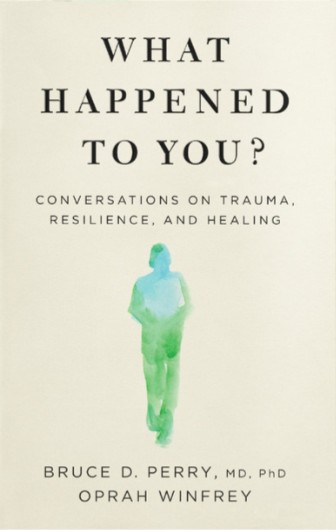
I’m not a particular fan of Oprah Winfrey but I admire her work in support of mental health. This book is unusual – it’s a dialogue between her and a child psychiatrist specialising in brain development and trauma. It is a masterclass in psychoeducation – bringing powerful therapeutic ideas and a path to healing to the masses. As a therapist dealing with the effects of adversity and trauma regularly, this is a book I will recommend to my clients. Book review: What happened to you? Conversations on trauma, resilience and healing by Bruce D Perry and Oprah Winfrey
Key idea in “What happened to you?”
The book is for those who have experienced trauma – or for those caring for those who have suffered trauma. And possibly for those people who have been labelled: people pleaser, self-saboteur, disruptive, argumentative, checked out, can’t hold don’t a job or bad at relationships.
It explains – drawing on medical science, psychiatry and psychotherapy – how adversity, abuse and trauma affect the development of children’s brains. And can result in a variety of adaptive coping strategies that remain with that child into adult life. It also offers a message of hope – on how to provide trauma-informed care (TIC), change maladaptive practices and find a calmer and more balanced life.
Oprah is open – she shares stories from her childhood, showing how harsh parenting and punishment can have such a terrible impact on who we become. And shows how conditioned compliance then shaped every interaction, relationship and decision in her life.
She also shares stories from many people she interviewed – who suffered traumatic loss, sexual abuse, racism, misogyny, domestic violence, community violence, gender and sexual identity issues and false imprisonment. Some stories are from those she encountered through the Oprah Winfrey Leadership Academy for Girls (OWLAG). OWLAG is becoming a model of trauma-sensitive, developmentally-aware education.
And there are some stories are from men – including Tyler Perry – who disclosed the impact of their sexual abuse. Dr Perry shares stories from those who suffer from Post-Traumatic Stress Disorder (PTSD) and Complex PTSD (which arises as a result of prolonged, repeated and inescapable traumatic experiences. These are often interpersonal, such as childhood abuse or neglect, prolonged domestic violence, or captivity).
There’s a really important message in the title alone. Rather than ask “What is the matter with you?” – which might convey criticism and cause shame it asks: “What happened to you?”. It’s a subtle but powerful shift of perspective which shows empathy, compassion and curiosity. And recognises the power of the past to shape our current functioning.
It’s a long read, and there is some repetition. But if you have suffered from trauma – especially in childhood – or have wondered why you think and feel a particular way – you will find the book illuminating and reassuring. It also offers guidance for parents too.
B.D. Perry, M.D., Ph.D. | Neurosequential
Contents of “What happened to you?”
- Making sense of the world
- Seeking balance
- How we were loved
- The spectrum of trauma
- Connecting the dots
- From coping to healing
- Post-traumatic wisdom
- Our brains, our biases, our systems
- Relational hunger in the modern world
- What we need now
Making sense of the world
The book starts with an accessible explanation of basic neuroscience. There is a simple explanation of the hierarchical functioning of the brain:
- Cortex (creativity, thinking, language, values, time, hope)
- Limbic system (reward, memory, bonding, emotions)
- Diencephalon (arousal, sleep, appetite, movement)
- Brainstem (temperature, respiration, cardiac)
All experience is processed from the bottom up. “To get to the smart part of the brain, we have to go through the lower not-so-smart parts”. This means that the most primitive, reactive part of the brain is the first to interpret and act on the information coming in from our senses.
It is noted that foetal brain development can be influenced by various factors including the mother’s stress, drug, alcohol and nicotine intake, diet and patterns of activity.
Experiences in the first few years of life are disproportionately powerful in shaping how your brain organises. “Young children absorb so much more than we realise – the younger you are, the more sensitive you are to your emotional climate”.
There are parts of our brain that are very sensitive to nonverbal relational cues. The book explains how memories are created by each part of the brain – from narrative memory as we are older to those related to the association of sensory features (people’s hair colour, music playing etc) and emotions such as fear when we are pre-verbal.
There’s a touching story about how children might perceive divorce as death and the introduction of a new relationship (shifting the parent’s attention away) can impact self-worth. A child exposed to unpredictable or extreme stress will become dysregulated.
When we form a first impression – frequently with no apparent information on which to base it – it may be because attributes of the person evoke in us something we’ve previously categorised as familiar and positive.
Seeking balance
We might soothe ourselves with food, a walk in nature, singing or dancing. Rhythmic things make us feel better. It’s why we rock babies when they cry. There’s a diagram here of the tree of regulation (the neural networks our body uses to help us process and respond to stress).
The emotions of people around us are contagious (Emotional contagion, delegation, coaching and team meetings). A consistent, nurturing caregiver builds an internal view that people are safe, predictable and caring. Similarly, if caregivers are unpredictable, cold or absent the child develops a different view. Our internal view of the world becomes a self-fulfilling prophecy – we project what we expect, and that helps elicit what we expect. Yet we have too many parents caring for children with inadequate support.
So the patterns of stress lead either to sensitisation (a vulnerability) or tolerance (resilience).
As well as an arousal response, another adaptive response is dissociation. One way to dissociate is to be a people pleaser. There’s an interesting quote here from Russell Brand “Drugs and alcohol are not my problem, reality is my problem – drugs and alcohol are my solution”. He refers to “his internal storm”. There’s a diagram showing how we fill our reward bucket – and a note that the healthiest way to do this is through relationships – connectedness regulates and rewards us.
How we were loved
One of the remarkable properties of our brain is its capacity to change and adapt to our individual world. This aspect of neuroplasticity – repetition leads to change – is well known and is why practice in sports, arts and academics can lead to improvement.
Belonging and being loved are core to the human experience. To the new born, love is action. The majority of brain growth and organisation takes place in the first years of life. There are three types of developmental adversity:
- Disruption before birth (prenatal exposure to drugs, alcohol and extreme maternal distress)
- Early interaction between infant and caregiver
- Sensitising patterns of stress
The “fight or flight” response coined by pioneering stress research Walter B Cannon in 1915. Yet when we first experience stress our initial default is to flock. We look to others – primarily their facial expressions – for emotional clues about how to interpret the situation. If no one is around you might freeze. As we feel more threatened we move to flight or fight. Our specific trauma-related responses will depend upon the stress response that was dominant in any given experience.
There’s a helpful diagram here on state-dependent functioning – from calm, alert, alarm, fear and terror – showing adaptive functions, cognition and functional IQ. Sometimes the hypervigilance of the alert state is mistaken for ADHD.
The spectrum of trauma
Almost 50% of children in the USA have had at least one significant traumatic experience (National Survey of Children’s health).
A 2019 study by US Centre for Disease Control and Prevention found 60% of American adults report having had at least one adverse childhood experience (ACE). The authors mention that John Steinbeck’s novel East of Eden is a masterclass of transgenerational trauma.
The Substance Abuse and Mental Health Services Administration (SAMHSA) came up with the three Es definition of trauma: the event, the experience and the effects.
It has been estimated that childhood adversity plays a major role in 45% of all childhood mental health disorders and 30% of mental health disorders among adults. These studies are consistent with other studies that show increased risk for major depression, anxiety, schizophrenia and other psychotic disorders following childhood trauma or adverse childhood experiences.
The original Adverse Childhood Experience study was published in 1998. Originally, 18,000 adults answered the 10 item questionnaire through first 18 years of life to obtain an ACE score ranging rom 0 to 10. The first ACE study found a correlation between the ACE score and the nine major causes of death in adult life.
Since then studies have shown that your history of relational health – your connectedness to family, community and culture – is more predictive of your mental health than your history of adversity.
A basic finding is that the experiences of the first two months of life have a disproportionately important impact on your long-term health and development.
While therapy helps, you can stand the emotional intensity of visiting the wreckage of your trauma-fractured life for only a few seconds before your brain starts to do things to protect you from the pain.
The authors explore PTSD – four main symptoms:
- Intrusive symptoms (e.g. recurring, unwanted images and thoughts of the traumatic event)
- Avoidant symptoms (e.g. avoid evocative cues, an attempt to regain control)
- Changes in mood and thinking (e.g. depressive symptoms)
- Alteration in arousal and reactivity (e.g. anxiety, hypervigilance, increased startle response, high and variable heart rate and sleep problems)
Connecting the dots
Is it possible for a heightened sense of fear to be inherited? We absorb things from previous generations and pass them on to the next generation. There’s a diagram showing the different channels of transgenerational transmission: genetic, epigenetic, intrauterine, perinatal experience and postnatal (family mediated and education, community and culture mediated).
There are comments here about how the African American community trauma can trace back trauma for generations – all the way back to slavery. Back to the theme of emotional contagion and the transmissibility of trauma. The authors suggest that this is why the Black Lives Matter protests of 2020 were so powerful.
Some people appear to have a genetically influenced capacity for hardiness – they can tolerate a wider range of sensory complexity and stressors. It takes more to dysregulate these people. In contrast, other people appear to be born with a ”sensitive” stress response. They are more easily overwhelmed by minor shifts in sensory complexity.
One of the most important areas is the way we connect with other. Developmental trauma can disrupt our ability to form and maintain relationships (this relates to attachment). This also relates to physical health as physical well-being and your emotional heath are deeply connected.
Reviewing the neurobiology of trauma, it is possible to see that a person’s worldview can change their immune system. 20 years ago trauma was never really considered a factor in a person’s health.
The more positive time you spend with someone, the more your brain categorises that person as safe and familiar. That is why, in therapy, it often takes ten to twenty sessions before the client begins to feel safe enough to share some of their most emotionally difficult experiences.
From coping to healing
Dissociation is a primary adaptation when animals were stressed in specific ways – relationships are the key to healing. There’s reference to Romanian orphans to explain the impact of neglect.
The most common form of neglect is fragmented, pattern-less caregiving. Another kind of neglect is splinter neglect – which occurs when many aspects of development are normal and some key systems received appropriate experience – but one or more does not. There’s mention of very wealthy parents who outsource parenting – not understanding the importance of relational consistency early in life.
There are comments about how technology (screens) are creating a distracted society where parents aren’t really present with their children. Children want eye contact and full engagement. There’s mention of Dr Ed Tronick’s Still Face paradigm – where children become distressed when their caregiver is disengaged, passive and cool. The dissociative response is used when there is inescapable, unavoidable distress and pain.
Downtime plays a crucial role for memory consolidation. Dissociative reflection is encouraged. Women who experienced early sexual abuse would sabotage their adult relationships. For some, there was a “terror of being alive”.
One of the common behaviours seen with a sensitised dissociative response is cutting. The opioid burst from cutting can actually feel regulating. Children will find a way to soothe. They note that making yourself throw up can also cause that burst of opioid burst – so there are eating disorders related to self-soothing and not to body image.
Oprah reports that books were a way for her to escape. Part of this behaviour was to stay under the radar and people-please by being compliant. She talks about the power of intention (Gary Zukav).
Why is it that people who are victims of trauma are so often drawn to abusive relationships? Dr Perry explains that all of us tend to gravitate to the familiar, even when the unfamiliar is unhealthy or destructive.
The most destabilising thing for anyone is to have their core beliefs challenged. When trauma victims get into a relationship with somebody who is not treating them poorly, they may find themselves increasingly uncomfortable. And then victims may behave in a way to provoke a response – as anger and poor treatment are validating – so their worldview is confirmed. Oprah suggests that you consider all your personal relationships to see what they have in common – then ask yourself how these people make you feel.
Post-traumatic wisdom
Children are not born resilient, they are born malleable. Adversity affects the developing child. Oprah explains that they used the term “weathering” for the experience of trauma. She talks about the intergenerational impact of the trauma many African Americans experienced – and how the church was a big part of how they got through.
All development involves being exposed to novelty, which in turn activates our stress response. Failure is an important part of the process. And through all this, relationships are absolutely key.
When someone is not regulated, the tone and rhythm of the voice probably has more impact than the actual words. If someone is being present, it’s best to restate what the person is saying – this is called reflective listening.
Rhythm is important and is often overlooked as a therapeutic tool. There is regulating potential in patterned, repetitive activity like dancing or massage. And it is especially regulating if you can walk in nature.
The healing journey from traumatised to typical to resilient helps create a unique strength and perspective.
The pillars of traditional healing were:
- Connection to clan and the natural world
- Regulating rhythm through dance, drumming and song
- A set of beliefs, values and stories that brought meaning to even senseless, random trauma
- On occasion, natural hallucinogens or other plant-derived substances used to facilitate healing with the guidance of a healer or elder
Today’s best practices in trauma treatment are basically versions of these four things. Dr Perry feels the medical model overfocuses on psychopharmacology and cognitive behavioural approaches and undervalues the power of connectedness and rhythm.
Illustrated with further stories, the authors argue that most healing happens in community. Where the uncontrollable and unpredictable is made more controllable and predictable. Whilst giving children multiple opportunities to make choices.
Oprah comments that you are not meant to raise children isolated and alone. Single parents often end up feeling like they are inadequate. Dr Perry suggest you need four developmentally mature individuals for each child under six.
Our brains, our biases, our systems
There’s a moving story about a man convicted of murder who started mediating, reading, journaling and writing a best-selling memoire – “Writing my wrongs”. He has now become an advocate for criminal-justice reform. The authors argue that people should not be defined by their past mistakes and that redemption is possible. Your past is not an excuse, but it is an explanation.
This leads to a discussion about what some call trauma informed care (TIC) which emerged in 2001. And then the book goes on to explore implicit bias, racism and misogyny.
There’s reference to 1989, when the National Center for PTSD was formed within the Department of Veterans Affairs (A) to study trauma and support veterans. In 2000, the National Center for Child Traumatic Stress was formed. It wasn’t until 2018 that the branches of the CDC and SAMHSA dedicated to studying trauma came up with their seven principles of TIC. So traumatology – the study of trauma – is young.
There is a need to create healing within our systems. Noting marginalisation is a fundamental trauma – and that many black, brown and indigenous children are more likely to be over-diagnosed and overmedicated in mental health systems and removed from their homes into the care system. And children of colour, especially boys of colour, are expelled at rates three times higher than white children. The hypervigilance from their sensitised stress response is often labelled as ADHD. And a school-to-prison pipeline is created.
Studies show that between 30 and 50 per cent of children in public schools have three or more ACEs. Observers often believe there are no reasons at all for behavioural outbursts – and the word “snapped” is often used.
Dr Perry developed a Neurosequential Model in Education (NME) which teaches the concepts discussed in the book. They emphasise regulation and connection. And encourage regulatory behaviours such as walking, rocking, fiddling with things while listening to a lesson and listening to music through earbuds (somatosensory regulation). They encourage powerful healing and resilience building activities like sports, music, dance and art – many of which have important relational elements.
Current mental health systems are under resourced and overwhelmed – meaning that they tend to be crisis-focused. A good assessment process is needed. Trauma-focused cognitive behaviour therapy (TF-CBT) is also valuable. There are also suggestions that the 50 minutes a week approach to therapy may not be ideal – and that therapeutic moments can be brief and ideally spread through a whole week.
Having access to a number of invested, caring people is actually a better predictor of good outcomes following trauma than having access to a therapist. Indigenous and traditional healing practices do a remarkable job of creating a total mind-body experience (cognitive, relational-based and sensory elements) that influence multiple brain systems.
The brain is always using shortcuts and these are not always accurate, The most powerful categories in our brain come from our first experiences, usually in early life. This contributes to our tendency for bias. The earliest relational experiences are the most powerful and enduring. One of the hardest things to grasp about implicit bias and racism is that your beliefs and values do not always drive your behaviour.
The Isabel Wilkerson book Caste quotes from a study called the Sentencing Project. Crimes involving a black suspect and a white victim make up only 10% of all crimes, but they account for 42% of what’s reported on television.
Be courageous enough to spend time with people who are different from you and who may challenge your biases. Cultural sensitivity training needs to be coupled with real experience and real relationships.
Relational hunger in the modern world
This starts with a story of a Māori elder. There are also mentions of other healers from this and Native American communities. Noting the use of rhythm and harmony with nature. In traditional communities, there is no conceptual separation of problems into categories such as education, mental health, juvenile justice or child welfare. There is a wholeness to their ways of thinking and being. There’s an argument that in order to understand the here and now, we need to know where we come from and what happened to us and our ancestors.
There are further stories about the impact of trauma on a young man and his family. This leads to a discussion that our world is relationally impoverished. And the links this has with the cancel culture.
Our ancestors had small social networks – with sixty to hundred people. Yet we had more development diversity – adults, youth and children mixing in the same space throughout the day. There was more physical proximity, more touch and more connectedness.
Dr Perry is concerned about the poverty of relationships in modern society. In a recent survey of selected urban communities in US, Europe and Japan – up to 60% of all households were just one person. At home, at work, at school we spend hours in front of screens – on average, over 11 hours a day. The result is a more self-absorbed, more anxious, more depressed and less resilient population.
The typical college-aged adult is 30% less empathic, and more self-absorbed than 20 year ago. One study documented a 40% increase in psychopathology in American college students over the last 30 years. Authors of the study suggest this is related to “cultural shifts towards extrinsic goals such a materialism and status and away form intrinsic goals such as community, meaning in life and affiliation”.
They talk here about disconnection (which is a key theme in this book: Lost connections – Why you’re depressed by Johann Hari). A recent study by a team at Harvard found that of all the factors involved in depression, the most powerful were related to connectedness. Dr Perry believes there is some correlation between rising suicide rates and the increased fraying of our social fabric. Part of the increase of anxiety in our modern world comes down to the constant bombardment of novelty – especially social novelty – and the absence of counterbalancing relational connection.
Your brain can manage only a limited number of fully reciprocal relationships. Interesting, in light of what’s been discussed in the book the number of about eighty to one hundred people – the size of a large hunter-gathered band. This is why people are most vulnerable in the first six months after major transitions.
We all want to be part of a group – being left out can have a deep and ensuring impact. The speed with which we’re inventing our world is outpacing our ability to understand the impact of our inventions. Dr Perry believes we need to develop social-practice “rules” about when and how to use our new technologies – e.g. no phone zones and no phone times, proper dosing and space of screen time etc. He suggests that children under the age of two or three should not even be looking at a tablet or screen. Fluency is related to the number of words spoken in a back and forth, interactive, conversational way.
What we need now
With better understanding of how brains develop it is easier to assess and understand the source of problems. Then we can put in place a rebuilding or renovation plan. Addressing the brain’s problems in the proper sequence and focusing on the lower networks before moving on to issue sin the higher regions.
Regulate, relate and then reason. There’s a story of how the Neurosequential Model helped – you need to know the stage and watch the state. To rewrite the script. Relationships are the currency of change.
Quotes I particularly liked in “What happened to you?”
- From the poem Invictus: “I am the master of my fate. I am the captain of my soul”
- For most people, the unknown is one of the major causes of feeling anxious or overwhelmed… fear shuts down thinking and amps up feeling
- Rhythm is regulating – we connect relationship to reward and regulation
- Many people who struggle with drug and alcohol abuse are actually trying to self-medicate due to their development histories of adversity and trauma
- In its essence, trauma is the lasting effects of emotional shock
- The fear of the grandparent, becomes the fear of the parent, becomes the fear of the child
- When someone is dysregulated, they simply cannot use the smartest part of their brain.
- Early in life, the brain needs consistent, patterned experiences to develop key systems
- People-pleasing is a classic coping mechanism that is part of the “compliant” behaviours seen with dissociation
- Always start by asking myself “What is my intention in doing this?”
- Why is it that people who are victims of trauma are so often drawn to abusive relationships?
- If as a child you’ve experience chaos, threat or trauma, your brain organizes according to a view that the world is not safe and people cannot be trusted
- “We feel better with the certainty of misery than the misery of uncertainty” (Virginia Satir)
- “You teach people how to treat you” (Maya Angelou)
- Therapy is more about building new associations, making new healthier default pathways
- In the wake of trauma, the hardest thig to understand is that nothing and no one can take away they pain
- Rhythm is important and is often overlooked as a therapeutic tool. There is regulating potential in patterned, repetitive activity like dancing or massage
- You are not meant to raise children isolated and alone
- Studies show that between 30 and 50 per cent of children in public schools have three or more ACEs (Adverse Childhood Experiences)
- When we’re with people who have attributes similar to our childhood “clan”, we feel safe
- Our first experiences create the filter through which all new experience must pass
- You don’t get trained in cultural sensitivity – you go spend time immersed in the culture, spend time with other people (Anthony Bourdian was a great example of this)
- We all need to get better at listening, regulating, reflecting.
- One of the things we don’t appreciate in Western cultures is how powerful and important touch is to our physical and emotional growth
- Until you heal the wounds of the past, you will continue to bleed
I would also recommend these books relating to the topic of (childhood) trauma:
“Adult children of emotionally immature parents – how to heal (kimtasso.com) August 2024 An excellent book that has helped several clients suffering from anxiety, depression and “failed” relationships. How to recognise emotional, driven, passive and rejecting parenting styles and the coping mechanisms adopted (e.g. people pleasing, high independence etc).
Book reviews on stress and trauma – “When the body says No” (kimtasso.com) June 2024 Review of “When the body says no – The cost of hidden stress” by Gabor Mate and “The body keeps the score – mind, brain and body in the transformation of trauma” by Dr Bessel Van Der Kolk
Attached by Dr Amir Levine and Rachel Heller August 2025 Explains the fundamentals of attachment theory – and how we develop a secure, anxious or avoidant attachment style as a result of our early interactions with our caregivers.
Related resources on therapy, trauma and resilience
My therapy web site is: Tasso Talking Therapy (Please don’t hesitate to telephone or email for an informal and confidential chat about your mental health)
Articles
What do I do if I’m feeling stuck? – Kim Tasso October 2025
Improve mental health at work, in marketing and for women September 2025
Assertiveness toolbox – Kim Tasso May 2025
What happens in therapy? – Kim Tasso April 2025
Confidence to overcome a fear of failure – Kim Tasso September 2024
my relationships like rollercoaster rides? Volatile relationships (kimtasso.com) August 2024
How do you choose a therapist? – Kim Tasso July 2024
Emotional Regulation – A key element of Emotional Intelligence (EQ) (kimtasso.com) August 2021
Psychology and business communication (kimtasso.com) January 2015 An introduction to Transactional Analysis (TA) and the Parent Adult Child model
10 tips to increase your resilience – Kim Tasso March 2013
Therapy and counselling self-help book reviews
Introduction to Internal Family Systems (IFS) October 2025. An overview of the therapeutic approach IFS that seeks to explore your internal parts – the exiles, managers and firefighters – and develop a greater sense of self and calm.
Attached by Dr Amir Levine and Rachel Heller August 2025. How attachment theory can help you understand your relationship style – secure, avoidant and anxious.
Book review – Feel the fear and do it anyway by Susan Jeffers June 2024. Classic self-help book on managing anxiety
Book review – Counselling for toads May 2025. The modern classic explaining Transactional Analysis (TA) using a story by Robert de Board using Toad and other characters from “Wind in the Willows”
Book Review: The Power of Now by Eckhart Tolle March 2025 A best-selling guide to ceasing your incessant thoughts, focusing on the present “here and now”, spiritual enlightenment and finding inner peace.
Overcoming low self-esteem – a self help guide using cognitive behavioural techniques by Melanie Fennell January 2025
Book review: Taking charge of Adult ADHD by Russell A Barkley (kimtasso.com) October 2024
“Adult children of emotionally immature parents – how to heal (kimtasso.com) August 2024 An excellent book that has helped several clients suffering from anxiety, depression and “failed” relationships. How to recognise emotional, driven, passive and rejecting parenting styles and the coping mechanisms adopted (e.g. people pleasing, high independence etc).
Book reviews on stress and trauma – “When the body says No” (kimtasso.com) June 2024 Review of “When the body says no – The cost of hidden stress” by Gabor Mate and “The body keeps the score – mind, brain and body in the transformation of trauma” by Dr Bessel Van Der Kolk
Book review: The Thriving Lawyer by Traci Cipriano (resilience) (kimtasso.com) June 2024 A review of a book into the mental health and resilience of lawyers in law firm cultures. The author is a former practising attorney and clinical psychologist.
The Tools – Five life-changing techniques to unlock your potential (kimtasso.com) April 2024 A review of the book by psychiatrist Phil Stutz
Book review – Creating self-esteem by Lynda Field (kimtasso.com) March 2024 A classic book on realizing your true self worth
Book review: How to do the work (recognise your patterns (kimtasso.com) December 2023. Review of a book to support psychoeducation. Topics include: conscious self, theory of trauma, mind-body healing practices, inner child, boundaries, reparenting and emotional maturity.
Dr Julie Smith (Mental Health Guidance) (kimtasso.com) July 2023. Review of the book “Why has nobody told me this before?” that explores helpful ideas on low mood and depression, motivation, anxiety, emotional pain, grief, self-doubt, fear, stress and a meaningful life.
Overcoming clinical depression (2021) by Oliver Kamm (kimtasso.com) March 2023. A review of the book “Mending the Mind” which explores what it is like to suffer from depression and both the medical and psychological sources of help.
Lost connections – Why you’re depressed by Johann Hari (kimtasso.com) October 2019. A review of a popular book about the nine common reasons people suffer from depression.
Crazy busy – Book review – Dealing with stress (kimtasso.com) October 2009. This book examines modern life and offers practical advice to avoid stress and restore calm.
Book review: The psychology of successful women by Shona Rowan (kimtasso.com) June 2022. Topics include: confidence, assertiveness, boundaries, public speaking, impact, influence, visibility and bouncing back from setbacks.
Your personal transition – Endings, neutral zone and new beginnings (kimtasso.com) June 2020. Helps you navigate major changes in your life and prepares you for the emotional roller-coaster of change.
Short videos on therapy and mental health
Soft skills – Boost your self-confidence and confidence (Video) (kimtasso.com) October 2020
Business relationships – Using the drama triangle to resolve conflict (kimtasso.com) September 2020
How the parent, adult, child (PAC) model helps with difficult interactions (kimtasso.com) September 2020
Change process – Emotions when reacting to change (kimtasso.com) April 2020
Building Resilience – Regulation, Reframing, Relationships and Reflection (kimtasso.com) May 2020