
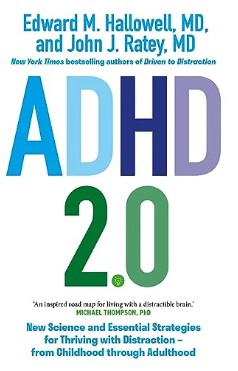
The full tittle of this 130 page, 2021 book is “ADHD 2.0 – New science and essential strategies for thriving with distraction – from childhood through adulthood”. I reviewed a classic book on ADHD in October 2024 (see Book review: Taking charge of Adult ADHD by Russell A Barkley) and I offer this book as a more accessible and up to date read. The authors – both New York Times bestselling authors – are American psychiatrists who both have ADHD. Several of my therapy clients have ADHD – some embark on formal assessments and obtain medication whilst others learn to adapt their thoughts and behaviour. This book will be helpful to both groups. Book Review – ADHD 2.0 by Edward M Hallowell MD and John J Ratey MD.
My overview of ADHD 2.0
By coincidence, one of the authors also happens to have written one of my favourite books on stress (see Crazy busy – Overstretched Dealing with stress) which I reviewed in 2007. This new book offers a plain-speaking explanation of the ADHD condition, a validation of those with ADHD, an evidence-based road map and a source of help. What I particularly like about it is that it argues that ADHD is not just a biological condition and that a related condition – VAST – can arise from particular environments in modern society.
I have many therapy clients with ADHD. Some choose to obtain a formal diagnosis and seek medication from psychiatrists to help manage the most extreme elements of the condition. Others – myself included – accept that we think differently, appreciate our differences (one colleague calls it his “superpower” and others believe it is the source of their creativity) and develop strategies to help us manage the challenges that our neurotypical colleagues don’t experience.
It reads a little like a detective novel – with case studies and stories revealing different investigations and approaches to managing ADHD symptoms. It’s an empathetic analysis of what it’s like to have ADHD – and a balanced view of the negative and positive aspects. It helps us to understand the condition and its impact. There are simple explanations of brain function although sometimes the neuroscience gets a little detailed.
A significant contribution of this book is that it shines a light on the impact of our fast-paced, always-on, overstimulated modern lives. These new environmentally-induced habits have come together to create something similar to ADHD which is called VAST – the Variable Attention Stimulus Trait. This is a theme developed in “The Anxious Generation: How the Great Rewiring of Childhood Is Causing an Epidemic of Mental Illness”. A 2024 book by Jonathan Haidt which argues that the spread of smartphones, social media and overprotective parenting have led to a “rewiring” of childhood and a rise in mental illness.
I recently read a related book on ADHD by another favourite psychiatrist (see Gabor Mate (Book reviews on stress and trauma – “When the body says No”). His 1999 book Scattered Minds: The Origins and Healing of Attention Deficit Disorder: Amazon.co.uk: Maté, Dr Gabor: 9781785042218: Books argues that ADHD is not caused by inherited genetics but a reversible impairment and developmental delay caused by experiences in infancy.
ADHD 2.0 is a valuable tool in psychoeducation (“a didactic intervention aimed at informing patients and their relatives about their disorders, enhancing coping abilities by providing information, building skills, developing social support, and reducing isolation, typically delivered in group settings over several sessions” Psychoeducation – an overview | ScienceDirect Topics).and self-help.
The book provides information, hope and tactics on how to manage ADHD to improve your life.
Contents of ADHD 2.0
- A spectrum of traits
- Understanding the demon of the mind
- The cerebellum connection
- The healing power of connection
- Find your right difficult
- Create stellar environments
- Move to focus, move to motivate: the power of exercise
- Medication: the most powerful tool everyone fears
- Putting it all together: find your feel and make it real
Appendices include:
- The Diagnostic and Statistical Manual (DSM) of mental disorders definition of and criteria for ADHD
Introduction
The authors start by referring to their 1994 book “Driven to Distraction” when few people knew about ADD (Attention Deficit Disorder). Yet now most teachers are on the lookout for children with undiagnosed or mismanaged ADD as children can disrupt classrooms and fail to fulfil their potential.
ADD has been updated to include hyperactivity – (ADHD) – to reflect the highs and lows of those with lived experience. Yet most people don’t understand the power, magnitude and complexity of the condition.
People don’t grow out of ADHD. And it can crop up for the first time in adulthood – particularly at times when life’s demands exceed a person’s ability to cope (classic examples include when a woman has her first baby or enters medical school). Some people judge those with ADHD as lazy – yet someone with ADHD is, in fact, constantly at work.
ADHD occurs in at least of 5% of the US population – although some believe this figure is much higher. There is a relative paucity of professionals who know how to diagnose ADHD. (NHS England have estimates of ADHD showing 2,506,000 in England, of which 744,000 are children (5-24). [November 2025]).
The authors comment on the huge toll that ADHD can place on individuals – contributing to a variety of other mental health issues including addiction and suicide. The authors refer to Russell Barkley’s book (see Book review: Taking charge of Adult ADHD by Russell A Barkley) who comments that ADHD is worse than the top five killers in the USA combined. They state that medication really can help as ADHD is the most treatable condition in psychiatry.
They go on to say that ADHD – if mastered – brings out talents you can neither teach nor buy.
A spectrum of traits
The lunatic, the lover, the poet
It lists various behavioural issues associated with children with ADHD – disorganised, unable to follow through, incapable of basic household tasks and forever interrupting. Or talented executives with ADHD who miss deadlines and forget obligations. Sometimes people with ADHD are the misfits, addicts and unemployed. But they are also imaginative, dynamic and entrepreneurial. Their ideas come in spontaneous, erratic bursts. Yet those with ADHD sometimes appear to be somewhere else – as they often “tune out”.
ADHD’s universal qualities are distractibility, impulsivity and hyperactivity. Risk taking and irrational thinking go hand in hand with ADHD behaviour. Those with ADHD tend to have unbridled optimism. And they don’t hold back. People with ADHD feel an abiding need to create something. They have an overabundance of attention – more than they can cope with.
Paradoxical tendencies
ADHD brings a complex set of contradictory or paradoxical tendencies:
- unexplained underachievement
- a wandering mind
- trouble organising and planning (trouble with executive function)
- a high degree of creativity and imagination
- super reliable when stimulated
- trouble with time management
- tendency to procrastinate
- Strong will, stubbornness and refusal of help
- Generosity
- Restlessness
- unique and active sense of humour
- trouble sharing and playing with others early on – but at the same time a desire to make friends
- exquisite sensitivity to criticism or rejection
- impulsiveness and impatience and an itch to change the conditions of life
- high energy
- uncannily accurate intuition
- transparency
- susceptible to addictions and compulsive behaviour
- having a metaphorical lighting rod and weathervane (the first to sense a shift in mood or energy in the group)
- tendency to externalise or blame others rather than seeing their role in the problem
- Distorted negative self-image
Biologically or culturally induced ADHD?
Scientific estimates suggest that between 5 and 10 per cent of people are born with some combinations of the characteristics listed.
ADHD is recognised as one of the most heritable conditions although it involves multiple genes (but please see the book “Scattered Minds” – mentioned above – that resists this idea). If one parent has ADHD the risk is one in three that a given child will have ADHD, if both parents have ADHD the risk is two in three.
Certain environmental stressors have an impact – head injuries, lack of oxygen at birth, early infections or brain ”insult”. Other indicators are the mother being obese or drinking alcohol. Using drugs or smoking can raise the risk. Researchers are still exploring the possible impact of MFR (magnetic field non-ionising radiation – from power lines and kitchen appliances and wireless networks).
Others have ADHD-like symptoms caused by the conditions of modern life most notably electronic communications. Modern life trains our brains to go faster and faster and to require constant stimulation. These new habits have come together to create something we now call VAST – the Variable Attention Stimulus Trait.
There’s a discussion about how a formal diagnosis of ADHD requires six out of the nine criteria to be present (there’s a DSM description in the annexe or see DSM-5 Diagnostic Criteria for ADHD) but no such requirements exist to identify VAST. The authors clarify that you can no longer get a diagnosis for ADD – but for ADHD predominantly inattentive, ADHD predominantly hyperactive-impulsive (rare) or ADHDS combined type.
The authors share a useful table considering the useful and problematic aspects of ADHD and VAST conditions.
(You should note that a formal ADHD diagnosis requires a psychiatrist report – these are available through the NHS or privately through organisations such as Berkeley Psychiatrists | Private Psychiatric Assessment)
Understanding the demon of the mind
The chapter starts by considering brooding and ruminative thoughts and excessive worry. All exacerbated by ADHD or VAST.
New findings, new help
Back to the nature or nurture debate, the authors describe epigenetics (varying the impact of environment upon expression of genes) and the ability of the brain to change over the course of our lifetime (neuroplasticity). And the message of hope that goes with this – we can change who we are and where we’re headed at any age.
They argue that the gift of creativity and the curse of brooding lie in two mindsets they call the Angel and the Demon. It uses this metaphor to explore some brain structures.
There are basic brain explanations to show how you think – the clumps of neurons (together called a connectome) seen through fMRI. When engaged in a task the area that lights is called the task positive network (TPN). In TPN you’re in Angel mindset – if trapped in hyper-focussed mode it can keep you stuck in one task. They reflect that people rarely spend enough time focusing on a single task.
The other connectome is the default mode network (DMN) which allows for expansive, imaginative and creative thinking. The posterior cingulate facilitates your autobiographical memory – the front part – the medial prefrontal cortex – is the opposite – allowing you to look forward and imagine the future.
Glitchy switch
Neurotypical people can switch between TPN and DMN. Yet those with ADHD or VAST often get stuck in the DMN. Those with ADHD or VAST are particularly prone to head toward gloom and doom because they have stored a lifetime of moments of failure, disappointment, shame, frustration, defeat and embarrassment. Life has taught those with ADHD to imagine and expect the worst.
It mentions research by neuroscientist John Gabrieli – who describes the anticorrelation property of the two networks. In ADHD people both TPN and DMN can be turned on whereas in neurotypical people it is either one or the other.
ADHD and addiction
When the DMN rules, it demands more. Yet the same hunger drives addiction. Addictions of all kinds are five to ten times more common in people who have ADHD than in the general population. This explains the truism that creative talent goes had in hand with addiction, depression, bipolar disorder, ADHD and all manner of mental disturbance.
The glitchy switch in action
There’s a story about a relative of one of the authors visiting a hardware store to get flowers. He left his wife at the store. They talk about pirouette syndrome – a circling back to make sure you’ve done something you’ve already done. Catastrophic thinking – referred to as Chicken Little Syndrome – is a form of rumination where you think about all the things that can go wrong.
The clever art of outsmarting the demon
They explore the popular saying “neurons that fire together, wire together”. When ruminating you are repeatedly doing something that fosters a negative connection. A tip is to focus on anything external to yourself as activating the TPN will shut down the DMN. (I find it helpful to think of the TPN as the master of task and DMN as the source of creativity).
The cerebellum connection
As each of our 100 billion brain cells connects with a hundred to thousands of other neurons at synapses, a staggering 150 trillion synapses enliven your brain. The cerebellum contains 75% of the brain’s neurons. Its combined components are referred to as the vestibulo-cerebellar system (VCS).
The authors continue to describe the inner workings of the brain – VCS basics. And explain that it is responsible for any endeavour requiring split-second decisions.
Improved cerebellar function = improved ADHD symptoms
In 1998, understanding of the cerebellum took a revolutionary step forwards with big implications for ADHD. This relates to work on cerebellar cognitive affective syndrome (CCAS) or Schmahmann’s syndrome where there is damage to the brain. The idea emerged of a universal cerebellar transform (UCT) that acts as a stabilizer of thinking, emotion and behaviour.
Schmahmann’s research and other MRI studies show that the central strip down the midline of the cerebellum (vermis) is ever so slightly smaller in people who have ADHD. And that you can develop them.
New treatments in the balance
One way to do this is balancing exercises like the Belgau Balance Board (based on the idea that balance and learning go hand in hand). This was taken further by Robert Melillo in a book called “Disconnected Kids” and franchised through Brain Balance Achievement Centres. A related programme is called Zing Performance. These exercises have improved ADHD symptoms.
The inner ear and one outside-the-box doctor
Doctor Harold Levinson prescribed medications for motion sickness. It seems the inner ear and vestibular system play a significant role in ADHD and other conditions. Dr Hallowell’s work shows the power of working on your balance – to find connection and focus on strengths over weaknesses.
There’s a case study from China for the “Driven to Distraction” book. Samuel was having difficulty at school – he was left -handed and had all ADHD symptoms. Using human connection (lots of hugs and reading aloud), promotion of a positive mindset and balancing exercises, he started to improve in a matter of weeks. The value of connection, education and exercise.
The healing power of connection
At Dr Felitti’s obesity clinic they accidentally discovered a link between trauma and weight management. Having extra weight made people feel safe. Later research found that two thirds of 17,000 subjects reported one experience of what’s come to be called Adverse Childhood Experience (ACE) scale. Research also found another adverse condition – loneliness. ACE scores are higher in families where there is ADHD.
Love heals
Further experiments described that show the power of love and connection in overcoming childhood adversity and healing. They call it “Vitamin Connect”. With love, people can overcome the dislocation or loss of psychosocial integration. (I was reminded of the power of connection in Lost connections – Why you’re depressed by Johann Hari).
The authors offer tips for a richly connected life noting that kindness makes kids and adults grow. Suggestions include: meals with family, get a pet, daily stop at a favourite coffee shop, visit favourite stores, keep up with at least two good friends regularly, arrange a sleepover for your child, at least half an hour of uninterrupted one-on-one time with your child every week, join a group that holds meetings, practice forgiveness of others and of yourself, daily inventory of gratitude, pay compliments, spiritual practice, walk in nature, never worry alone, minimise consumption of news, visit graveyards, connect with your desire to improve, personal vision of greatness, identify one living person you admire, learn about your ancestors, talk to non-related old people, climb a tree, associate with dream makers and lookout for a charismatic mentor.
Find your right difficult
Most people who have ADHD or VAST are naturally creative and original. The authors adopt a strength-based approach to treating people – they don’t treat disabilities but help people unwrap their gifts. Some people with ADHD or VAST find their superpower through serial entrepreneurship and others through a kind of “lightning strike” of one particular interest.
People with ADHD or VAST need a challenge – the “right difficult”. The authors provide a helpful list of 10 questions to help people find their right difficult. They argue that a major reason kids with attention issues do poorly in school is that they feel bored.
Get to know your strengths in a whole new way
The Kolbe Index – from the author of the Wonderlic Personnel Test which is given to all incoming NFL players – focuses on learning why smart people aren’t more productive or creative. It concerns a person’s conative style.
Conation is the mental faculty of purpose, desire or will to perform an action. It determines what you actually do in life. The 36 question test (costing $55) represents your innate aptitude in four areas of action: Fact Finder, Follow Thru, Quick Start and Implementor. The Kolbe web site Kolbe.com | Home of the Kolbe A™ Index explains the scoring system in detail, but it helps you find your strengths.
What’s up with self-defeating behaviour?
People with ADHD need the stimulation of intense challenge. And they don’t like to ask for help. They are non-conformists. Those with ADHD have to learn to be effectively interdependent. The authors found that the refusal to accept help is the single biggest reason for a person not to progress once an ADHD diagnosis has been made.
Create stellar environments
This explores the extent to which environment impacts those with ADHD. Many adults never discover they have ADHD until their environment dramatically changes. An example is stepping onto the next rung of school.
There are tips on how to organise your environment including: daily structure (a schedule and to do list), nutrition, sleep, positivity and the right help. There’s ample warning about the need to limit screen time. And practical suggestions for home, learning and working environments.
There’s guidance on nutrition – noting what kinds of foods contribute to hyperactivity or substandard performance. The general advice is to stick to wholefoods and lots of vegetables and fruits. And avoid sugar which promotes the production and release of dopamine. The authors refer to “Non-drug treatments for ADHD” by Richard Brown to help navigate vitamins and supplements, but they recommend OmegaBrite.
There’s also guidance on sleep and “populating your world with positivity”. And accessing the right help such as social coaching,
Move to focus, move to motivate: the power of exercise
“For getting and staying on track, exercise is one of the most powerful non-medical tools we have and an important first line of defence”.
There are stories (from individuals and teachers) and scientific explanations illustrating why exercise helps those with ADHD. There’s an interesting explanation of how balance and coordination training can be transformative for kids with ADHD (see above). And the particular benefits of martial arts, yoga and meditation. They authors suggest some sort of physical activity for at least twenty minutes every day.
Medication: The most powerful tool everyone fears
This chapter starts with the question “Do you believe in Ritalin?”. And answers: “as long as medications are prescribed and taken properly, they afford by far the most immediate and effective benefit of any treatment there is”. Quoting a study of studies, medication for ADHD if effective from 70 to 80 per cent of the time.
They also observe that some people with ADHD self-medicate with caffeine and energy drinks.
It’s argued that any medication works better if you want to take it. And to think in terms of risks and benefits. But they also note that a child with ADHD needs to learn boundaries with the help of a parent. (see Healthy boundaries at home and at work – how to set and maintain).
There is a description of the various ADHD medications available: stimulants (methylphenidate and amphetamines which raise the levels of dopamine and norepinephrine), stimulant-like drugs and outliers. Outliers are gaining in importance because of a newly understood disorder – Rejection-Sensitive dysphoria (RSD). This is extreme emotional pain triggered by the perception that a person has been rejected, ridiculed or criticised by important people in their life.
Note that taking a stimulant or stimulant-like drug early in life helps prevent, not promote, addiction later on. Since 80% of addictions start between the ages of 12 and 23 and since people with ADHD are far more prone to develop an addiction than the general population. However, ADHD drugs are listed amongst the top drugs abused by high school and college students.
Side effects often associated with ADHD medications are irritability, dry mouth, sleep disruption, headaches and a decrease in appetite. Proper diagnosis and treatment not only help ADHD but are also protective against secondary problems like anxiety and depression.
There’s a helpful six-page table of all the ADHD medications
Putting it all together: Find your feel and make it real
ADHD was totally misunderstood for so very, very long. Now we know that our neural functioning is slightly but meaningfully different form that of the neurotypicals in the population. The world is starting to see the tremendous potential – creativity, entrepreneurial spirit, energy – of people with the condition.
“No brain is the same, no brain is the best, each brain finds its own special way”.
Favourite quotes from ADHD 2.0
- A person with ADHD has the power of a Ferrari engine but with bicycle-strength brakes
- ADHD is neither entirely a disorder nor entirely an asset
- People with ADHD recognise only two times – “now” and “not now”
- Rejection-sensitive dysphoria (RSD) describes a tendency to overreact to even the slightest perceived put down, dis or vaguely negative remark (there’s also Recognition Sensitive Euphoria – an enhanced ability to make constructive use of praise, affirmation and encouragement)
- Those with ADHD are five to ten times more likely to develop a problem in the domain of addictions and compulsive behaviours
- Between 5 and 10 per cent of people are born with some combinations of the ADHD characteristics listed
- If one parent has ADHD the risk is one in three that a given child will have ADHD, if both parents have ADHD the risk is two in three
- We can change who we are and where we’re headed. It’s not easy but it can be done, and at any age
- Life has taught those with ADHD to imagine and expect the worst
- Addictions of all kinds are five to ten times more common in people who have ADHD than in the general population.
- One study showed that leaders totally focused on task are less supportive and nurturing of their teams than other managers
- As each of our 100 billion brain cells connects with a hundred to thousands of other neurons at synapses, a staggering 150 trillion synapses enliven your brain
- “A race car for a brain, but with bicycle brakes”
- Rewards work much better for the ADHD mind than do consequences
- With regular practice, you can actually change the structure of your brain through meditation. A 2011 Harvard study found that just eight weeks of mindfulness-based stress reduction work increased the cortical thickness in the hippocampus.
Other resources for those with ADHD
ADHDadultUK – The UK’s adult ADHD charity
Many people I know with ADHD have found the podcast ADHD Chatter helpful. It is hosted by UNILAD and LADbible founder Alex Partridge. It is a top UK ADHD podcast featuring candid conversations with experts and neurodivergent guests. Launched in 2023 following his own late diagnosis, the podcast tackles topics like shame, masking, and living a fulfilling life with ADHD. He had an anxiety attack in a classroom when he was six years old, started LADBible when he was 22 years old and was diagnosed with ADHD at 34.
Related articles on mental health and therapy topics
My therapy web site is: Tasso Talking Therapy (Please don’t hesitate to telephone or email for an informal and confidential chat about your mental health)
Articles on mental health and therapy
Healthy boundaries at home and at work – how to set and maintain January 2026
Confidence – Radiators and Drains and the 90 second rule January 2026
The stress bucket, healthy coping mechanisms and resilience December 2025
What do I do if I’m feeling stuck? – Kim Tasso October 2025
Improve mental health at work, in marketing and for women September 2025
Assertiveness toolbox – Kim Tasso May 2025
What happens in therapy? – Kim Tasso April 2025
Confidence to overcome a fear of failure – Kim Tasso September 2024
my relationships like rollercoaster rides? Volatile relationships (kimtasso.com) August 2024
How do you choose a therapist? – Kim Tasso July 2024
Emotional Regulation – A key element of Emotional Intelligence (EQ) (kimtasso.com) August 2021
Psychology and business communication (kimtasso.com) January 2015 An introduction to Transactional Analysis (TA) and the Parent Adult Child model
10 tips to increase your resilience – Kim Tasso March 2013
Therapy and counselling self-help book reviews
Book review: The Gift of Anxiety – Harnessing the EASE method December 2025
What happened to you? Conversations on trauma, resilience November 2025. Book review: What happened to you? Conversations on trauma, resilience and healing by Bruce D Perry (psychiatrist) and Oprah Winfrey
Introduction to Internal Family Systems (IFS) October 2025. An overview of the therapeutic approach IFS that seeks to explore your internal parts – the exiles, managers and firefighters – and develop a greater sense of self and calm.
Attached by Dr Amir Levine and Rachel Heller August 2025. How attachment theory can help you understand your relationship style – secure, avoidant and anxious.
Book review – Feel the fear and do it anyway by Susan Jeffers June 2024. Classic self-help book on managing anxiety
Book review – Counselling for toads May 2025. The modern classic explaining Transactional Analysis (TA) using a story by Robert de Board using Toad and other characters from “Wind in the Willows”
Book Review: The Power of Now by Eckhart Tolle March 2025 A best-selling guide to ceasing your incessant thoughts, focusing on the present “here and now”, spiritual enlightenment and finding inner peace.
Overcoming low self-esteem – a self help guide using cognitive behavioural techniques by Melanie Fennell January 2025
Book review: Taking charge of Adult ADHD by Russell A Barkley (kimtasso.com) October 2024
“Adult children of emotionally immature parents – how to heal (kimtasso.com) August 2024 An excellent book that has helped several clients suffering from anxiety, depression and “failed” relationships. How to recognise emotional, driven, passive and rejecting parenting styles and the coping mechanisms adopted (e.g. people pleasing, high independence etc).
Book reviews on stress and trauma – “When the body says No” (kimtasso.com) June 2024 Review of “When the body says no – The cost of hidden stress” by Gabor Mate and “The body keeps the score – mind, brain and body in the transformation of trauma” by Dr Bessel Van Der Kolk
Book review: The Thriving Lawyer by Traci Cipriano (resilience) (kimtasso.com) June 2024 A review of a book into the mental health and resilience of lawyers in law firm cultures. The author is a former practising attorney and clinical psychologist.
The Tools – Five life-changing techniques to unlock your potential (kimtasso.com) April 2024 A review of the book by psychiatrist Phil Stutz
Book review – Creating self-esteem by Lynda Field (kimtasso.com) March 2024 A classic book on realizing your true self worth
Book review: How to do the work (recognise your patterns (kimtasso.com) December 2023. Review of a book to support psychoeducation. Topics include: conscious self, theory of trauma, mind-body healing practices, inner child, boundaries, reparenting and emotional maturity.
Dr Julie Smith (Mental Health Guidance) (kimtasso.com) July 2023. Review of the book “Why has nobody told me this before?” that explores helpful ideas on low mood and depression, motivation, anxiety, emotional pain, grief, self-doubt, fear, stress and a meaningful life.
Overcoming clinical depression (2021) by Oliver Kamm (kimtasso.com) March 2023. A review of the book “Mending the Mind” which explores what it is like to suffer from depression and both the medical and psychological sources of help.
Lost connections – Why you’re depressed by Johann Hari (kimtasso.com) October 2019. A review of a popular book about the nine common reasons people suffer from depression.
Crazy busy – Book review – Dealing with stress (kimtasso.com) October 2009. This book examines modern life and offers practical advice to avoid stress and restore calm.
Book review: The psychology of successful women by Shona Rowan (kimtasso.com) June 2022. Topics include: confidence, assertiveness, boundaries, public speaking, impact, influence, visibility and bouncing back from setbacks.
Your personal transition – Endings, neutral zone and new beginnings (kimtasso.com) June 2020. Helps you navigate major changes in your life and prepares you for the emotional roller-coaster of change.
Short videos on therapy and mental health topics
Soft skills – Boost your self-confidence and confidence (Video) (kimtasso.com) October 2020
Business relationships – Using the drama triangle to resolve conflict (kimtasso.com) September 2020
How the parent, adult, child (PAC) model helps with difficult interactions (kimtasso.com) September 2020
Change process – Emotions when reacting to change (kimtasso.com) April 2020
Building Resilience – Regulation, Reframing, Relationships and Reflection (kimtasso.com) May 2020