
This 185-page 2025 book “Stop letting everything affect you – how to break free from overthinking, emotional chaos and self-sabotage” by Daniel Chidiac will be helpful for those who find themselves ruminating, overthinking and that anxiety of constantly worrying about things. I read and assess many books – and provide reviews of those that might be helpful to my clients. This is a great book for psychoeducation – helping people understand the way their emotions and minds work and to support increased self-regulation. It can be used to supplement therapy (or even instead of therapy for those who want to try a self-help solution). Book review: Stop letting everything affect you by Daniel Chidiac
Overview of Stop Letting Everything Affect You
So many of my clients tell me that they ruminate, overthink and often feel at the mercy of their spiralling thoughts. Some clients feel trapped in toxic patterns in relationships and want to walk away without feeling regret. If therapy isn’t an option for you, then this book may bring some light and relief.
The book is written in a kind, warm and compassionate voice to help you release yourself from the unconscious unrelenting pressure you place on yourself. The book helps you learn how to control what you give energy to. It helps you practice the art of emotional detachment – a key aspect of emotional regulation (see Emotional Regulation – A key element of Emotional Intelligence (EQ) and Grounding tools (support for emotional regulation) – Kim Tasso)
It’s a deceptively short book written in a simple and accessible way. With plenty of exercises and powerful practical tools. Reassuringly, it’s Interspersed with short references to research. Although there are some uncomfortable philosophical observations which may encourage you to consider your self-identity and self-worth.
It will help you change yourself. And provides a guide for your transformation journey to help you overcome the challenges of changing your thoughts, feelings and behaviour.
Related reviews on books relating to anxiety include:
Book review: The Gift of Anxiety – Harnessing the EASE method
Book review – Feel the fear and do it anyway by Susan Jeffers
About the author
Australian Daniel Chidiac is the international best-selling author of “Who says you can’t – You do” and “The modern break up”. He doesn’t position himself as a therapist but as a coach and consultant for media and entertainment professionals. He focuses on personal development, lifestyle and motivational literature. He suggests that the book is a transformative guide for anyone who overthinks too often, gets stuck in emotional chaos, and finds themselves trapped in cycles of self-sabotage.
Contents of “Stop letting everything affect you” by Daniel Chidiac
Part 1 – Why you let everything affect you
- The root of the problem: why you feel everything so deeply
- The problem isn’t just people, its everything
- The thought prison: how your mind creates mental loops
- The bigger perspective
Part 2 – You’re letting life control you
- The illusion of control
- The connection between control, rejection and the desire to “win” (power of reflection)
Part 3 – The weight you carry – Boundaries and detachment
- The hidden cost of carrying everyone’s weight
- The power of guilt and the struggle to set boundaries
- The trap of over-explaining and letting go
Part 4 – The breaking point – Recognition and realization
- Hidden manipulation: Recognizing when other make you the problem
- The last time they’ll make you feel this way: Knowing when to walk away
- The grief of growth: Mourning relationships left behind
- The emergence of your authentic self
- The empty space: death and the rebirth of identity
Part 5 – Beyond the surface – the different ideas that are just as important
- You can do it
- The ego’s silent trickery: how your mind keeps you small
Part 6 – Ways to freedom
- What they didn’t tell you about forgiveness
- Beyond happiness: Finding inner peace
Part 7 – The light
- Finding light in life’s journey
- Go and live
Introduction of “Stop letting everything affect you” by Daniel Chidiac
He suggests that cycles of over-thinking, over-caring and overreacting indicates an undercurrent of anxiety.
That you let everything and everyone have access to your peace, to your mind, to your emotions. You are hard you on yourself and the cost of this emotional rollercoaster is immense.
Maybe you’ve sought validation from others or tried to control everything. He says that hyperreactivity isn’t a character flaw or some unchangeable aspect of your personality – it’s a learned pattern.
Growth isn’t linear – it’s a series of expansions and contractions, breakthroughs and setbacks.
Part 1 – Why you let everything affect you
The root of the problem: why you feel everything so deeply
Some people are just wired to feel things more deeply – a mixture of genetics, personality and life experiences. Research on Highly Sensitive People (HSPs) by Dr Elaine Aron (1997) suggests that about 20% of the population is born with a more reactive nervous system.
If you grew up in an environment where emotions weren’t validated, you might have learned to overanalyse them as a way of making sense of things. The problem isn’t just that you feel deeply – it’s that you don’t know how to turn it off. The problem with being empathetic is that you even feel sorry for people who hurt you.
This level of sensitivity also leads to overthinking everything – and a sense of guilt that comes with it. The emotional cost of caring too much is often your own emotional well-being. When you constantly put others first, there’s little room left for yourself.
One of the biggest struggles of caring too much is the weight of emotional responsibility – other people’s happiness is not your responsibility. The hard truth is that caring about people doesn’t mean they’ll care about you in the same way
Other posts relating to these topics:
my relationships like rollercoaster rides? Volatile relationships
“Adult children of emotionally immature parents – how to heal
Book Review – ADHD 2.0 by Edward M Hallowell MD
Attached by Dr Amir Levine and Rachel Heller
The problem isn’t just people, it’s everything
The thing with overwhelm is that it doesn’t hit you all at once – it creeps up on you. The difference isn’t the situation itself – it’s your mental state when it happens. It’s about everything else you’ve been holding in.
Psychologist John Sweller’s Cognitive Load Theory (1998) explains why even small stressors can feel unbearable when your brain is already overloaded. You brain has a limited capacity for processing information at any given moment. When too much stress of decision-making is competing for mental space, your brain struggles to function efficiently. When our brain is at capacity, it often causes emotional reactions that are connected to deeper wounds.
He says to imagine your mind is like your bedroom – whether its messy or tidy. It has an impact on how you feel and function.
The problem isn’t just that people drain you or that your thoughts overwhelm you – it’s that life itself has become an endless series of inputs, expectations and demands that few of us were ever taught to manage.
Related posts:
Crazy busy – Overstretched Dealing with stress
The stress bucket, healthy coping mechanisms and resilience
Book reviews on stress and trauma – “When the body says No”
Improve mental health at work, in marketing and for women
The thought prison: How your mind creates mental loops
Your mind plays tricks on you – subconsciously it tries to convince you that if you think about something long enough, you’ll somehow gain control over it.
It’s trapping you in a cycle psychologists call the “anxiety loop”. It begins when your brain fixates on a worry, feeds it with more stress and then convinces you that you must keep thinking about it to “solve” it. But the more you engage, the worse it gets. He uses the metaphor of quicksand – the more you struggle, the deeper you sink.
Yet most of the things you’re anxious about never even happen. Your brain doesn’t like uncertainty, so it creates a narrative – usually one that leans toward negativity. These become core beliefs that shape how you see yourself and the world.
Your brain is wired to focus on threats (sometimes this is referred to as a negativity bias) – it’s a survival mechanism. These days the hypervigilance is warning you about potential embarrassment, rejection, failure or uncertainty. Your brain craves certainty.
Pain becomes so familiar that you don’t even realise you are clinging to it. Without realizing, you keep going back to what hurts you – simply because it feels normal.
Psychologist Susan Nolen-Hoeksema (2000) conducted research on rumination – the act of continuously thinking about distressing experiences. The more you replay past pain, the harder it becomes to break free from it. But your thoughts are not your reality. The prison exists only in your mind.
The reason these patterns persist:
- Your brain rewards overthinking
- Your brain prefers familiarity
- You’ve never actually challenged these thoughts
- Letting go feels irresponsible
Stepping back becomes not just helpful, but essential
The bigger perspective
We need distance and space to see the whole picture. We need to let go and accept that we can’t always understand why things happen the way they do, when they do.
The intensity of our suffering is a powerful reminder of how limited our view can be. We have to learn to let go and trust that there may be purpose and meaning even in experiences that seem senseless from our perspective.
Solutions to uncontrolled emotions, worries and thoughts
This chapter explores the witness practice to transform your relationship with emotions. Learn to witness your emotions rather than becoming them:
- Name what you’re experiencing specifically
- Create linguistic distance (from “I am angry” to “I notice anger arising in me right now”)
- Bring awareness to the physical sensations
Create mental space (“attention sanctuaries” – physical or temporal times when you are free from demands of your attention) with the attention restoration system by:
- Sensory simplicity – Choose an environment with minimal sensory input
- Technology absence – Keep it device free
- Natural elements – Take small doses of nature
- Temporal boundaries – Agree how long you will spend (even if just five minutes)
Thought containment practice gives your brain a sense of control and completion. Instead of trying to stop thoughts, you create a structured container for them
- Designate a specific “worry time” each day
- When intrusive thoughts arise outside the time, acknowledge them briefly, write the thought in a dedicated (digital) notebook
- During your designated worry time review what you’ve written and give each one your full attention – ask
- Is there an action I can take about this now?
- If yes, what’s the smallest first step?
- If no, can I accept this uncertainty for now?
- When worry time ends, close your notebook and brain
Practice consistently. For long standing thought patterns, pair this practice with a counter-narrative journal (evidence that contradicts your negative beliefs – building to a new perspective). This is straight out of the CBT (Cognitive Behavioural Therapy) playbook.
Mental strength conditioning – breaking free from thought loops
Research from Stanford University revealed the more you try to suppress unwanted thoughts, the more persistent they become (Wegner et al, 2012). Use the thought diffusion exercise instead:
- Notice when you’re stuck in repetitive thoughts
- Say to yourself “I am noticing that I’m having the thought that (followed by the specific thought)”
- Visualise the thought as text scrolling across a screen
- Observe the thought passing by without engaging with its content
This creates psychological distance. Research by Masuda and colleagues (2010) demonstrates this simple practice reduced the emotional impact and believability of negative thoughts by over 40%.
Pattern interrupt and pivot – Dr Jeffrey Schwartz developed a four step approach that has proven effective even for severe thought patterns in OCD
- Re-label – Identify the thought loop by name (“This is ruminating/catastrophizing”)
- Reattribute – Remind yourself this is your brain getting stuck, not a reflection of reality
- Refocus – Engage in an absorbing activity that requires your full attention
- Revalue – Afterwards briefly reflect “That thought pattern isn’t helpful or necessary”
Integration requires daily practice for lasting change. So create “implementation intentions” – specific plans for when and where you’ll practice. Research shows concrete plans make you more likely to follow through.
There’s a helpful diagram for quick interruptions when you experience an anxiety loop by asking “How are thinking these thoughts benefitting my life in any way?”
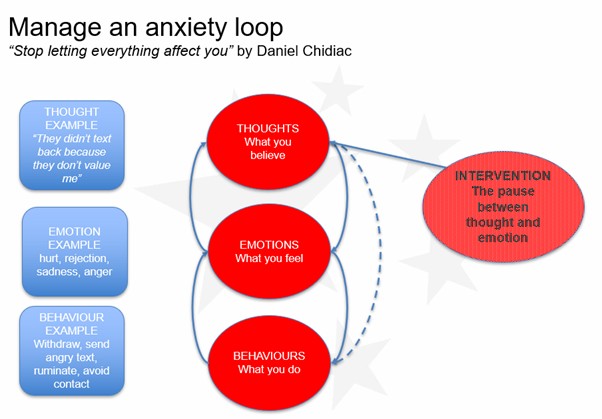
The most ridiculously effective way that can beat overthinking, anxiety and self-sabotage is to say thank you to your anxiety. While smiling. This shifts your relationship and loosens its grip without fighting it. (This is a similar theme to that in Book review: The Gift of Anxiety – Harnessing the EASE method)
Research from UC Berkely found that gratitude practices actively counteract negative emotions by triggering positive neural circuitry. The author notes that saying “thank you” during difficult moments lessens the power of others over him. He talks about the paradox that by embracing what troubles us, we diminish its power.
“What you resist persists” Carl Jung
Part 2 – You’re letting life control you
The illusion of control
The reason small things stress you out is because they break the illusion of control. Life didn’t go the way you expected, and that makes you feel out of control. This is about perceived control. Studies show that people who feel a greater sense of control over their lives, experience lower stress levels, better emotional regulation (Emotional Regulation – A key element of Emotional Intelligence (EQ)) and even improved physical health.
Even small feelings of control can make a big difference in how we handle stress. This links to Julian Roter’s concept of Locus of Control – people with an internal locus of control believe their actions shape their lives – they experience less stress. Those with external locus of control feel life is dictated by external forces.
The connection between control, rejection and the desire to “win”
Wanting to control the narratives in our mind is deeply connected to social rejection – which activates the same neural pathways as physical pain (see leadership conversation skills: SCARF model of neuroscience). The brain perceives rejection as a threat to survival. The brain despises feeling powerless, so when something is out of your hands, your instinct is to try to gain some control – by overanalysing, obsessing or engage in self-blame.
The overthinking extends into the need to prove oneself – the desire to win in some way after experiencing rejection or uncertainty. But the feeling of needing to win is temporary and keeps you emotionally tied to the rejection – it doesn’t heal the wound, because the real issue isn’t about winning, it’s about feeling enough without external validation.
When rejection makes someone feel powerless, their mind tries to regain control which can lead to – obsessing over proving your worth, needing to win against them and revenge motivation. The author explores rejection in dating too.
So he advises that you stop taking it so personal – when someone mistreats you or leaves you, it’s a reflection of them. They operate from their own unresolved issue and patterns. What people have experienced in life shapes not just what they consciously want, but what they unconsciously believe they need.
Our brains are wired to seek control, avoid rejection and chase validation. You need evidence-based approaches to help you break free from the trap of emotional reactivity and self-doubt.
Solutions to needing control and validation
Reframe control – from external to internal. Neuroscience reveals that perceived control activates the prefrontal cortex, reducing activity in the amygdala (your brain’s alarm system).
Create a control inventory. Take a sheet of paper and draw a line down the middle. On the left, list everything that causes you stress. On the right, identify one aspect of each situation that you can directly influence. This isn’t about positive thinking. It’s redirecting your brain’s resources towards actionable areas and reducing the cognitive load. Even when overwhelmed, pause and ask “What’s one thing I can control right now?”
Break the rejection-control cycle. Research by Eisenberger revealed that social rejection activates the same neural pathways as physical pain (see leadership conversation skills: SCARF model of neuroscience). The key is to regulate your threat response before it hijacks your thinking. So try the emotional circuit breaker:
- Take a deep breath and acknowledge what’s happening
- Ground yourself in the present moment (see Grounding tools (support for emotional regulation) – Kim Tasso)
- Ask yourself “What do I truly need right now?” – this gives the rational part of your brain time to come back online before you react. Dr Jill Bolte Taylor’s research (2009) on neuroanatomy of emotional reactions demonstrates that emotional reactions require a reset period before rational thinking can resume (see Confidence – Radiators and Drains and the 90 second rule)
Psychologically, you need to break the pattern of seeking external validation to feel worthy. This means developing “unconditional self-regard” (see Unconditional Positive Regard here A general law of interpersonal relationships?)
An effective way to do this is through Values Alignment Practice: Identify 3-5 core values that matter deeply to you – so that you can ask yourself “What would someone who truly lives by these values do right now?”
Replace the need to win. The urge to win is actually about regaining a sense of power. Address this need through “approach goals” rather than “avoidance goals” using the redirection protocol:
- Acknowledge the desire for validation or vindication without judgement
- Ask yourself “What meaningful goal would give me a genuine sense of agency?”
- Take one small action toward that goal immediately
Research by Elliot and Thrash (2002) has shown that approach-oriented goals lead to greater psychologically well-being, sustained motivation and reduced rumination.
“True victory isn’t about proving yourself to others or gaining external validation – it’s about living consciously by your own standards regardless of others’ perceptions”
The power of reflection – recognising your strengths
Things might not be perfect – but you got through it, didn’t you? Acknowledge your strengths, resilience and moments of unexpected grace.
“You’re stronger than you give yourself credit for. You are worth more than you believe sometimes”
“Sometimes the things that break your heart, fix your vision”
Part 3 – The weight you carry – boundaries and detachment
The hidden cost of carrying everyone’s weight
We rarely realise how much we are carrying. Being there for others feels like a choice. But what began as a choice transforms into an obligation. You weren’t meant to be an emotional dumping ground for everyone around you. Pushing down your own emotions means that every time you set yourself on fire to keep others warm. This isn’t kindness – it’s self-abandonment.
Trauma researcher Charles Figley recognised the trend and called it “compassion fatigue” which mirrors clinical burnout in people who constantly take on others’ emotional burdens. “Stay away from people who act like a victim in the problem they’ve created”.
You can get caught in one-sided relationships and the cycle of false hope. You think that if you give more time, more effort and more understanding things will change. But they don’t. You have to admit that some people only keep you around because you make their life easier, not because they value you.
Prochaska and DiClemente studied thousands of people trying to make difficult personal changes. And found that it only happens when someone has developed their own internal motivation – never because someone else wants them to change. (The model is not shown in the book:
The Six Stages of Change
- Precontemplation (“Not Ready”): Individuals do not intend to take action in the foreseeable future, often unaware that their behaviour is problematic
- Contemplation (“Getting Ready”): People recognize their behaviour is problematic and begin looking at the pros and cons of changing, but have not yet committed
- Preparation (“Ready”): Individuals intend to take action in the immediate future (usually within the next month) and start taking small steps toward change
- Action (“Doing”): People make overt, specific modifications to their lifestyle and actively modify their problem behaviour, typically for less than 6 months
- Maintenance (“Keeping It Going”): Individuals have sustained their new behaviour for over 6 months and are working to prevent relapse
- Relapse (“Slip”): A return to previous behaviours, commonly included as a normal part of the process, which often leads to re-entering earlier stages
You might be emotionally invested in the version of them that exists in your mind. The real version of them, the one who refuses to change, is the one wo keeps hurting you.
There’s a cost to your health – carrying all the weight wears you down. Your body doesn’t distinguish between your pain and the pain you absorb from others – it responds with the same cascades of stress hormones either way.
Chronic emotional caretaking is linked to increased risk of anxiety, depression, sleep disturbances, anger and even physical health issues. Your body keeps the score of the emotional labour you’re doing, even when you mind tries to push through. It isn’t sustainable. (see Book reviews on stress and trauma – “When the body says No”)
It’s not selfish to prioritise your wellbeing. Real compassion must include compassion for yourself – you can’t effectively care for others when you’re depleted.
The power of guilt and the struggle to set boundaries
The sunk cost fallacy is a psychological tendency (cognitive bias) to keep investing in something simply because you’re already put so much time, energy and emotion into it.
No one tells you how much guilt comes with growth. It comes from the idea that you owe people the version of you they once knew.
Invisible boundaries enable disappointment. People don’t automatically know how to treat you. You have to show people how to treat you. And override your conditioning that makes you believe that keeping the peace is more important than protecting your own well-being. People will only respect the boundaries you enforce (see Healthy boundaries at home and at work – how to set and maintain).
The trap of over-explaining and letting go
You may have a compulsion to over-explain your decisions and justify your growth. The power of silence isn’t about cutting people off – it’s about reclaiming your peace.
Letting go of people is hard. But letting go of yourself – the self you’ve known for so long – that’s something else entirely. Because the old version of you protected you. Growth feels like loss before it feels like freedom (there is great advice on this in Your personal transition – Endings, neutral zone and new beginnings)
Solutions – Boundaries and detachment
Research shows that many over-givers were once children who learned that their worth was tied to how well they could attend to others’ needs (Miller, 1981). (see “Adult children of emotionally immature parents – how to heal)
Conduct an energy exchange audit where you track for a week every significant interaction and note:
- How you felt before the interaction
- What emotional weight you absorbed during the interaction and
- How you felt afterwards (a similar idea is radiators and drains – Confidence – Radiators and Drains and the 90 second rule)
Then implement “compassionate detachment” – the ability to care deeply without absorbing others’ emotional state.
He offers the compassionate container technique – where you imagine and visualise other peoples’ emotions as water – and rather than absorbing it you see it clearly, honour its presence and offer genuine care – but let it remain in its own container – separate from your own emotional state. Neuroscience research confirms that this kind of mindful compassion activates different neural networks than emotional contagion.
Set boundaries without guilt. When you feel guilt, it is your brain experiencing withdrawal from its habitual pattens. Break the discomfort cycle by implementing the boundary reinforcement system:
- Prepare boundaries in advance (time, physical, emotional, mental etc)
- Focus on clearly communicating your boundaries (see Healthy boundaries at home and at work – how to set and maintain)
When guilt inevitably arises implement guided guilt release (guidance included) – this is particularly helpful for people-pleasers.
To break free from one-sided relationships, the author suggests a reciprocity reset. Implement a temporary (7 – 14 days) giving fast. To create space to see the relationship’s true nature. During this time journal what you observe. Then make a conscious decision about each relationship:
- Renegotiate those that are worth preserving
- Accept others with clear limits
- Release those that you no longer need
It’s challenging to then navigate the emptiness that comes when you stop filling your life with other people’s needs, drama and emotions. Psychologist Carl Jung called this the “creative void” – the necessary emptiness that precedes genuine transformation (it’s also similar to the no man’s land in Your personal transition – Endings, neutral zone and new beginnings). For this, the author offers the void navigation protocol. Research in neuroscience shows that novel situations activate the brain’s threat-detection system, triggering anxiety even when no actual danger exists. “This emptiness isn’t harmful – it’s unfamiliar. My brain is registering the unfamiliar as threatening but I am safe”.
Then implement self-connection practices. When your identity has been built around others’ needs, connecting with your own needs becomes a skill to develop. Research on transition psychology indicates that premature closure – filling the void before genuine transformation occurs – often leads to repeating old patterns in new contexts,
The liberation of letting go is the final step and feels counterintuitive. Release the need for others to understand your journey. He offers a minimal explanation policy. This honours both your need for authentic expression and your right to privacy.
These practices aren’t separate techniques but interconnected elements of a new way of being. It’s not selfish or cold – but creates a life where giving comes from choice rather than compulsion.
Part 4 – The breaking point – recognition and realization
Hidden manipulation means recognising when others make you the problem. There’s material here about dealing with Narcissists – people who gaslight you. Psychological manipulation makes you second guess your thoughts, emotions, and even memory of events. Gaslighting makes you question and doubt yourself. One of the biggest red flags of gaslighting is when someone refuses to acknowledge your feelings.
Often, the perpetrators pretend to be victims – they will hurt you and then act like you hurt them. Why do they do this?
- To avoid accountability
- To control the narrative
- Because they genuinely believe their own lies
- To manipulate your emotions – the moment you doubt yourself, you give them back their power
- Because it’s always worked before
They’ve learned that if they act like victims, people will side with them. These behaviours are called ‘psychological projections” – defence mechanisms identified by Sigmund Freud and further developed by researchers like George E Vaillant (1992).
When someone projects their own negative behaviours onto you, they’re unconsciously transferring unacceptable feelings or actions to protect their self-image. By casting themselves as victims, they resolve the cognitive dissonance between their actions and their desired self-image as good people. (see Business relationships – Using the drama triangle to resolve conflict)
To recognise manipulation and reclaim your reality it is important to remember that your feelings are real. Note your doubts, document the reality-distortion, watch for when defending your perspective becomes your full-time job. Finally, recognise that clarity often comes only with distance.
The last time they’ll make you feel this way: Knowing when to walk away There comes a moment when you just know (a quiet realisation) that you can’t do it anymore. You’re just tired. And that’s when it hits you – this is the last time. The truth is that the right people won’t need convincing to treat you well.
True closure isn’t about getting an apology or an explanation – it’s about making peace with the fact that you may never get one, Closure is a choice. Walking away is a powerful decision. And you may feel grief.
The grief of growth – Mourning relationships left behind. No one tells you about the profound sadness that comes with outgrowing relationships. It’s a special kind of sorrow from consciously choosing to walk away from connections that once felt like home. The truth is that as you evolve, some connections don’t evolve with you. Transformation is not betrayal. You can honour people while still releasing your grip on relationships that have completed their purpose. You don’t need closure form others. You don’t need permission to grow.
The emergence of your authentic self. Transformation is about the beautiful unfolding of your true nature. Like when a butterfly emerges (scientists call this the imaginal stage) and total reorganisation happens. This is your time. What’s new is your willingness to let yourself be seen. Your tendency to overthink is replaced by quiet confidence in your instincts. Moving forward authentically means knowing your worth without needing external validation. You are not someone who needs to be fixed. Step forward not as a new person, but as the real you who has been waiting all along to be expressed.
The empty space: death and rebirth of identify. There are deeper challenges of the empty space where your old identify dissolves. Face the void. After walking away from a toxic relationship, you reach a clearing. At first you feel relief. Then discomfort – a deep confusion that few people talk about. You see how much of your identify was built around adaptations, defences and habits. Many of those old patterns were numbing – so who are you without those old patterns? The resistance is a sign that you are getting close to a breakthrough.
This phase often looks invisible to others and feels hard to explain even to yourself. You shift from being your thoughts to watching your thoughts happen. The old self wasn’t a mistake – it was a necessary shell that protected you until now. What you feared losing was never actually who you were.
The greatest freedom comes your release from the belief that you need to become anything at all to be worthy of existence.
Solutions when moving on
At this point your awareness crystalises into action. Now you need to rebuild trust in your own perception.
To reclaim your perception use the reality perseveration protocol. Create an objective record (a private journal) to share your experience with a trusted outsider – and use key questions to recognise manipulation in real time.
When you notice them use the Cognitive protection response which is beyond “one more chance”
The most difficult part isn’t deciding to leave but actually leaving. You need to understand others’ “extinction burst” – a temporary intensification of behaviour to keep you attached. Use the Clean break protocol – crystallise your decision that this is the point of no return. Then create a departure plan and embrace the communication minimalism principle. So you return to the disorienting space between who you were and who you’re becoming.
For navigating identity transition there’s the identity bridge framework – then use transitional anchors. Research on major life transitions shows that maintaining certain constraints during periods of change significantly reduces associated psychology distress. The author suggests practising emergent identify cultivation – to actively nurture the self that’s being born.
To have courage in uncharted territory use Uncertainty Embrace practice. Each day do one thing for which you have no script. When doubt arises implement the Soul Compass check:
- Place your hand on your heart or solar plexus
- Ask yourself “Does this choice create expansion or contraction in my being?”
- Notice the physical sensation that arises
- Trust the body’s wisdom over intellectual justifications
This taps into what neuroscientists call interoception – your brain’s perception of your body’s internal state. Research increasingly shows this plays a crucial role in intuitive decision-making. Reinforce your courage daily with freedom affirmations.
Part 5 – Beyond the surface – the different ideas that are just as important
The author reassures you that “You can do it”.
He suggests you try to notice how many times you have actually progressed without realising it. Movement creates new energy. New spaces create a new possibility.
Growth doesn’t come from waiting for the perfect moment – it comes from deciding that where you are is no longer an option.
The ego’s silent trickery – how your mind keeps you small. Your ego is quieter than you think – it stops you sharing your thoughts because you’re afraid people will disagree. But the ego’s goal is to make you happy – it’s to keep you safe. You don’t gain confidence by playing it safe – you gain confidence by proving to yourself that you can handle whatever comes your way.
Part 6 – Ways to freedom
A common teaching is that forgiveness is essential for healing. But you need a clear-eyed acceptance of what happened and a commitment to your own well being. So prioritise restoration rather than reconciliation.
True forgiveness, when it arises naturally from within, holds tremendous power and I guess is the pinnacle we’d all like to get to one day, for every situation.
Beyond happiness, you find inner peace. The modern myth of happiness has set us up for profound disappointment. Happiness, by its very nature, is fleeting. We’re always in a process of learning – and that process rarely follows a straight line. When you make a small mistake, feel it fully for a moment, then allow yourself to move on by accepting it. The years spent in poor relationships – they weren’t wasted time.
Aim for a state of being that doesn’t depend on everything going right, but on your ability to comprehend and accept life even when things go wrong. Allow yourself to be fully human.
So rather than ask “How can I be happy?” ask “How can I understand and accept what is?”
Part 7 – The light
The author urges us to find the light in life’s journey. Often we wake up feeling heavy. Do your best never to leave the house feeling that heaviness. Whisper the words “Thank you, for another day of life”.
Appreciate fundamental changes in who you are and how you interact with the world. We have enough time – despite the constant rushing. He reminds us that Mandela was 71 years old when released from prison and at 75 he became president of South Africa. You need a quiet certainty that you are exactly where you’re meant to be.
He ends by encouraging us to go and live – and signs off with “Love and Light”
Related articles on mental health and therapy topics
My therapy web site is: Tasso Talking Therapy (Please don’t hesitate to telephone or email for an informal and confidential chat about your mental health)
Articles on mental health and therapy
Grounding tools (support for emotional regulation) – Kim Tasso April 2026
Healthy boundaries at home and at work – how to set and maintain January 2026
Confidence – Radiators and Drains and the 90 second rule January 2026
The stress bucket, healthy coping mechanisms and resilience December 2025
What do I do if I’m feeling stuck? – Kim Tasso October 2025
Improve mental health at work, in marketing and for women September 2025
Assertiveness toolbox – Kim Tasso May 2025
What happens in therapy? – Kim Tasso April 2025
Confidence to overcome a fear of failure – Kim Tasso September 2024
my relationships like rollercoaster rides? Volatile relationships (kimtasso.com) August 2024
How do you choose a therapist? – Kim Tasso July 2024
Emotional Regulation – A key element of Emotional Intelligence (EQ) (kimtasso.com) August 2021
Psychology and business communication (kimtasso.com) January 2015 An introduction to Transactional Analysis (TA) and the Parent Adult Child model
10 tips to increase your resilience – Kim Tasso March 2013
Therapy and counselling self-help book reviews
Book Review – ADHD 2.0 by Edward M Hallowell MD March 2026
Book review: The Gift of Anxiety – Harnessing the EASE method December 2025
What happened to you? Conversations on trauma, resilience November 2025. Book review: What happened to you? Conversations on trauma, resilience and healing by Bruce D Perry (psychiatrist) and Oprah Winfrey
Introduction to Internal Family Systems (IFS) October 2025. An overview of the therapeutic approach IFS that seeks to explore your internal parts – the exiles, managers and firefighters – and develop a greater sense of self and calm.
Attached by Dr Amir Levine and Rachel Heller August 2025. How attachment theory can help you understand your relationship style – secure, avoidant and anxious.
Book review – Feel the fear and do it anyway by Susan Jeffers June 2024. Classic self-help book on managing anxiety
Book review – Counselling for toads May 2025. The modern classic explaining Transactional Analysis (TA) using a story by Robert de Board using Toad and other characters from “Wind in the Willows”
Book Review: The Power of Now by Eckhart Tolle March 2025 A best-selling guide to ceasing your incessant thoughts, focusing on the present “here and now”, spiritual enlightenment and finding inner peace.
Overcoming low self-esteem – a self help guide using cognitive behavioural techniques by Melanie Fennell January 2025
Book review: Taking charge of Adult ADHD by Russell A Barkley (kimtasso.com) October 2024
“Adult children of emotionally immature parents – how to heal (kimtasso.com) August 2024 An excellent book that has helped several clients suffering from anxiety, depression and “failed” relationships. How to recognise emotional, driven, passive and rejecting parenting styles and the coping mechanisms adopted (e.g. people pleasing, high independence etc).
Book reviews on stress and trauma – “When the body says No” (kimtasso.com) June 2024 Review of “When the body says no – The cost of hidden stress” by Gabor Mate and “The body keeps the score – mind, brain and body in the transformation of trauma” by Dr Bessel Van Der Kolk
Book review: The Thriving Lawyer by Traci Cipriano (resilience) (kimtasso.com) June 2024 A review of a book into the mental health and resilience of lawyers in law firm cultures. The author is a former practising attorney and clinical psychologist.
The Tools – Five life-changing techniques to unlock your potential (kimtasso.com) April 2024 A review of the book by psychiatrist Phil Stutz
Book review – Creating self-esteem by Lynda Field (kimtasso.com) March 2024 A classic book on realizing your true self worth
Book review: How to do the work (recognise your patterns (kimtasso.com) December 2023. Review of a book to support psychoeducation. Topics include: conscious self, theory of trauma, mind-body healing practices, inner child, boundaries, reparenting and emotional maturity.
Dr Julie Smith (Mental Health Guidance) (kimtasso.com) July 2023. Review of the book “Why has nobody told me this before?” that explores helpful ideas on low mood and depression, motivation, anxiety, emotional pain, grief, self-doubt, fear, stress and a meaningful life.
Overcoming clinical depression (2021) by Oliver Kamm (kimtasso.com) March 2023. A review of the book “Mending the Mind” which explores what it is like to suffer from depression and both the medical and psychological sources of help.
Lost connections – Why you’re depressed by Johann Hari (kimtasso.com) October 2019. A review of a popular book about the nine common reasons people suffer from depression.
Crazy busy – Book review – Dealing with stress (kimtasso.com) October 2009. This book examines modern life and offers practical advice to avoid stress and restore calm.
Book review: The psychology of successful women by Shona Rowan (kimtasso.com) June 2022. Topics include: confidence, assertiveness, boundaries, public speaking, impact, influence, visibility and bouncing back from setbacks.
Your personal transition – Endings, neutral zone and new beginnings (kimtasso.com) June 2020. Helps you navigate major changes in your life and prepares you for the emotional roller-coaster of change.
Short videos on therapy and mental health topics
Soft skills – Boost your self-confidence and confidence (Video) (kimtasso.com) October 2020
Business relationships – Using the drama triangle to resolve conflict (kimtasso.com) September 2020
How the parent, adult, child (PAC) model helps with difficult interactions (kimtasso.com) September 2020
Change process – Emotions when reacting to change (kimtasso.com) April 2020
Building Resilience – Regulation, Reframing, Relationships and Reflection (kimtasso.com) May 2020