
At the recent MBL session on “Boost Your Confidence at Work – A toolbox for professionals” we explored confidence in the workplace. Both what affects how we feel inside (self-confidence) and what we convey to others (confidence). We explored numerous tools to help us feel more confident internally and externally. A couple of ideas really resonated with delegates: Confidence – Radiators and Drains and the 90 second rule for emotional control.
Our delegates were wonderfully diverse. From trainee solicitors and safety advisers, to finance professionals and senior managers and heads of teams. They worked in areas such as private client, consumer contracts, commercial property and environment. And represented law, accountancy, engineering and not-for-profit organisations. From across the UK – London, Somerset and Manchester to name a few. Their takeaways and poll results are shown below.
Radiators and Drains – Emotional contagion
As human beings, we are all subject to emotional contagion. We pick up on the emotions and energy of others (Emotional contagion, delegation, coaching and team meetings). This can affect both our confidence and motivation.
So be mindful of the energy of those around us. Are they lifting us up and bolstering our mood and confidence? Or are they deflating our energy and enthusiasm and bringing us down?
We talked about people who tend to be radiators – who generate warmth, encouragement and positive energy. And of people who are drains – who bring the mood down with negative energy. Drains “sap” us, they reduce our energy, strength, confidence or vitality.
Negativity breeds negativity. This can of course sometimes be fun or a release if you’re bonding over a shared poor experience. However, it can put a damper on other interactions.
We also need to recognise whether we are being radiators or drains. Do people associate us with positive or negative energy? This can impact as whether we are perceived as confident (secure and sure of ourselves) or unconfident (shy, insecure or victims at the mercy of others). It may impact our personal brand. Of course, we all experience different situations at work and at home that impact our moods throughout each day. No one can be a non-stop radiator.
It’s important to be authentic and to convey how we genuinely feel. And not to mask what we are really feeling and thinking. But be mindful of what we might be inadvertently communicating to others.
Naturally, there’s a link between radiators (optimism) and drains (pessimism). Gabriele Oettingen developed a strategy for mental contrasting called WOOP (Wish, Outcome, Obstacle, Plan). She found that those that combine a positive view of the future with an understanding of the obstacles and barriers are most successful (Soft skills: Introduction to coaching – Three frameworks).
More information on radiators and drains:
- Do You Radiate or Drain? How many drains are in your life? | Changing People Changing People
- Are you surrounded by ‘Radiators’ or ‘Drains’? – Unleash Your Potential
- Is Your World Filled With People Who Are “Radiators” or “Drains”? | Psychology Today United Kingdom
The 90 second rule for emotional control
Being aware of our mood (radiator or drain) is one challenge. Better self-regulation of our emotions and moods is another. Self-awareness and self-regulation are two core components of emotional intelligence (EQ or EI – An introduction to emotional intelligence (EQ) and empathy (Video)). As a psychotherapist, I spend a lot of time explaining emotions and helping my clients achieve better emotional control. Sometimes, our childhoods haven’t provided the necessary support to develop our emotional regulation.
Simply put, emotions are when something external or internal creates a physiological response. For example, in a threat scenario we experience the fight, flight, freeze or fawn response. And subsequently feel an emotion likely to be interpreted as anxiety or fear. But emotions don’t last long – and often come in waves.
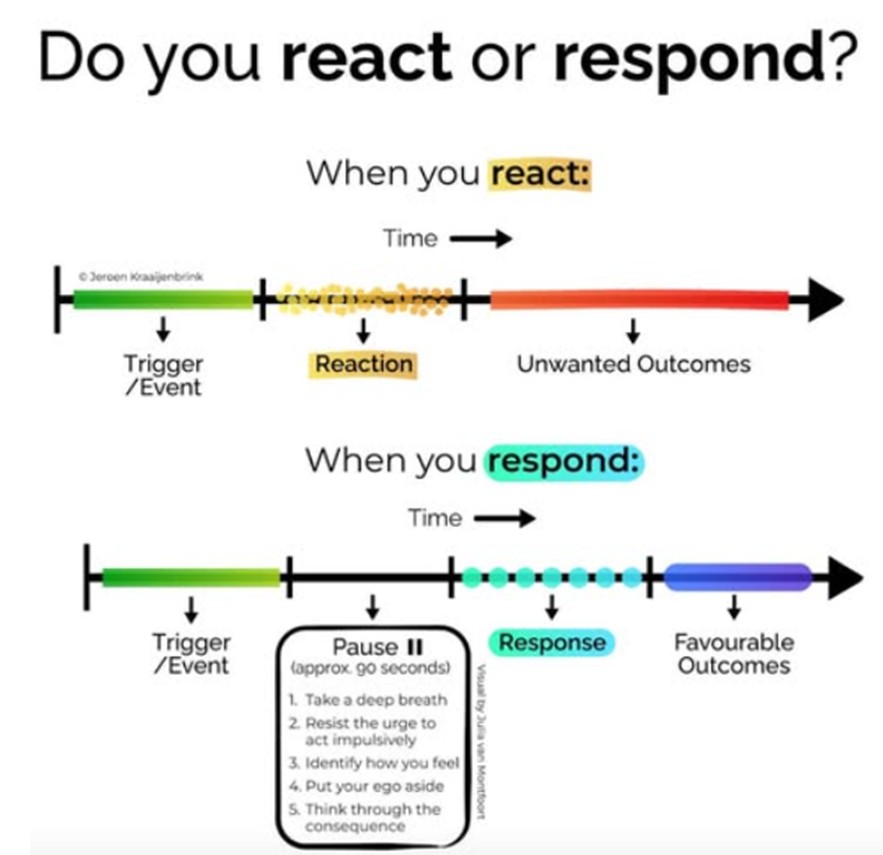
When we react to a situation or emotion, we make a choice (an unconscious choice perhaps) or a neurological choice – but a choice nonetheless.
Rather than REACT immediately to an emotion we can wait 90 seconds and then choose how we RESPOND.
Brain scientist Jill Bolte Taylor (author of “My Stroke Of Insight”), describes our ability to regulate neurological processes as the 90-second rule: “When a person has a reaction to something in their environment, there’s a 90-second chemical process that happens; any remaining emotional response is just the person choosing to stay in that emotional loop.”
Bolte Taylor suggests how to ride the emotional wave:
- Observe and experience emotions without getting attached (the 90 second rule)
- Shift your focus with a sensory anchor (i.e. use a grounding technique – we looked at several of these during the session including breathing exercises)
- Ask “What thought is keeping this alive?” (a simple process to notice, then question or challenge and then reframe it)
We can be more mindful. We can focus on the present moment (in the “here and now” – see Book Review: The Power of Now by Eckhart Tolle). We can steer ourselves. to being a radiator rather than hounded into a drain mood
Further information on the 90 second rule:
- The 90-Second Rule That Builds Self-Control | Psychology Today United Kingdom
- A Psychologist Shares The ‘90-Second Rule’ To Survive Emotional Waves
- 3 Ways To Use The ’90 Second Rule’ For Emotional Regulation
N.B. Practice makes (nearly) perfect
No one is perfect!
Adopting new ways of feeling, thinking and behaving takes time and effort. It’s a learning process. We are changing long held ways of thinking, feeling and behaving. Change is hard. And takes practice., We need to be kind to ourselves.
And the same applies as we try to develop more internal and external confidence.
One delegate reflected that when she started running she could barely make it to the end of the road. After lots of training and practice, she now runs marathons. We reflected that practice makes (nearly) perfect.
Delegate key takeaways
- Internal (self-confidence)
- Avoid being misled by cognitive distortions
- Consider the Dunning Kruger effect peak of mount stupid – climb out of the valley of despair! Dunning-Kruger Effect | Psychology Today United Kingdom
- Use positive affirmations and memories of good situation (to avoid panic)
- Reflect on why I feel a certain way
- Manage my inner critic
- Reflect on whether I and others are radiators or drains
- Use breathing exercises to relax (especially when problem-solving)
- Reflect on how I’m feeling in the moment
- Think about non-verbal communication and body language
- External (confidence)
- Think about my non-verbal communication
- Use body language to show confidence
- Remember confidence is not just in person but also by way of email/text
- Ask (incisive) questions
Delegate poll results
Confidence levels
| At the start of session? | How would you like to feel at work? | At the end of the session? | |
| 1 | |||
| 2 | 14% | ||
| 3 | |||
| 4 | 7% | 7% | |
| 5 | 21% | ||
| 6 | 7% | 7% | |
| 7 | 50% | 21% | |
| 8 | 20% | 57% | |
| 9 | 7% | 33% | 7% |
| 10 | 40% |
How often do you experience Imposter Syndrome?
- 67% Occasionally
- 13% Often
- 20% All the time
Which is the situation where you most lack confidence?
- 58% Presentations/public speaking
- 58% Conflict situations
- 8% Social/conversations Book review: “Now we’re talking” by Sarah Rozenthuler
- 8% Telephone calls
- 8% Actual or virtual meetings
- 8% Day-to-day role within the team
- 0% Learning new things
Do you avoid things that make you feel nervous?
- 83% Sometimes
- 17% Always
(I mentioned that you should not avoid the things that make you nervous. As this will usually increase your anxiety about it and make you feel more nervous Book review – Feel the fear and do it anyway by Susan Jeffers and Book review: The Gift of Anxiety – Harnessing the EASE method)
Are you mostly:
- 43% An optimist
- 57% A pessimist
How resilient do you think you are? Improve your resilience – tools to help you cope in difficult times (kimtasso.com)
- 14% Low
- 64% Average
- 21% High
What impact do you think clothes have on how confident you appear? (1=low, 10=high)
- 1
- 2
- 3
- 4
- 5
- 6 7%
- 7 27%
- 8 47%
- 9 20%
- 10
Where does most of your personal power come from? How do you make a personal impact – Make a difference (kimtasso.com)
- 33% Presence
- 25% Authority
- 42% Impact
Do you think you are: Assertiveness skills – getting what you want and saying “No” (kimtasso.com) and Assertiveness toolbox – Kim Tasso
- 33% Assertive
- 67% Passive
- 0% Passive-Aggressive
- 0% Aggressive
I think my boundaries are:
- 62% Porous
- 38% Healthy
- 0% Rigid
Thanks to the delegates for this feedback
“Kim is great, really enjoyed the course. Any more courses on developing professional skills like this would be great!”
“Very good speaker”
“Thank you so much Kim, this has been great”
“The session was really good – Thanks for an interesting and brilliant session”
“The content was great – there was a high emphasis on participation. Lots of really good stuff to takeaway.”
Related posts on confidence, assertiveness and mental health
Book review: The Gift of Anxiety – Harnessing the EASE method December 2025
The stress bucket, healthy coping mechanisms and resilience December 2025
Improve mental health at work, in marketing and for women September 2025
Building the confidence of young professionals – Four tools July 2025
Book review – Feel the fear and do it anyway by Susan Jeffers June 2025
Assertiveness toolbox – Kim Tasso May 2025
Towards leadership – Elevate your Presence, Influence and Impact April 2025
Overcoming low self-esteem – a self help guide using cognitive January 2025
Be more confident – Slow down – Kim Tasso January 2025
Book review: “Now we’re talking” by Sarah Rozenthuler January 2025
Confidence to overcome a fear of failure – Kim Tasso September 2024
Confidence – How to get a word in when people keep talking (kimtasso.com) July 2024
fixed views and closed to new ideas (dealing with stubbornness) (kimtasso.com) July 2024
we’re all in the same (stressed) boat (kimtasso.com) May 2024
How to create and promote your personal brand – Kim Tasso May 2024
Book review – Creating self-esteem by Lynda Field (kimtasso.com) March 2024
What do you do when your boss is a micro-managing control freak? (kimtasso.com) March 2024
Questions on confidence at work (kimtasso.com) January 2024
Book review: How to do the work (recognise your patterns (kimtasso.com) December 2023
The patterns of NLP applied to business interactions by Daryll Scott (kimtasso.com) December 2023
How to start conversations that get results (kimtasso.com) September 2023
Marketing and Business Development (M&BD) Assistants can shine (kimtasso.com) September 2023
Dr Julie Smith (Mental Health Guidance) (kimtasso.com) July 2023
Boosting Your Confidence at Work – A Toolbox for Success (kimtasso.com) July 2023
Assertive communication: The importance of voice (kimtasso.com) May 2023
Conversation skills book review (kimtasso.com) May 2023
Soft skills – Boost your self-confidence and confidence (Video) (kimtasso.com) October 2022
Telephone skills: Anxiety, voice, etiquette and the client experience (kimtasso.com) September 2022
Book review – Great networking by Alisa Grafton (kimtasso.com) July 2022
Book review: The psychology of successful women by Shona Rowan (kimtasso.com) June 2022
An introduction to presentation skills – Easy as ABC (Video) (kimtasso.com) March 2022
Non-Verbal Communication (NVC) – the basics (Video) (kimtasso.com) August 2021
Emotional Regulation – A key element of Emotional Intelligence (EQ) (kimtasso.com) August 2021
Book review: Digital Body Language – How to build trust by Erica Dhawan (kimtasso.com) June 2021
Dealing with “difficult” people – Nine strategies for dealing with arrogance (kimtasso.com) June 2021
Building rapport in the digital space (kimtasso.com) Jun2 2021
Improve your resilience – tools to help you cope in difficult times (kimtasso.com) November 2020
Insights into assertiveness, confidence and effectiveness (kimtasso.com) October 2020
Be more visible – the PVI model (kimtasso.com) September 2019
Be more confident and convey confidence – top tips (kimtasso.com) June 2019
assertiveness, impact and effectiveness (kimtasso.com) March 2018
How do you make a personal impact – Make a difference (kimtasso.com) March 2018
Winning pitch presentations – tips for competitive tendering (kimtasso.com) May 2017
Assertiveness skills – getting what you want and saying “No” (kimtasso.com) March 2017
Presentation skills – TED Talks Chris Anderson book review (kimtasso.com) October 2016
Book review – The presentation book by Emma Ledden (kimtasso.com) February 2014
Book review – Persuasive Presentations by Duarte (kimtasso.com) December 2012
11 tips for your first presentation – Kim Tasso June 2010
Crazy busy – Book review – Dealing with stress (kimtasso.com) October 2009