

At the recent MBL workshop on cross-selling and referrer management, we adopted a back-to-basics approach for these strategies. (see Kim Tasso – MBL Seminars for details of future sessions). Delegates from legal, property, construction and financial services firms came together to look at how to initiate or improve their cross-selling and referrer management performance. In this article, we focus on what the delegates felt were the most useful ideas. Don’t try to boil the ocean – Be more focused with Cross-Selling and Referrer Management Strategies
Cross-selling is where we look at internal sources of referrals (our colleagues) whereas referrer management is where we look to external organisations (clients and referrers and introducers) to direct their clients and work opportunities to us.
CASPIM – Take a strategic and structured approach to cross-selling and referrer management
Some delegates were faced with initiating cross-selling and referrer management programmes across multiple offices and service lines. They weren’t sure where to start and felt a little overwhelmed.
Other delegates found that their firms were hives of activity – organising lots of breakfasts, lunches, seminars and joint events – involving a myriad of relationships. But no one was recording data about what they were doing (or why). So they weren’t sure of the aims of this activity and whether it was yielding results.
Some delegates faced a specific challenge – how to get more from their existing referrer relationships or how to cultivate new ones. Others said that the prevailing view in their firm was that each fee-earner regarded their connections as the most important and wanted to maintain control and to continue do their own thing.
To avoid the overwhelm of trying to “boil the ocean”, we talked through the stages of a more strategic and structured approach to focus attention on the relevant programmes and referrers/introducers. We worked through a structured approach – CASPIM
- Collect data
- Analyse, research and diagnose opportunities and issues
- Set goals to bring focus
- Plan strategy and programmes
- Implement and support action
- Monitor
Collect data on cross-selling and referrer management
The first stage is to gather data on what is currently happening.
This is no easy task. And led to some delegates despairing that they were without a functioning CRM or even a CRM at all! CRM – Applications, systems and fee-earner engagement
So start with conversations with the fee-earners on the ground about what they are doing and what they would like to do better. This isn’t a Marketing and Business Development Show – we are the backstage team supporting the fee-earners on the stage! They are the ones out there talking to clients (for cross-selling) and to referrers, introducers and intermediaries (for referrer management). Start with stakeholder engagement so they share with you the challenges they face and what help they would appreciate.
If it’s too challenging to collect data for the whole firm then focus – initially at least – on one office or practice group. Break things into manageable bite-sized pieces.
Analyse, research and diagnose issues and opportunities
We looked at lots of tools to analyse the data and work out where there are issues and opportunities.
Delegates shared ideas on valuable activities in this area including: organising lunch and learn events, conducting client interviews (see client feedback playbook – How professional services firms and turn feedback into strategic advantage (Research)) and interrogating Google reviews.
Part of the audit process considers what we do and don’t know and who we know and don’t know.
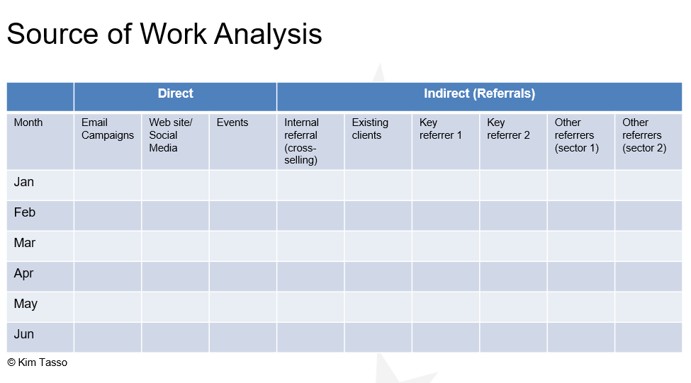
Analyse the source of work
One tool assessed where clients and work originates at present. Most MBD teams will have lots of information about leads and work generated directly – often through digital marketing (e.g. email campaigns, social media, web sites etc). That’s because it’s automatic and we control that data.
It’s harder to track what work comes in indirectly – through cross-selling and referrer management as that relies on what fee-earners enter into financial, case management and other systems.
A source of work analysis helps us appreciate the breadth of referral relationships generating work for the firm.
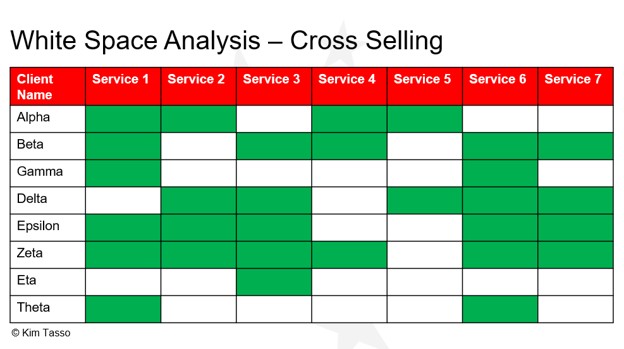
Analyse clients to identify cross-selling opportunities
One delegate talked fondly about the “white space analysis” they produce regularly for their key clients and within particular teams.
Build profiles of key referrers
One delegate commented “A key thing for me is that I can see a first activity plan forming in gathering more data to understand who are key referrers across the business”
Most delegates realised that they didn’t know much about their referrers beyond the firm’s name, its sector and the people where they have relationships. So they considered a deeper dive (more depth) to produce profiles of key referrer relationships e.g:
- About the organisation
- Services and (locations) markets
- Major clients
- About its goals and strategy
- Highlights from the annual review/report (finance)
- Its vision, mission and values
- Core strategies for future growth
- About the relationship between our firms
- Start and source of the relationship
- Who knows who in each organisation
- Gaps in our knowledge and network
- Past collaborations
- Inbound and outbound referrals
In addition to gathering data from systems, it’s often fruitful to organise a short discussion amongst those fee-earners who have relationships with the referring organisation to consolidate knowledge into a fuller picture. Such discussions might allow you to produce a relationship map of the many-to-many relationships that exist within a firm (in the absence of a CRM that automatically produces a heat map).
Once you have a profile of a key referrer, it is easier to spot the gaps in your knowledge (that can be filled through further research or referrer conversations). And also to assess the strengths, weaknesses, opportunities and threats (SWOT) in the relationship. This then prompts ideas into what needs to be included in a plan for short, medium and long term action.
Referrer Management: Improve knowledge of your referrers September 2025
Conduct research into referrer perceptions and preferences
Some firms conduct research into their referrers in order to find out more about how they are perceived. This might lead to a refinement of your messages and broader brand and communications programmes. And may set the agenda for specific referrer meetings. See, for example:
- Travers Smith solicitors Professional services marketing/BD case studies August 2023
- Menzies accountants Case studies: Marketing and Business Development at law (kimtasso.com) November 2023
- LawNet solicitors Case studies: Marketing and Business Development at law (kimtasso.com) November 2023
- Mercer and Hole accountants Case studies: Marketing and Business Development at law (kimtasso.com) November 2023
- Mills and Reeve solicitors Cross-selling and referrer management – Past, present and future September 2025
Set goals
During our conversations with fee-earner stakeholders we should also explore what they are hoping to achieve. What good would look like. And whether these goals are realistic. Remember, this work is about generating the right relationships, nurturing them over time and cultivating a flow of profitable referrals. It doesn’t happen overnight.
We also need goals from the firm-wide perspective, the team perspective and individual fee-earner perspective. Referrer Management Strategies – Planning for the firm, teams (kimtasso.com). Remember the warning above about trying to boil the ocean – setting ambitious firm-wide goals about how much revenue we hope to generate might make us feel good – but are they realistic?
So we may have to experiment with a variety of goals – which will vary depending on whether we are focused on cross-selling for clients or obtaining referrals from external organisations. And assuming we can track the data for both process and results. For example:
- Cross-selling
- Each partner to generate four cross-referrals a month
- Increase the average number of services used by clients (from X to Y)
- Increase adoption of ServiceA by 25 clients
- Encourage 15% more referrals from PracticeA to Practice B
- Increase client lifetime value of top 30 clients by 10%
- External Referrals
- Increase revenue from referrers in SegmentA by 17%
- Increase share of referrals from FirmB from 5% to 10%
- Generate 4 referrals a year (with a minimum value of £x) from FirmA
- Secure 2 major referrals for ServiceA
Plan strategy and programmes
Once we know what we are trying to achieve, it becomes easier to select the programme of activities to craft into campaigns. Depending on goals, some of the delegates suggestions here include:
- Cross-selling
- Develop training programmes for junior, intermediate and senior staff on cross-selling systems and skills
- Prepare an internal communications campaign to raise awareness of propositions from key service teams
- Organise an internal marketing campaign to promote engagement in ServiceB
- Present an internal roadshow explaining three key services
- Update the onboarding system to produce auto-alerts on X, Y and Z services when agreed criteria are met
- Create a multi-divisional SWAT team to focus on cross-selling opportunities within each team
- Referrer management
- Commission a research exercise to learn more about the perceptions of referrers in SectorA
- Reverse engineer our three most successful referrer relationships
- Prepare a team, profile and plan for ReferrerX
- Organise a series of collaborative social media campaigns and events with ReferrerY
- Produce a newsletter and web site portal for ReferrerZ
Implement action
As already mentioned, it may be helpful to do a pilot study with one team, one service or one key referrer. This is easier manage, allows you to learn and refine your ideas. And success stories can be shared to motivate others.
Whilst marketing and business development teams might take the lead in this, they will need input from fee-earners and support from other resources in the firm (e.g. IT, know-how). Typical implementation activities might include:
- Improve internal information and communications (e.g. the intranet)
- Produce content for newsletters and social media posts
- Design and schedule webinars
- Organise internal and external events
- Prepare campaigns targeting particular groups
- Ensure cross-selling or referrer management appears on the agenda at key meetings
- Encourage junior members to create peer level relationships with referrers
- Support the creation of breakfast and lunch programmes
- Guide the activities of teams focused on particular key referrers
- Embed the right behaviours and BD instruments
There are other practical examples here Cross-selling – Practical steps to take (from John Timperley)
We observed the following behaviour and process gaps:
- We don’t know enough about our referrers
- Fee-earners don’t research referrers before meetings
- We rarely plan what we want to find out
- Before a meeting, we don’t plan what we want to say and who we intend to introduce
- There is no process for when we stop investing in a relationship that fails to deliver
- We rarely have a clear view of what happens next after an event or meeting
A lot of the implementation work involves changing the behaviour of fee-earners. This might involve training and coaching programmes.
Monitor
Return to the Goals and Data stages and create reports or dashboards that show – at a glance – what you are achieving against past baselines and new goals. Tailor these reports for senior management, team heads, client and referrer teams and MBD teams.
Some teams will measure new leads, others will monitor the strength and quality of relationships, whether the agreed activity levels are maintained and others the pipeline (propensity and likelihood of new work).
One delegate commented “For our key clients we have key client plans where someone from each practice will be involved with conversations about plans to grow them with dashboards to visibly show what services we are selling, highlighting white space where we can cross-sell”
Promote and share success stories to generate enthusiasm, engagement and motivation.
Focus MBD support on those who are not progressing as well as expected. And capture best practice from those that are succeeding. Refine strategies, sales processes and resources as required.
Delegate views and poll results
Delegates included marketing/BD executives, managers and heads; an operations director and a sector lead.
Delegate aims
- New to legal sector so keen to understand the sector
- Learn best practice for working with referrers
- Find new referrers
- Obtain ideas to implement
- Explore how to track leads and contacts
- Increase conversion of our relationships into productive referrers
- Explore strategies to engage introducers
- Discover how to leverage relationships within a particular sector
Delegate Takeaways
- Importance of data (we suffer from a lack of CRM systems)
- Make more use of CRM to record data on referrals
- Ensure everyone is on board to record information in the CRM
- Develop a robust strategy before jumping into activity
- Find out about our referrers – gather data about them
- Discover who in the firm knows each person at each referrer organisation
- Encourage everyone to talk to their clients about our services
- Telling isn’t selling
- Go back to basics and put them in place
- It takes time to build relationships – it doesn’t happen overnight!
Delegate planned actions
- Gather client data – what we have done for them, their story etc
- Provide more communication, relationship and selling skills training
- Train staff to better understand cross-selling and referral management
- Improve client and referrer knowledge across the firm
- Update job descriptions and KPIs
- Provide staff with knowledge about each department (projects, clients, key elements etc)
- Produce internal campaigns on our new services
- Map all of our introducer connections
- Identify new referral partners in the local area
- Develop staff habits to connect on social media and nurture relationships
- Allocate responsibility to team members for each key referrer
- Agree a strategy to deepen our understanding of our introducers
- Develop an engagement plan that will strengthen relationships with referrers
One delegate commented: “Today has given us clear ideas on things we could implement into our business to gather key information, such as a client survey, staff training on LinkedIn and internal communication of our services including key jobs, clients and the teams”
Delegate poll results
Your role
- 20% Delivering services to clients (fee-earning)
- 80% Marketing, business development and selling
Your sector
- 40% Legal
- 40% Property/surveying/architecture/construction
- 20% Financial services/pensions
Which topic is of most interest?
- 40% Working with external referrers
- 40% Cross-selling to existing clients
- 20% Sales processes
- 0% Key Account Management (KAM)
- 0% Strategy and planning
- 0% Psychology of selling
Approach to selling/business development mostly:
- 40% Cast the net wide – connect with lots of people
- 60% Targeted – aimed at specific organisations and individuals
Amount of work generated by internal and external referrals?
- 20% Less than 20%
- 60% 20% – 50% of our work
- 0% 50% – 80% of our work
- 20% Over 80% of our work
- 0% Don’t know
Main focus for a referrer management strategy
- 40% The firm
- 60% A particular team
Our systems and information for referral management are:
- 20% Average
- 40% Inadequate
- 40% Non-existent
Three main reasons cross-selling doesn’t work well:
- 100% Everyone too busy/no time
- 80% No incentive
- 40% We are in silos
- 40% Lack of information about other services
- 20% Client resistance
- 0% Lack of trust between departments
Issues when referrers refer clients:
- Referrers don’t appreciate the range of services we provide
- Where referrers misunderstand our proposition
- They don’t appreciate our sector focus
- Referring work we don’t do
- Not understanding what the client actually wants
Digital activities most effective for building relationships with referrers?
- 40% Zoom/Teams meetings
- 40% Online collaborative/joint marketing
- 20% Webinars
Use of social media in referrer relationship management?
- 100% Researching individuals and organisations
- 100% Sharing our content
- 80% Connecting after meeting
- 80% Liking and sharing their content
- 80% Sharing joint content
- 40% Monitoring/listening to their accounts
- 20% Collaborative social media campaigns
- 0% Endorsements and recommendations
How do you feel about selling?
- 33% Uncomfortable
- 33% Neither uncomfortable or comfortable
- 33% Comfortable
How much time do you spend selling?
- 67% 0-10% of my time
- 33% 10-40% of my time
How well do you understand the psychology of business relationships?
- 25% Not at all well
- 75% OK
What is your personality type? Adapting to dog, cat and bear personalities – Better business relationships (kimtasso.com)
- 75% Dog
- 25% Cat
Do you have a Key Account Management (KAM) programme at your firm? Key Account Management (KAM) programme (kimtasso.com)
- 100% No
Related articles on cross-selling and referrer management
Referrer Management: Improve knowledge of your referrers September 2025
Cross-selling and referrer management – Past, present and future September 2025 (This provides an overview and summary of most of the earlier articles)
Cross-selling and referrals – Listen, Focus and Proximity March 2025
Referrer management: Diagnosis, Aims, Strategies and Action November 2024
Referrer Management Strategies – Planning for the firm, teams August 2024
Cross-selling and referrer management – Data, focus (kimtasso.com) March 2024
Sales Targeting Toolbox for Professional Services Firms February 2024
Referrer Management – Capacity and Capability (kimtasso.com) October 2023
The EAST framework for behavioural nudges in marketing? (kimtasso.com) August 2023
Employee Communications and Alumni Programmes (kimtasso.com) August 2023
Referrer management – Grading, Research, Discipline, Storytelling (kimtasso.com) April 2023
Cultivate a cross-selling culture (kimtasso.com) March 2023
Referrer and Intermediary Management – Silos, Targets and Culture (kimtasso.com) February 2023
Referrer Management Strategies – Rationale and Challenges (kimtasso.com) January 2023
Referrer Management workshop (June 2022) (kimtasso.com) June 2022
Cross-selling and referrer management – Expectations, Data and Focus (kimtasso.com) March 2022
Referrals – The role of internal communications (kimtasso.com) December 2021
Three referrer management themes – Plans, Relationships (kimtasso.com) July 2021
Referrer Management and Cross-Selling Insights (March 2021) (kimtasso.com) March 2021
Highlights from a referrer management workshop (2020) (kimtasso.com) December 2020
Six themes on cross-selling and referrer management workshop highlights (kimtasso.com) September 2020
pragmatic steps to improved referrer management 2019 (kimtasso.com) December 2019
Structured programmes for Referrer Relationships – workshop July 2019
A personal approach to cross-selling – outbound and inbound internal referrals (kimtasso.com) August 2018
Client satisfaction benchmarks – How do you measure up? May 2018
Relationship and referrer management (kimtasso.com) December 2017