
The 2026 Annual Strategy and Marketing Benchmark is always eagerly anticipated by the professional marketing community at Home – PM Forum. The 14th report was presented by Alastair Beddow | LinkedIn (MD of Home – Meridian West). Charlotte Green | LinkedIn (Head of Clients and Markets at Gowling WLG) chaired the subsequent panel discussion with Sarah Zokay-West | LinkedIn (Director of Business Development & Marketing at Harbottle & Lewis solicitors) and Richard Crook | LinkedIn (Marketing and Business Development Director Saffery accountants and tax advisers). 14th Annual Strategy and Marketing Benchmark – Routes to Growth in 2026 strategies (Meridian West research)
The presentation covered:
- Outlook and priorities for 2026
- The growth agenda and the role of marketing and business development
- Benchmarking marketing spend, activity and headcount
- Panel discussion
1. Outlook and management and marketing/BD priorities for 2026
Further uncertainty is anticipated. Fee pressures and the poor economic outlook remain the top concerns. This is similar to last year as the volatility continues.
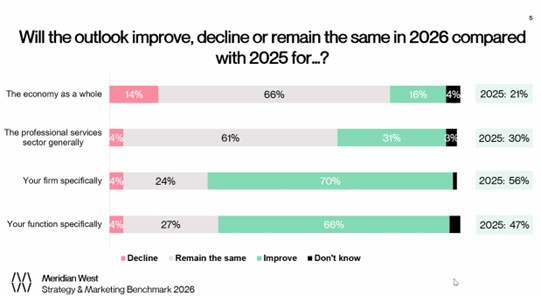
The management agenda is shifting further towards efficiency and technology adoption. Yet participating firms show resilience with over two thirds expecting the outlook to improve.
Meridian West benchmark marketing and business development 2026
The five biggest constraints for growth in 2026 are:
- Fee pressures (69%)
- Poor economic outlook (47%)
- Margin erosion (40%)
- Lack of skills or talent (34%)
- Political uncertainty (31%)
The top management priorities for firms in 2026:
- Increase use of technology (63%)
- Increase operational efficiency (58%)
- Differentiate the brand (37%)
- Develop people’s skills and capabilities (35%)
- Develop people’s commerciality (32%)
- Develop a clear purpose and strategy (27%)
Alastair observed that management teams and marketing are driving the efficiency agenda. Yet this always makes me feel a little nervous – a focus on efficiency and cost control compared to investment and growth. It feels a little short term.
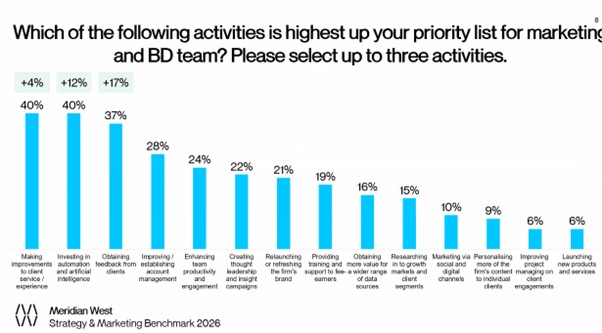
The priorities for marketing and business development teams (see image above):
- Making improvements to client service/experience (40%)
- Investing in automation and artificial intelligence (40%)
- Obtaining feedback from clients (37%) client feedback playbook – How professional services firms
- Improving/establishing account management (28%)
- Enhancing team productivity and engagement (24%)
- Creating thought leadership and insight campaigns (22%)
- Relaunching or refreshing the firm’s brand (21%)
- Providing training and support for fee-earners (19%)
- Obtaining more value for a wider range of data sources (16%)
- Researching into growth markets and client segments (15%)
- Marketing via social and digital channels (10%)
- Personalising more of the firm’s content to individual clients (9%)
- Improving project management on client engagements (6%)
- Launching new products and services (6%)
I was pleased to see improvements to client service and experience topping the list. And that includes obtaining client research and establishing account management. But I wondered why innovation (e.g. launching new products and services) was so low. Although I guess that researching growth markets and client segments would be a pre-cursor to innovation.
I’m not surprised at the relatively low rate of brand renewal – last year saw so many firms, particularly in the accountancy sector, tackle this (see Marketing and Business Development (MBD) accountancy firm case studies)
2. Growth agenda and the role of marketing and business development
There’s strong evidence that growth priorities are being shaped by MBD leaders:
- 84% The Board has set clear growth priorities for the next 12 to 24 months for my firm
- 79% Marketing and BD leadership played an active role in shaping these growth priorities
- 72% My firm’s growth priorities are informed by a robust analysis of the external market and supported by data
This suggest the use of robust strategic evidence-based analysis (for which I am so happy for my level 6 Marketing Manager students who must follow the SOSTAC framework).
However, there appears to be a gap in understanding between internal and external audiences:
- 74% My firm’s growth priorities are clearly understood by most people in the firm
- 44% My firm’s growth priorities clearly understood by most of our firm’s clients
So this is good news on the employee engagement front. But indicates that marketing and client communications need attention. Although you could argue that client communications should focus on client needs and interests.
There are fears that a growth mindset is lacking within nearly half of firms (54% agreed that “most fee-earners/advisors in my firm have a growth mindset” (i.e. they instinctively look for new opportunities to win work, build relationships, introduce colleagues etc). However, you could argue that fee-earners have a growth mindset but take little personal action as a result of lack of time, training or motivation.
Rankings for the priorities on what is going to have the biggest impact on driving firm growth in 2026
- 69% Selling more to the firm’s existing clients Cross-selling and referrer management – Past, present and future
- 11% Merging with or acquiring another firm
- 8% Diversifying the kinds of clients the firm works with (eg new industries or segments)
- 5% Diversifying the firm’s services
I was a little surprised at this result. It is, of course, a sound strategy to develop existing clients. But future profit streams are more likely to be generated by new services or new market development and these have little support with these figures.
How confident are you that your firm’s marketing and BD team has the necessary skills and capabilities to support the firm’s growth priorities:
- 84% Confident
- 13% Not confident
- 3% Neutral
3. Benchmarking MBD spend, activity and headcount
Overall growth in MBD budgets is slowing (from 6.5% growth last year to 5.6% this year), as leaders reprioritise spending towards technology. After the bounce back following Covid, growth in MBD budgets has declined – despite high levels of inflation.
Modest headcount growth is expected, as MBD leaders prefer to increase salaries to retain top talent
How spending is likely to increase in MBD the next 12 months:
- 76% Business development technology and systems (previously 47%)
- 69% Client listening
- 50% Thought leadership/content marketing campaigns
- 47% Skills development for your team
- 41% Social media and web site
- 21% Sponsorships
- 9% Virtual events
On MBD headcounts:
- 55% Firms increased their marketing and BD function headcount last year (consistent with previous year)
- 3% Average increase in marketing function headcount for 2026
- 8% Average increase in marketing function salaries anticipated for 2026
Overall, firms appear to be spending on efficiency and technology. Which begs the question of how important is brand, relationships and business development? These are key areas of differentiation which acts as a defence to downward fee pressure and reducing margins.
Panel discussion themes
There were numerous themes from the panellists:
Focus
We need clear purpose and mission. Brand allows fee-earners to be clear on who we are in the market. And our clients and why they choose us. Sales objectives focus attention on what must be achieved. These things mean that we don’t waste time on things that shouldn’t be a priority. Focussing on client needs gives an innate confidence that we are doing the right thing.
Change, opportunity and resilience
Some of us have been through previous economic cycles so this is not the first time we have had to navigate volatility. We need conviction in our chosen strategy. The best firms still invest in brand – which amongst other benefits also reassures nervous clients.
Volatility is a good opportunity to invest in and promote thought leadership – especially if this links to more client listening. Leaders need confidence not to panic and reduce budgets. The accountancy sector inherently thrives on volatility – there is a new budget each year. And this Government proposes then retracts policies (e.g. changes to IHT reforms before Christmas). Each change is an opportunity to get in touch with clients.
Research shows that General Counsel are now seen as strategic advisers as well as risk advisers. We need to develop our services to meet their changing needs as their role evolves.
Over the last five years, the professional services sector has been resilient and performed well. Change creates opportunity – to innovate and create new services and new ways of working.
Automation
Automation is key to marketing – it allows us to get to market quicker, to analyse more data (and improve our CRM, build lists and relationships) and to do more inhouse (e.g. video and podcast content production). It can help the MBD team be more efficient – particularly with data analysis and the way we work with clients.
Automation also helps improve audit practice so work can be turned around quicker. Clients like that things can be done quicker – and possibly allows them to achieve cost savings. Most clients are comfortable with the use of AI – although it does merit a conversation. And, of course, you need clear policies about when and how AI can be used (e.g. AI is not permitted for private client tax issues),
Most firms are still on the journey – learning how technology can be used. Clients are on a similar journey learning how to use AI in their businesses.
Generational differences
Increasingly, early career professionals are keen to do more to understand client needs and adapt the service accordingly. Perhaps as they are fearful of automation commoditising their roles. So they try to think about how to add value to the firm. So they have a greater appetite to get involved in business development from an early stage in their career.
They need to build confidence in extending conversations with clients beyond the current instruction. MBD needs to collaborate with Learning & Development colleagues to help fee-earners develop the necessary skills.
Reframe cross-selling to deepening client relationships
It was interesting to hear one of the panellists say that they don’t use the word cross-selling as it isn’t helpful and scares people. So they focus on client listening and the service experience. And how to make clients stickier.
This means equipping people to talk confidently about the firm and its service when it is appropriate and relevant for clients. And also to help them build relationships with colleagues in other departments.
Demonstrate Return on Investment
Firms are happy to invest in MBD if we can demonstrate expected ROI. Yet we need to recognise that fee-earners in different departments may have very different cost of sales. And some teams required two to three years to win a substantial client.
There were suggestions that a Return on Objectives approach may be better to measure progress against aims relating to profile and positioning. It is hard to monetise activities such as sponsorships.
Others commented that when budgets are under pressure, we are forced to be more creative. There was evidence of this with increasing use of transport advertising and new digital channels.
Final reflections
- We are at a Darwinian moment – evolve or die
- The biggest capability gap is attracting and retaining the best talent (possibly through the development of Employee Value Propositions – which is increasingly part of the MBD portfolio whereas historically this was parked with HR)
- Help teams to have the curiosity to look beyond the tasks on their desks – to want to understand the firm, its services and its clients
- Generate more rainmakers so that they move beyond reactive help and look actively for new opportunities
- Ask the questions: “What more? What else? What next?”
Past articles on Meridian West annual benchmarks
Political, Practice and Marketing Trends February 2025
International Marketing Benchmark 2024 from Meridian West February 2024
Annual International Marketing Benchmark – PM Forum and Meridian West January 2023
Meridian West’s Marketing Leaders Benchmark 2022 February 2022
Related articles on trends and research in professional services
client feedback playbook – How professional services firms January 2026
30th PM Forum Conference – Beyond Boundaries November 2025
Strategic analysis – PWC’s UK Legal Services Market Report 2025 September 2025
Highlights from the 2025 Professional Growth Summit – Kim Tasso May 2025
Political, Practice and Marketing Trends February 2025
Private client commercial conversations March 2024
Book review: The Strategy Book by Max McKeown November 2023
Managing Partners’ Forum – Highlights September 2023
Professional services benchmark and accountancy profession September 2023
Context and curiosity drive commerciality and pricing September 2023
know about commercial awareness by Christopher Stoakes August 2023
Managing Partners’ Forum Strategy Summit July 2023
Key Account Management (KAM) – Research companies June 2023
2023 financial benchmarks for law firms April 2023
Be more strategic – PESTLE, Positioning and Plans December 2022
Nine Marketing and Business Development trends in 2021 December 2021
Law Society Research Report – Future Worlds 2050 July 2021
Law firm analysis – MHA Legal Benchmarking Annual Report 2020 January 2021
Digital and soft skills – Microsoft on skills needed for an inclusive economy September 2020
Emerging marketing and business development roles September 2020
Marketing basics – Marketing audits with onions and pestles August 2020
Client satisfaction benchmarks – How do you measure up? May 2018