
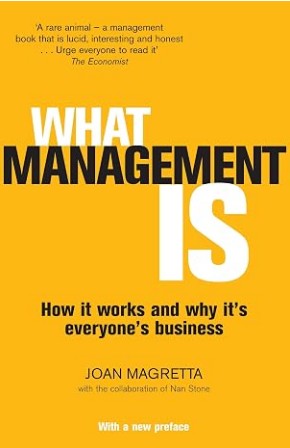
This is a review of the book “What management is – how it works and why it’s everyone’s business” by Joan Magretta with the collaboration of Nan Stone. I’m often asked for book recommendations to support workshops on management, leadership, strategy and commerciality. I strongly endorse this book – despite its age – whether you are new to management or a seasoned pro. It provides a clear and jargon-free explanation of the most significant and enduring management ideas – and illustrates points with insightful business stories. Book review: What management is by Joan Magretta
My overview of “What Management is”
The book was first published in 2002 (this edition in 2013). The 220 pages are information-dense so it is a long but highly engaging read. Business Week chose it as one of the best books of the year when it first appeared. It’s American but relevant across the globe as it shares many international examples. The authors describe it as “everything you wanted to know about management but were afraid to ask”.
As you would expect of a management book, there’s clear influence of great management thinkers such as Peter Drucker and Michael Porter. What I particularly liked is that despite all the recent changes – and all the new things we must learn – the book focuses on fundamental business management ideas that have stood the test of time. You can see how management has evolved from the measurement days of the manufacturing industry to people-oriented service businesses that dominate today’s economy.
It’s suitable for those engaging with management for the first time. It explains how the management discipline emerged and how it has developed – with many hard-hitting history lessons. It’s almost a “back to basics” with a concise synthesis of important ideas and practice such as value creation, business models, competitive strategy, the 80-20 rule, performance metrics and decision analysis.
The authors also take on some fundamental economics ideas in their stride. But it’s not an academic or theoretical book – it provides delightfully simple and elegant descriptions of business, management and strategy ideas. It considers businesses focused on both products and services – across many sectors – and there are plenty of references to the nonprofit sector.
Nearly every point is backed up with a relevant example for illumination. It’s like a business storybook with case studies including: 3M, Air France Concord, American Express, Charles Schwab, Dell, eBay, Elderhostel, Enterprise Rent-a-car, EuroDisney, Fidelity Investments, Ford, GE, General Motors, Habitat for Humanity, Hewlett Packard, Humana, Kodak, The Nature Conservancy, TimeAuditor.Com, Kodak, Midvale Steel, McDonalds, National Basketball Association, New York Police Department (NYPD), Southwest Airlines, Toyota, Walmart and Xerox
The authors have managed to convey a lot of complex business ideas in a calm, easily-accessible and jargon-free way. It feels confident and credible. It’s a goldmine of business insight – with lessons learned over the decades. So there’s plenty here too for more seasoned professionals. Experienced and sophisticated readers will obtain value from steeping back and seeing the big picture. And finding frameworks and ideas to help them improve performance at their organisations.
So whether you wish to build your commercial, management or strategic knowledge or understand fundamental economic principles and core ideas around innovation and change management – this book would be an excellent choice.
I genuinely enjoyed reading it – despite some of the material being a little old. But it’s a great refresher of MBA studies. And it’s encouraging to see such a well-regarded business book authored by two women with PhDs from the Harvard Business Review stable.
I’d like to thank Edward Gordon-Hall – CEO of Druces law firm (see Aspiring MBD leaders – Advice from a CEO – Kim Tasso) who recommended this book to me.
For an accessible book on strategy: Book review: The Strategy Book by Max McKeown. For a more academic review of some of the most important management and strategy theories look at the first part of Book review: The Management Shift by Vlatka Hlupic.
Contents of “What management is”
Preface: a roadmap back to business basics
Introduction: The universal discipline
Part I – Design: Why people work together and how
- Value creation: from the outside in
- Business models: covering insight to enterprise
- Strategy: the logic of superior performance
- Organization: where to draw the lines
Part II – Execution: Making it happen
- Facing reality: Which numbers matter and why
- The Real bottom line: Mission and measures
- Betting on the future: Innovation and uncertainty
- Delivering results: First, you focus
- Managing people: Which values matter and why
Detailed review of “What management is”
Preface – When everything changes, what stays the same?
The fundamental job of management – creating value for customers by helping people to be more productive and innovative in a common effort – hasn’t changed. Despite one shock after another (and I couldn’t help think the ideas are still relevant after the seismic shift driven by AI).
Dealing effectively with change requires a clear understanding of what doesn’t change. The book explores the enduring, fundamental ideas that have stood the test of time.
Management is a discipline. Organisations don’t just happen by themselves, management makes them possible. Good management makes organisations – and society as a whole – more prosperous.
Introduction – the universal discipline
The human ability to manage, to organise purposely, is a characteristic of the species – and probably as old as the opposable thumb. Management discipline is new – its roots can be traced to the mid-nineteenth century. Management turns complexity and specialisation into performance.
There’s been an increase in MBAs – in the USA from 5,000 in 1960 to around 100,000 by 2000. (Note: a quick search revealed an estimated 200,000 to 250,000 people have graduated with an MBA in the UK over the past 20 years (2006–2026)).
Whenever our needs exceed our resources, we need management. Management is a discipline that is often misunderstood. The world’s most admired manager – GE’s legendary CEO Jack Welch is part of the problem. He rejected the word management and called for leaders. Peter Drucker shied away from the word too, shifting instead to executive.
The more highly educated and specialised we become, the more we need other people to perform. Today’s organisations demand greater initiative and responsibility from individuals. In essence they demand that we all think like managers. Managerial literacy means we will all need to learn to think like managers, whether or not that is what we’re called.
In 1954, Peter Drucker’s book “The practice of management” was considered the best introduction to management. Among his many roles were journalism – consultants learned that publishing books was a valuable form of marketing. And he learned that you could brand ideas. There was then an explosion of management books. The busier we all get, the more seductive a short to-do list becomes.
The goal of the book is to present a coherent view of the whole of the work known as general management. It’s not a how-to book but explains the underlying “why” of both the theory and practice of management. True mastery of change comes from understanding why the world works as it does. The more things change, the more fundamental principles matter.
There’s an overview of the nature of the book, its structure and contents. This includes core concepts such as planning, budgets, rituals and execution. And how to balance short-term and long-term performance. It adopts the case method – the best way to teach. Cases (including those from the non-profit sector) come closest to capturing the multidimensional nature of management work.
Part I – Design: why people work together and how
-
Value creation: from the outside in
Value creation is the animating principle of modern management and its chief responsibility. Value is defined not by what an organisation does but by the customers who buy its goods and services.
Often the value created by B2B (business-to-business) organisations resides in time or labour saved and better customer relationships. Whereas in B2C (business-to-consumer – two thirds of the US economy) it’s difficult to quantify the value (although see Malcolm McDonald on value propositions – How to develop them). It is often intangibles – such as emotions like power and prestige or the beauty sector’s “hope in a jar”.
One of management’s chief responsibilities is to remember this external orientation – essentially the marketing view of the world. It is natural for those within an organisation to focus on the outputs but customers must be willing to pay for it.
“Value versus efficiency” is the manufacturing mindset and so the challenge is to increase productivity. Making a product affordable can create a vast new market. There’s a story about a steel labourer who rose through the ranks and was hired by Joseph Wharton at Bethlehem Steel – the founder of the business school. Scientific management – with its emphasis on measurement and analysis – was the first true management discipline.
Then the marketing mindset enters – with a focus on “what does the customer value?”. Until the entry of Peter Drucker in 1943 – studying General Motors from the inside for two years – “Customers don’t buy products – they buy the satisfaction of particular needs”. You need to look through the customer’s eyes – from the outside in.
This quickly led to crucial distinction between selling – convincing a customer to buy whatever it is you make, and marketing – understanding what customers value so that you can work to satisfy their needs. This is an especially powerful questions for people who do knowledge work – Who depends on my work? How do they use it? and Why is it valuable to them? There’s a mention of lawyers and consultants – who have their own version of the manufacturing mindset – defining their product as hours of advice, relationship or studies. The start of Bain & Co management consultants was – “Our clients want better business results, not reports”.
There’s a look at the early innovation at Kodak – it helped professional photographers with the advent of dry plates so they no longer had to mix and pour their own chemicals. It moved from a manufacturing to a service business: “You push the button, we do the rest”.
Maximising shareholder value became the new mantra. Efficiency – doing the things right – remained important. However, now effectiveness – doing the right things (which customers valued) became more important to performance.
During the 1960s and 1970s management was becoming more insulated and arrogant. There was the emergence of lean and aggressive Asian competitors in the 1970s – with America’s auto industry losing ground. Customers were won over by simple fact that Japanese cars gave them both higher quality and lower cost – i.e. they offered better value.
1980s saw an unprecedented war between owners and managers. There were hostile take-overs – the law of survival became “maximise value for shareholders or you will be ousted by the unrelenting discipline of the capital markets”.
How is value created? Michael Porter’s “Competitive strategy” (1980) was a landmark book that almost single handedly created the new field of business strategy. He introduced the concept of the value chain – and management consequences. Each activity was seen not as a cost but as a step that had to add some increment of value to the finished product. Charles Schwab stripped out the advice and supported executing trades in discount brokerage. So match the company’s value chain to the customers’ definition of value. Another consequence was forcing you to see the entire economic process as a whole – and therefore the interdependence between suppliers. Purchasing evolved into supply chain management.
Non-profits focus on mission, not markets. Non-profits make up over 10% of the US economy. Why are they hard to manage? The economic value they exist to create is far easier to define and measure than social welfare. There’s an interesting example of Habitat for Humanity – succeeding through partnership. With most non-profits there is a disconnect between the people who fund the organization and its beneficiaries. The Red Cross had to make the proper and critical distinction between a customer and a donor. Value is a system – and value for employees may also reside in noneconomic factors.
-
Business models: Converting insight to enterprise
This chapter explains business models and promises to help you tell a good model from a bad one.
“A business model is a set of assumptions about how an organisation will perform by creating value for all of the players on whom it depends, not just its customers”.
From spreadsheets to business models, and what if? questions. Alfred Chandler and Peter Drucker knew it as general management – how all the pieces and policies of a corporation fit into a coherent whole – returning value for shareholders by delivering value to customer. Driven by the explosive growth of new ventures sparked by the Internet.
The concept of “float” – companies pay money for things that go into a product or service before they can recover their costs. They tie up capital and perhaps borrow money – the cash flow issues.
What makes a good story a better story? The revolutionary use of specialised labour. By definition, a successful business model represents a better way than existing alternatives. It’s driven by insights into unmet needs. New business models are all variations on the universal value chain. The first part is activities to make the product, then part two is activities to sell the product.
There are stories about entrepreneurs who saw a better way to do something. Michael Bronner created the first direct marketing firm as he focused on relationship marketing with an early product to provide vouchers for local businesses to students. Then Pierre Omidyar and the emotional connection between eBay users and the site. eBay is a network and gets a small fee for every listing. For sellers, eBay is an inexpensive marketing channel.
Size is essential to create an efficient market. In economist terms – give buyers greater utility (value) and their willingness to pay grows higher.
How markets work looks at markets as power relationships. Consumers focus on one product at a time and choices, fairness and value. For business the issue is choosing a price between costs to make and value to customer. Margins are the spread between the cost of a good or service and its price.
Supply and demand – whether it’s a sellers’ or buyers’ market – relies on industry structure and the relative concentration of buyers and sellers. Some companies set out to change the balance of power by altering the structure of existing markets. Dell computers eliminated the middleman (disintermediation) by selling direct to customers.
On nonprofit business models, there are clearly drawn characters, with plausible motives, who come together in a plot that makes sense. A key idea is theory of change (The Theory of Change Process – Guidance for Outcome Delivery Plans – Government Analysis Function). For example, the New York police commissioner and the broken window theory. And Elderhostel – a fee-based model with a mission to help older adults find new interests through high quality, affordable educational programmes which evolved into a business with various services to mature adults.
-
Strategy: The logic of superior performance
“The essence of strategy is choosing what not to do” Michael E Porter
This chapter provides a helpful overview of the theories of Michael Porter (generic strategies and five forces of competition).
Strategic thinking begins with a good business model that describes, as a system, the economic relationship central to fulfilling an organisation’s particular purpose in the face of competition. There are always alternatives and you need to find a means of being different – strategy is how you are going to do better by being different.
There are choices about which customers and markets to serve, which products and services to offer and what kind of value to create. There’s a story about how discount retailing emerged as a new business model in the mid-1950s. Walmart chose to serve a different group of customers in a different set of markets (isolated rural towns) – taking the first-mover advantage. Walmart promised national brands at everyday low prices. This required a focus on its supply chain – with continuous cost reduction and heavy investment in systems and logistics (a hub and spoke system and cross-docking).
There are only two ways a company can outperform – get customers to pay higher prices or operate on lower costs. To do either of these it has to be different. There are stories explaining how Japanese companies competed by imitating each other. And so competition in consumer electronics is intense – approaching what economists refer to as perfect competition. It’s like running a never-ending race that no one can win.
At the other end of the spectrum is monopoly – where one company has acquired a stranglehold on a product or service for which there are no alternatives. So Government steps in to protect consumers from potential abusers.
There’s an exploration of whether you can achieve sustainable competitive advantage. The author uses interesting metaphors to describe strategy – building a moat or moving the castle. By building barriers to entry (including patents and brands, infrastructure) or raising switching costs to consumers.
An effective roadblock to pure competition is unique positioning. The use of trade-offs is like a fork in the road. This is illustrated with Enterprise Rent a Car. Whereas other car hire companies target air travellers, Enterprise targets those who’s car is in for repairs. And its customers come from insurance referrals rather than advertising.
Strategy is hard because no organisation acts in a vacuum. Thinking strategically means recognising that the world is filled with purposeful people whose aims may constrain or challenge yours. So you can either compete or collaborate (there’s a nod to mathematician John von Neumann and economist Oskar Morgenstern who wrote “The Theory of Games and Economic Behaviour”.) Recognise that every strategic move will evoke a response.
On strategy for nonprofits, the ethic of service is deeply ingrained. The goal of strategy – superior performance from competing alternatives – is desperately needed in a world where the demand for many social-sector services are so great. The loss of focus in some nonprofits is referred to as mission creep.
-
Organization: Where to draw the lines
What should an organisation look like? On mergers and acquisitions, there’s mention that GE bought hundreds of other companies. Management’s job, turning complexity and specialisation into performance, requires it to draw three kinds of lines:
- Boundary lines – what’s within and outside the organisation
- Organisation chart lines – how it is divided into parts and the relation between those parts
- Lines of authority
The design of an organisation is implicit in its strategy. Ford used economies of scale to produce the cheapest car with an assembly line – but limited to one model (the Model T) – using a command and control model with centralised organisation. This contrasts to how Alfred Sloan at General Motors acquired a string of independent car and parts manufacturers leading to a strategy of product variety and customer segmentation – requiring a multidivisional corporation with decentralised decision-making.
Then there are make or buy decisions. Scope refers to an organisation’s product line and range of activities. Ford took vertical integration to an extreme – buying companies to supply all components. Whereas GM asked its major supplier to build a plant adjacent to a new GM assembly plant and when they refused GM bought the supplier (backward integration to earlier steps in the value chain). But by solving a co-ordination problem, you create a motivation problem.
Toyota sparked a global revolution in quality. Before empowerment became a thing, Toyota demonstrated the value of a fully engaged workforce. It shared information with suppliers and it introduced “just in time” to reduce inventory. Its employee-led quality – with participation rather than hierarchy – became Total Quality Management (TQM).
There’s consideration of outsourcing. Transaction costs occur whenever two parties interact and their work must be co-ordinated. In the health care industry, 30% of costs lie in activities best described as the gathering, processing and reporting of information. Ronald Coase explained organisational size – when it is cheaper to conduct transactions internally, organisations grow larger. When it is cheaper to conduct them externally, organisations stay small or shrink. Many companies no longer make the products that bear their name – Nike is a marketing company, not a maker of sneakers. Disney makes Mickey Mouse – but Asian manufacturers make tee shirts with Mickey on them.
Adam Smith referred to “the invisible hand” of the market as a superior way to get everything done. But there’s a warning story of the National Basketball Association (NBA) – where the self-interest of individual players detracted from the game overall.
Consolidation is where companies become bigger to meet scale requirements. Companies need volume production, brand marketing and R&D. Honda took a different approach – applying what it learned about F1 racing car engines to those it mass produced for cars of other manufacturers.
Nonprofits tackle huge global issues with limited resources. There’s an interesting story of an eye hospital which develop a standard operating procedures – and then divided operations between those who could pay and those who couldn’t.
There is no one best way to organise. Scale, scope and structure are enormously contingent on what you’re trying to do.
Part 2 – Execution: Making it happen
-
Facing Reality: Which numbers matter and why
“Not everything that can be counted counts, and not everything that counts can be counted” Albert Einstein
Execution is translating plans into performance. Everyone in an organisation needs basic numeracy. But the real skill is making sense of the numbers, not crunching them. Numbers summarise the behaviour of actual people doing real things. It starts with the simple act of measurement. The numbers that truly matter are the ones that tell a story about what the organization is doing. And compare one dimension of performance to some clear reference points. The Six Sigma quality measure is a batting average that tells you what percentage of your efforts are error-free.
The S-curve allows you to see the larger pattern unfolding so that you can take appropriate action. What is harder and takes longer is developing judgement about what the number means.
Real time data collection and data mining have become professions. Robert McNamara proposed a management by numbers approach (the original bean counters). The danger is demonstrated in the 1970s, with the tragic deaths of those driving the Ford Pinto as a result of a decision not to line gas tanks. It taught the nation the basics of cost-benefit analysis. A hedge fund – used dynamic hedging – and its decline shook global capital markets
Business and markets are about people and their complex behaviour.
-
The Real bottom line – mission and measures
Managers translate the organisation’s mission into a set of goals and performance measures that make success concrete for everyone. There’s a story about a school to support poor orphan boys and how they struggled to find suitable measures of success.
Profits are a result, not a mission. The real purpose of any business is to create value for its customers and to generate profits as a result. “The only things that evolve by themselves in an organisation are disorder, friction and malperformance” (Peter Drucker)
Examples including the Model T Ford and the Mars Mission demonstrate good and bad measures. Ford created the “people’s car” by reducing prices by 58% from 1908 to 1916. NASA adopted a “faster, cheaper, better” approach to multiple small space agency projects – which then suffered numerous issues due to small, faulty parts.
What gets measured gets managed. EVA – Economic Value Added – is the current buzzword. Return on Investment (ROI) has been one of the most persistent. The bottom line is an acid test of value creation. A healthy bottom line tells you that the customer values what you do. But it tells you nothing about sustainability.
As enterprises grew larger and more complex, we needed measures that could compare performance across different kinds of activities. A Harvard Business Review article in 1980 by Robert Hayes and William Abernathy titled “Managing our way to economic decline” argued that over-reliance on short term financial measures like ROI could lead to the slow death of investment in innovation which is the lifeblood of most organisations.
Many talk about ROI, SVA, ROIC, EVA and EBIT which tell a lot about an organisation’s priorities. Brenneman said: “The foundation of any successfully run business is a strategy everyone understands coupled with a few key measures that are routinely tracked”.
Fidelity Investments (a mutual find with over $800 billion in manged assets) has a retirement business. Its mission “making sure that Americans have enough money to retire” is different from having the biggest market share in the retirement business.
There is a danger of running out of cash when starting up. Start ups worry about burn rates – how fast it uses its seed money. So they balance rapid growth with profitability and liquidity through gross margin – to take account of money invested in growth (Return on invested capital).
Welch learned from Peter Drucker that market leaders, by virtue of their greater market power and scale, were more likely to achieve superior performance. They adopted a “Fix, close, sell” strategy and moved to three “to live by” key measures: customer satisfaction, employee satisfaction and cash flow. But he redrew the goals periodically. And became obsessive about Six Sigma – so 300,000 employees became a new warrior class of green belts, black belts and master blackbelts based on increasing levels of training and accomplishment.
Many nonprofit organisations measure their success by their efforts and not their impact. NYPD used metrics to track against ultimate goal – to reduce crime. Nature Conservancy now has five measures of success.
-
Betting on the future: Innovation and uncertainty
Good managers have one eye fixed on the horizon and the other on their current position.
Innovation is the search for new ways to create value and new value to create. And this chapter focuses on how the discipline of management tackles the risky business of innovation.
Demonstrating how hard it is to juggle the present and the future are Ford’s myopia focusing on the Model T, DEC’s demise from focusing on mini-computers and denying the potential rise of PCs and Kodak ignoring the digital photography revolution. Sometimes the technology was ready but the market wasn’t (e.g. genetically modified crops).
3M’s track record of innovation is due to requiring each division to generate at least 30% of its sales from products or services introduced in the last five years.
Good management is entrepreneurial. Thinking inside the box is the antithesis to thinking outside the box. A decade ago, overcoming resistance to change was the challenge facing organizations of all sorts.
The essence of innovating, of creating new value, is solving problems within constraints (such as business model or budget). To set them up as challenges that spark creativity and ingenuity. When Charles Schwab tackled customer complaints – it learned that 80% of complaints were for less than the company spent researching them. So they conceded any dispute where the dollar amount was less than the cost of investigation. And changed the performance measure from complaint response to customer retention.
The information you need is to look through the customer’s eyes – from the outside in. Listening to customers requires true curiosity about other people. The approach owes much to the methods of cultural anthropology. Pepsi fell behind Coke and curiosity revealed that the only limit to the amount of soda people would drink was the amount they could carry home. So Pepsi developed lighter packaging.
Questions about the future don’t require a crystal ball but the skills of logic.
The author explores risk aversion. New opportunities to create value always come with a price tag. The cost of capital and concept of payback ignore risk. An important idea in finance is net present value (NPV) which requires a discounted cash flow analysis (DCF). There’s a need to clarify the best case (what you hope will happen) and the base case (what’s likely to happen). Yet NPV rests on assumptions. Ways to structure and quantify investment decisions do not capture the dynamic sequence of learning and acting that characterises so many strategic decisions. It describes how Xerox failed to commercialise its innovations.
When decisions are sequential it helps to map them out graphically in a decision tree where you can assign probabilities. It notes that pharmaceutical companies need to plan for time to market – as whoever gets to market first is likely to capture and keep the lion’s share of the rewards. Forecasting is important too for the airline industry where fuel price is a key determinant of profitability.
-
Delivering results: First, you focus
“Results are obtained by exploiting opportunities, not by solving problems” Peter F Drucker
The ability to deliver every year is the hallmark of a seasoned professional – to enable the organisation to meet plan each month, quarter and year. Pareto’s Law (principle of imbalance) indicates that 80% of a company’s sales or profits come from 20% of its customers. So performance will depend disproportionately on doing a few things really well. Another rule is Moore’s Law – from Silicon Valley relating to the speed with which computing power improves.
There’s a story about a new CEO at eBay in 1998 at a marketing meeting – who found that 20% of users represented 80% of eBay’s volume. They learned that most of the 20% were serious collectors and this led to the Power Sellers programme. And this translates to other sectors – in the US 20% of Americans accounted for 60% of spending on new automobiles, 20% of fast food users account for 60% of visits. Airlines keep track of frequent fliers. Conversely, if some customers are unprofitable you need to know which ones – by “torturing the data until it confesses”.
Businesses use computing power to disaggregate the numbers – choosing which customers to serve (customer selection or segmentation) is an important part of strategy. The quality revolution – Joseph Juran’s ground-breaking “Quality Control Handbook” in 1951 – observed Pareto’s law – a relatively small number of quality problems accounted for most of the losses related to defects. So this was applied to production processes – becoming TQM and six sigma.
Another story about GM which asked customers what they value most about a product (CTQ – Critical To Quality or drivers). They were surprised to find that customers cared about their interactions with GE’s staff. If staff were courteous and professional, customers would tolerate late deliveries. So they trained staff in soft skills for interacting with customers – leading to superior performance. When people complained they were working too hard the leader advised them to make a list of the 20 things they were doing and identifying the 10 that were “nonsense”.
Resource allocation involves the hard part of saying “No” to match resources to opportunity. Healthcare company Humana found 10% patients accounted for 80% of its costs. Patients with Congestive Heart Failure (CHF) were the most costly. So disease management programmes were developed that assigned nurses to follow patients most at risk – to avoid expensive hospital visits.
Avoid formulaic approaches such as allocating resources according to sales – it eliminates politics and numbs the pain but are symptomatic of bureaucracies focused more internally than externally on achieving results. Performance-oriented companies have smarter ways to make resource-allocation decisions – there’s the story of Intel’s transition from a memory company to a microprocessor company.
Learn the discipline of letting go to liberate resources from yesterday’s priorities. Peter Drucker said “The greatest obstacle to innovation in organisations is the unwillingness to let go of yesterday’s success, and to free up resources that no longer contribute to results”. It suggests the discipline of “systematic abandonment” – by asking the question “if we weren’t already in the business, would you enter it today?” This avoids the mental trap of sunk costs (psychologists have known for years that people hate to walk away from decisions they’ve already made).
Grove’s corollary to Moore’s Law is “only the paranoid survive”. Before benchmarking and best practice became buzzwords, Walmart had ”beat yesterday” ledgers. People greeters in stores were introduced to reduce shrinkage (shoplifting). McDonald’s learned that every six seconds saved at the drive-thru increased sales by 1%.
-
Managing people: which values matter and why
Not surprisingly this last chapter was the most reassuring for me…
The authors held the subject of people until the last chapter as most people are deeply – and rightly – resistant to being managed. Management’s responsibility is to provide a context of values within which individuals can manage themselves. It is about what it means for individuals to take responsibility for their own performance. We continue to confuse authority and control.
The most powerful sources of value are locked in people’s heads, and in their hearts. For knowledge workers, who by definition know more about their jobs than their bosses do, supervision is a very special kind of hell. The same is true for emotional labour – people whose performance depends on people being nicer than is natural (e.g. flight attendants). Management resolves the tension between the individual and the organisation.
On managing culture (“the social dimension”) GE’s categorised managers:
- Everybody’s star – they deliver on commitments and share our values (i.e. love of speed, hatred of bureaucracy and excitement about change)
- Opposite – do not meet commitments and don’t share values (they don’t last long)
- Try hard and miss some commitments but work well with people and share values (deserve another chance)
- Deliver the numbers but do so by forcing them out of people
In 1997, Jack Welch wrote to shareholders that he decided to remove type 4 – as this had to be done if they wanted people to be open, to speak up and to share (i.e. the fundamentals of what later became known as psychological safety).
Southwest Airlines’ point of difference is “to fly you there for less”. But the cost advantage relies on its workforce of highly motivated, highly productive people. Its ground turnaround time is impressive – a ground crew team of six takes 15 minutes what other airlines take 35 minutes with a crew of 12. The founding CEO believes delivering such service relies on putting employees first.
“Setting an example is not the main means of influencing others – it is the only means” Albert Einstein
Making values come alive requires communication, a talent for overacting, big gestures, rituals and a flair for symbol and storytelling.
Management’s golden rule: Trust. Economics has become a quantitative discipline – one of the numbers subjects. But its underlying aim has always been to explain human behaviour. Modern behavioural economics extend explanations beyond self-interest – and demonstrate that people respond to fairness and reciprocity. There’s a story about avoiding scripts as they don’t sound natural. And a reminder from “Good to Great” – where Jim Collins and Jerry Porras said “above all, the core values that animate a company must be authentic”. Classic management book reviews – The McKinsey way, Good to great
Show respect for the individual by accepting that each person is different and therefore good at different things. What matters most to performance is getting the right individuals for the job. Management’s job is to spot talent, and to put it where it can contribute to performance. You need a robust process of hiring, promoting and firing people. Southwest’s Kelleher: “We can change skill levels through training. We can’t change attitude”.
There are stories – including from nonprofits – about replacing significant portions of the workforce. And there’s an interesting anecdote about “firing” students at university so that they learned empathy about being fired. This confirms that empathy is yet another instance of the power of the outside-in perspective:
- Value creation begins with seeing the world through customers eyes
- Strategists see the world through competitor’s eyes
- Good negotiators see the world through the other party’s eyes
Management makes it possible for people to manage themselves. Creating a culture whose values are aligned with the organisation’s purpose. Select the right individuals and encourage them to develop their strengths.
Know thyself was, for the ancient Greeks, the foundation of a good life and the work of a lifetime. There are stories about the value of feedback and coaching. Purpose comes first – explore “Why do I work?”. And there’s a warning with “We persist in defining our performance by how hard we work at something, rather than by the results we achieve”.
The paradox of the modern economy – the more highly educated and specialist we become, and, therefore, the more likely we are to work as individual contributors and to think of ourselves as free agents or independent professionals, the more we need other people to perform. Another paradox – the more we need to work through others, the better we need to understand ourselves.
Epilogue: Next steps
Management discussions never end with conclusions – they end with next steps.
- Ask how your own organisation is doing
- Underneath all the theory and tools lies a commitment to performance
- Management is distinct from individual managers – it is the discipline that makes joint performance possible
- Its mission is value creation – and purpose comes first (a mission worth accomplishing)
- A design to match the purpose – articulate a theory of how an organisation can achieve its purpose
- The work of execution – does it deliver the results it has promised? Set goals, track measures of progress, innovate to balance today with tomorrow, set priorities, and allocate resources to them, energize and inspire people to manage themselves in pursuit of the common mission
- Evaluate individual managers in the context of the whole management team. Management’s scope exceeds the abilities of most mere mortals. That’s why it takes a team to run most organisations
- As we test management’s limits in the social and public sectors we, as citizens, will need to make decisions about the kind of value we want management to create
Management is the art of trade-offs, taking the fork in the road best suited to the organisation’s purpose.
Favourite quotes from “What management is”
- Dealing with change is one of management’s most difficult responsibilities
- Management is easier to describe than to do
- Unlike most other professions – law or medicine or accounting for example – you don’t need a license to practice management. In fact, it’s the only field we can think of where practice precedes formal training
- Some of the most prominent and effective managers in the world are self-taught
- Execution requires both discipline and judgement, on the part of everyone in the organisation, not just the people who occupy formal management positions
- Quickly led to crucial distinction between selling – convincing a customer to buy whatever it is you make, and marketing – understanding what customers value so that you can work to satisfy their needs
- Once one of the world’s premier industrial companies, GE now gets 80% of its profits from services
- A business model is a story of how an enterprise works
- The bigger the market you try to reach, the more it will cost you
- The mantra of the new economy is that value is shifting from things to ideas, from products to services
- Offer customers a better deal and your business will grow
- Peter Drucker’s 1964 book “Managing for Results” was originally titled “Business Strategies”
- Strategy is something of an art as well as a science
- Thinking strategically means recognising that the world is filled with purposeful people whose aims may constrain or challenge yours
- Strategy is difficult because it about how others react to what you do
- Patents and proprietary intellectual property, brands and special competencies help defend the castle, while strategy creates the protective moat that underlies superior performance.
- The design of an organisation is implicit in its strategy
- There is no one best way to organise. Scale, scope and structure are enormously contingent on what you’re trying to do
- Numbers are essential to organisational performance – what is harder and takes longer is developing judgement about what the number means
- Profits are a result, not a mission
- The foundation of any successfully-run business is a strategy everyone understands, coupled with a few key measures that are routinely tracked (Brenneman)
- For the most part, organisations in the social sector have a better handle on inputs than they do on outcomes
- Good managers have one eye fixed on the horizon and the other on their current position
- “The greatest obstacle to innovation in organisations is the unwillingness to let go of yesterday’s success, and to free up resources that no longer contribute to results” (Peter Drucker)
- “Setting an example is not the main means of influencing others – it is the only means” (Albert Einstein)
- The more we need to work through others, the better we need to understand ourselves
- Management is the art of trade-offs, taking the fork in the road best suited to the organisation’s purpose
Related articles on management, leadership and strategy
Climate change, carbon literacy and sustainability October 2026
Aspiring MBD leaders – Advice from a CEO – Kim Tasso July 2026
Aspiring MBD Leaders – Advice from a Chief Commercial Officer June 2026
Managing Partners’ Forum Growth Conference 2026 May 2026
Aspiring MBD leaders – Advice from a CFO – Kim Tasso April 2026
Be more strategic – Strategy is about making choices August 2025
Be more strategic – Strategy into Action (Strategy Implementation) December 2024
Change Management – Ted Lasso leadership lessons, emotions May 2024
Book review: The Strategy Book by Max McKeown November 2023
Context and curiosity drive commerciality and pricing September 2023
Managing Partners’ Forum – Highlights September 2023
know about commercial awareness by Christopher Stoakes August 2023
Managing Partners’ Forum Strategy Summit July 2023
Being more strategic – Case studies and insights (Ireland May 2023) June 2023
Book review – Managing Brands May 2023
Strategy case studies and more matrices February 2023
Be more strategic – PESTLE, Positioning and Plans December 2022
Soft skills revisited – with a leadership perspective November 2022
Book review: The Management Shift by Vlatka Hlupic October 2022
The Association of Change Management Professionals (ACMP) August 2022
Next steps in growing a small surveying and property practice May 2022
Classic management book reviews – The McKinsey way, Good to great May 2022 (Good to Great, The McKinsey Way, How to manage organisational change and the new strategic selling)
The GC Index® – a Leadership and Board Assessment tool (organimetric) February 2021
Strategy basics – Mission and vision statements with hedgehogs August 2020
Innovation in Marketing August 2020
Be more strategic – Strategy in a post-Covid19 world July 2020
Why do you need a business plan? 10 reasons why March 2020
Malcolm McDonald on value propositions – How to develop them May 2019
Change management – Change Catalyst book review by Kim Tasso September 2018
Non-Executive Directors: Benefits for professional service firms April 2018
become the firm of choice – strategy development September 2017
Marketing planning in a nutshell – simple and complex plans June 2017
Book review: Developing a business strategy – strategic planning August 2014
Book review – How to think strategically by Sola and Couturier August 2014
Strategy basics – Mintzberg April 2013
Seven deadly sins of business plans and how to fix them January 2013
McKinsey’s “Managing the strategy journey” says spend more time August 2012
The Marketer’s Handbook: Reassessing marketing techniques July 2011