

This article is one in a series supporting the Home – PM Forum training course Aspiring Marketing and Business Development Leader – PM Forum (for marketing and BD managers preparing for their next career move). Leor has worked hard during his successful professional services marketing career – spanning legal, accountancy and consulting firms – and we can all learn much from his experiences. He has held three CMO (Chief Marketing Officer) roles – before progressing to CCO at Kingsley Napley – a law firm renowned for its leading practices in a number of areas. Aspiring MBD Leaders – Advice from a Chief Commercial Officer (CCO).
Leor Franks’ career
Leor Franks | LinkedIn is a familiar face to those who attend PM Forum Annual Conferences – as he is often the chair (see 30th PM Forum Conference – Beyond Boundaries).
Leor is dual qualified – with professional qualifications in both finance and marketing. This demonstrates a key concept in senior career development – the need to be T-shaped – to have deep expertise and experience in one discipline but also a broad knowledge of others (See: Future Marketing Manager – T-shaped people, senior promotions and on a similar theme I like this book Range – How generalists triumph in a specialized world” by David Epstein).
He has held three CMO roles (Kingsley Napley, Augusta Ventures and FTI Consulting EMEA) as well as MBD leadership roles at EY and Deloitte. A year ago, he progressed into the broader role of Chief Commercial Officer (CCO) at Kingsley Napley.
He also holds board positions at the Managing Partners’ Forum (where he Chairs the Marketing and Strategy Group), at Queen Mary University of London Business School and The Royal National Orthopaedic Hospital Charity. Thus demonstrating the relevance of MBD professionals at board level in a variety of sectors.
Leor’s advice to aspiring marketing and business development (MBD) leaders
What advice would Leor offer to aspiring MBD leaders? He talked about five topics:
- Understand the business, clients, partners and numbers
- Build strong relationships with fee-earners
- Be visible
- Connect with the team regularly
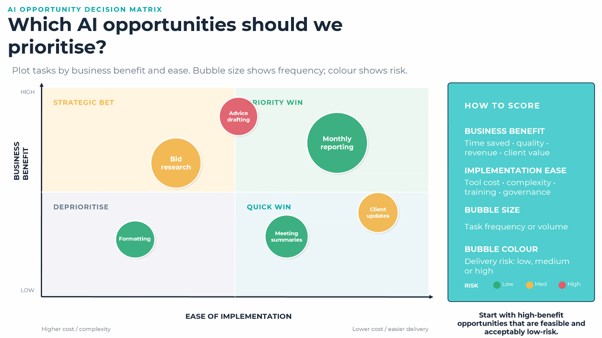
- Engage with the great artificial intelligence debate
Understand the business, clients, partners and numbers
Leor is clear on foundational requirements. The marketing and business development skill set positions us well to understand the business and the clients. Developing relationships with the partners and other front-line technical staff is fundamental to us working collaboratively to help the firm and its teams identify and use appropriate MBD strategies and tactics.
“The more you know about the firm, its owners and clients, the more easily you can identify opportunities and risks. And the easier it is to see how to deliver MBD that has a real impact”.
“You need to understand and be fluent in all the numbers that matter to your business – where revenue and profit come from (they might be different places) – across different sectors, services and clients. You need to be comfortable with what underlies the business plan – and how the annual figures measure up. MBD numbers reveal the size and speed of the future pipeline of work, the current conversion rates and digital metrics show engagement that fuels both brand awareness and future opportunities. But you need to understand the wider picture as well ”.
He feels that not enough MBD professionals really know the data: “You need to apply real focus to convert data into insight, to see hidden or weak signals, to spot opportunities and scrutinise risks. We aren’t all gifted with high levels of numeracy. And spreadsheets may not set your world alight. Numbers are the lifeblood of business management – the language of growth and profits – a universal measure against which goals are set and performance is evaluated”.
Despite the need to understand the numbers and the value of data driven strategy, Leor also commented on the need to tolerate ambiguity and uncertainty in more senior roles.
Build strong relationships with fee-earners
Leor emphasizes the importance of having a deep understanding of the stakeholders within the firm – from equity partners to junior fee-earners and other “support” staff. And stressed the need to build strong relationships across the firm.
“On a practical note, you need to understand the interests and drivers of each fee-earner that you work with. It’s lesson one in empathy. This can be a vast undertaking in firms where there are hundreds or thousands of fee-earners. So map out all the key relationships and have a plan on when and how you will forge relationships with the most relevant ones in the short term. This is an ongoing effort as you progress to more senior roles”.
These relationships will help you to lobby people, get them on side and “recruit” your MBD champions and sponsors. But there’s also a protective and risk management element – the more people you know and have on side, the more likely you will have support during inevitable debates around budgets and resources at a firmwide level.
He advocates regular lunches where you can really to get to know people – their professional interests but also their politics, interests and personal lives. Naturally, it is easier to do with those of a similar age, background and life stage.
And he is keen to promote the idea of “constellation marketing” – promoting a range of superstars rather than relying on a few lone “rock stars”. I was delighted at him sharing this idea – which I have written about before (see Marketing and BD planning – Segmentation, Rock Stars and Engagement)
Be visible
Leor links the need for relationships with the need for visibility: “It doesn’t matter how good your work or how astonishing your results and impact, people need to know who you are. Whether that visibility is in meetings, at socials, around the office or online – people in the firm need to know who you are and what you do and how well you do it”.
Yes, it is a form of self-promotion. But it is also about being present. This is trickier in today’s remote working times – when many people (especially when juggling parenting duties) find it more convenient to work from home. You need to be in the office regularly. And to be seen. And to interact. We advise fee-earners to be visible in their market – MBD professionals need to be visible within the firm and amongst teams.
Leor shared a story from being on the promotion panel for three lawyer candidates. The two successful candidates had researched the appointment and the appointing panel. They had anticipated questions. And they had ensured that their LinkedIn profiles showed a consistent effort to promote their own, their team’s and the firm’s messages to the market. While some might consider this “playing the game”, they demonstrated their visibility.
We also talked about the importance of proximity for visibility. And I shared a story about a highly successful MBD manager at a US law firm who was so embedded with the practice group she served that she was seen as an integral and critical part of that team. Her visibility was really strong and accelerated her progression.
Connect with the team regularly
Most firms provide aspiring leaders with management and leadership training. And that is likely to include guidance on how to build, manage, grow and develop a team.
Early career success is often based on personal success and impact – and visibility within the practice group. But Leor advises that you must pay attention to other members of the MBD team – you need to show you are a team player and a collaborator – not a lone wolf.
Management training will teach you that a team is made of individuals who trust each other. Leor feels strongly that a leader should meet with each team member on a face-to-face basis regularly where possible. To show an interest in each person and to remain connected with what they are doing now and planning to do in the future.
These check-ins enable team leaders to learn about the strengths, development needs, motivations and aspirations of each team member. And it provides a real human connection. “Don’t adopt a formulaic process to this endeavour. Tune into each person and let them take the lead in how they want to interact and what they want to gain from the conversation – some want to ask questions, some want to share ideas and others want to practice their pitching skills!”.
“Naturally, your relationships with fee-earners and team members evolve as you become more senior. And sometimes, in senior roles, you have to stop being nice and adopt a more directive style. You sometimes experience a form of grief for the loss of your previous style and former relationships”. So manage your career transitions.
Engage with the great artificial intelligence debate
There’s much media hype about how AI is transforming marketing – and thus transforming marketing and business development careers. There is, of course, some truth in this – in the same way that the arrival of the Internet, emails, sophisticated CRM systems and digital marketing tools transformed marketing careers.
Yet Leor shares my dislike of people demanding AI with everything (much like kids demanding chips with everything! It’s not healthy).
Leor understands the benefits (and risks) of AI well. Yet he is saddened to see some junior people becoming over-reliant on AI tools. He feels they need to understand the concepts, strategies and processes that make MBD work well in their firm. They need to constantly strive to do things better – not just faster. He wants junior marketing professionals to engage their brain and really do the work – rather than rely on the generic blandness that gets churned out of many AI systems. And he points out that if you only ever produce work with AI then you are surely hinting that your role is potentially redundant!
We shared stories of the red pen approach to learning. As Leor grew in his career, he would take time to research, prepare and craft a document. And then deliver it to his line manager. The line manager would use a red pen to mark where corrections, changes or elaborations were needed. Leor interpreted the amount of red pen on his returned documents as a sign of how well he was doing (lots of red pen = more learning needed, little red pen = you’re performing at a high level and ready for promotion). I smiled at this as one of the teams I had managed at a multinational accountancy practice decades ago had named me “The Red Pen Princess”. It was a vital teaching and learning mechanism.
Of course, aspiring MBD leaders need to know what AI can do and how to deploy it appropriately to innovate, to achieve efficiencies and to free up people’s time to tackle more challenging and motivating work. This reminded me of the quote by Scottish poet Andrew Lang (which was later popularized in advertising by David Ogilvy): “He uses [research/statistics] as a drunken man uses lamp-posts – for support rather than illumination.”
Related links for aspiring marketing and business development managers
Aspiring MBD leaders – Advice from recruitment consultants – Kim Tasso May 2026
Aspiring MBD leaders – Advice from a CFO – Kim Tasso April 2026
Nick Hughes talks about brands in real estate April 2026
future marketing and business development managers March 2026
Annual Strategy and Marketing Benchmark Meridian West February 2026
Strategic marketing case study – Brand at Mishcon de Reya November 2025
Chartered Institute of Marketing (CIM) updates standard September 2024
Future Marketing Manager – New product development March 2024
Future Marketing and Business Development Manager: Connections December 2023
Context and curiosity drive commerciality and pricing September 2023
know about commercial awareness by Christopher Stoakes August 2023
Annual International Marketing Benchmark – PM Forum and Meridian West January 2023
How to advance your career in professional services marketing April 2022
A practitioner’s guide to Account-Based Marketing (ABM) February 2020
Future Marketing Manager – T-shaped people, senior promotions April 2018