

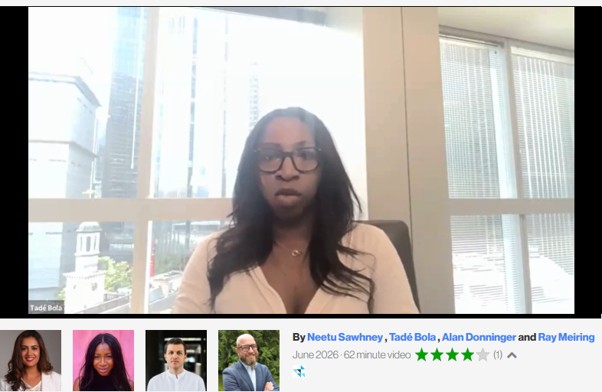
PM Forum’s June webinar resonated. Neetu Sawhney (Head of Pitching, Herbert Smith Freehills Framer) moderated a panel including Tadé Bola (New Business Team Lead at Latham & Watkins), Alan Donninger (Pricing Manager, GenAi and technology) and Ray Meiring (CEO and co-founder QorusDocs) on AI’s impact on bids and pricing in professional services. But what struck me most was that for both bids and pricing, there appears to be a need for firms to up their game on developing value propositions.
The main themes explored here are:
- Fast-changing landscape for pitches and tenders
- The new bid landscape in professional services
- Impact of artificial intelligence on pitches and tenders in professional services
- Why aren’t we getting better results? Why isn’t AI landing better?
- Impact of AI on pricing in professional services
- My reflections on pricing and value propositions in professional services
PM Forum members can watch the hour video: Beyond efficiency: AI’s real impact on bids and pricing in professional services
Fast-changing landscape for pitches and tenders in professional services
Panellists commented that the pitching landscape was unrecognisable from how it was a few years ago. Clients expect firms to use AI. And clients are often ahead of firms in their use of AI. Some of the discussion was about the impact of AI on pitch processes. Clients want to see how AI use translates into stronger value propositions, smarter pricing and better outcomes.
The role of pitch teams is broad:
- client and market intelligence
- managing the pitch process
- develop pitch strategy
- co-ordinating responses through multiple stakeholders
- structuring fees
- producing documents and presentations
- ensuring compliance with firm policy and client requirements
- integrating technology (including AI) into pitching for complex mandates
Two years ago AI was barely mentioned. Now there’s almost universal acceptance that AI will be used both in the pitching process and the delivery of the professional work. You can gauge a client’s AI maturity from an RFP – vague questions show they are early in the journey. And clients are asking a broader range of questions about AI within their RFPs.
Whilst acknowledging we are in a transition period towards greater AI use, the situation is moving fast.
The new bid landscape in professional services
The reality on the ground is that there is enormous noise about AI and pitching – many vendor promises, regular LinkedIn posts and much conference rhetoric. Proposal teams are fielding questions on AI from all directions – internally and externally.
The largest firms are spending 7% of global revenues on technology. Then there is further investment in training and development to be factored into prices.
Panellists reassured everyone that AI doesn’t work alone and won’t take over jobs. But it needs people who understand how to use the right prompts. AI can help provide structure and can help develop a good first draft in many scenarios.
They observed that there is a massive increase in the number of RFPs out there. A panellist mentioned that every year they run a survey with 1,500 people. The volume of RFPs is climbing and the pressure increasing as timelines compress. There is an assumption that AI will enable us to manage the higher volumes.
It was noted that our natural reaction is to use AI to draft and find answers. But the real value is to consider the processes around RFPs. For example, using AI to analyse historical data and help decide whether we submit a response to a RFP. Another example is using AI to manage the administration around clarification questions and to provide summaries of responses. Or using AI to run the RFP process. These AI applications increase productivity as by choosing the right RFPs, we can achieve a better outcome as we have more time to spend on the chosen bids.
Impact of artificial intelligence on pitches and tenders in professional services
There were numerous descriptions of how AI is being used in the pitching process:
- Manage responses to RFPs
- Support market and client research
- Analyse critical elements and questions in RFPs
- Assess and prioritise the scope of RFPs
- Draft responses to RFP questions
- Assess responses and content
- Check quality and consistency of responses
- Support data-driven pricing strategies and negotiations
There was discussion around using AI to assess the RFP document and the draft submissions. Increasingly, there is an AI-to-AI loop – where AI is being used to construct RFPs and questions and also used to assess those questions and formulate answers.
Likewise, there are increasingly questions relating to AI used in RFPs which need careful responses.
There was recognition that bottlenecks have never been in the drafting of materials. And drafting isn’t the hard part anymore. It was suggested that for transactional RFPs you could probably get 80% of the response through AI. On more complex RFPs, AI can help you to get to 50% or 60%.
AI is not a “magic button”, but it’s taking a lot of friction out of the process. AI helps in the co-ordination, consistency and compliance of the pitch process.
AI helps manage the review loops. AI helps teams with summarising and finding where we have answered similar questions before. It helps us to be more efficient with our own data. And helps with reviewing, refining and restructuring information.
As AI can help us get to an answer faster – there’s an expectation that the answer will be better. AI allows us to spend less time on the low value mechanics we’ve had to do over the years to get pitches out the door. It helps us surface our most relevant content. The human in the loop is vitally important – we have to understand the client and understand the partners.
Bid professionals decide on the workflow, and identify what gets automated so they can concentrate on where we add value to differentiate from other firms.
From a strategic point of view, firms need to demonstrate in RFP responses how they are using AI – and how their approach is different to and better than others. Evidence is also required to demonstrate actual AI use cases too.
Naturally, there was a focus on the QorusDocs system – an AI-driven tool to help firms pitch and automate their pitching process. Although there was recognition that there is an ever-growing range of AI systems and tools to assist the process. A key issue is knowing how these systems integrate and when and where to use them. I recently reviewed a purpose-built AI system to manage pitch and tender document production (see System review – Referonix AI pitch automation system – Kim Tasso)
The panel’s conclusions were that there is a redistribution of effort – shifting from process to judgement and from efficiency to value.
(Subsequent to posting this article, I was contacted and alerted to a system designed for those tendering in property and built environment sectors.
Kantiv is a pursuit intelligence platform for architecture, engineering and construction firms. It analyses RFx requirements and surfaces the past projects with the strongest proof points before drafting begins, builds first drafts from a traceable knowledge base, and checks every requirement for compliance before submission. Users include Mortenson, PCL Construction and Woodard & Curran.)
Why aren’t we getting better results? Why isn’t AI landing better?
There was consideration of what do we need in place to get the expected AI results.
Initial expectations were high – and not aligned with where firms were or are with AI. There were initial concerns about confidentiality – protecting documents and data. And changing policies and processes to give AI access to the right content.
10 years ago the main challenge was finding content, that is now secondary. The top challenge now is accessing subject matter experts and achieving collaboration within timescales. So it is now about co-ordinating and managing the people around the systems. And the change management element – changing bid processes.
There was recognition too that we need to unpick some processes to take advantage of AI. Using the technology to help with structuring and not just drafting. To use AI to avoid starting with the dreaded blank page and double check content with AI initially rather than colleagues. Some panellists suggested using AI like a second person in the room to test the logic, structure and tone. Others mentioned AI’s role in consolidating feedback and reducing review loops.
There is now a need to leverage a suite of AI tools and co-ordinate workflows. More AI tools arrive and people have to learn to use them – learn how to prompt them well. The next phase is agents – which are more autonomous and listening to and picking up where we are in the process, being proactive to – for example – do a compliance check. (PM Forum members can read about Ben Lee’s Profile event review : AI agents at GIA surveyors)
Panellists suggested we need a front end for all these AI tools – to consolidate data, knowledge, tools and resources. To help BD professionals and fee-earners to figure out which systems to use and when. If they are given one place to access them, this will drive up adoption. Engagement is important as there are lots of different AI applications and always something new. Theres a lot to take in.
There was some discussion about hallucinations – and questions about how you know that AI has given the most up to date and correct content. Panellists commented that we have all seen examples of this and that the models are improving with the latest versions. And we are getting better at detecting where answers could be wrong. Also, there were comments that your content had to be good and human intervention was needed to ensure content libraries were accurate and up to date. Some commented about the AI to AI loops – with AI in one system checking outputs from AI in other systems. And, of course, the human in the loop for ultimate checks.
There was a general observation that how you manage and leverage operational and legal data and systems within AI processes is critical. Change management effort is heavily underestimated and a culture of experimentation is needed. While AI disrupts the legal industry, those with a culture of adoption (experiment fast and fail fast) will win. This is not a tech problem but a data and behaviour change problem.
Other advice included:
- Good quality data has to be there – Don’t skip this foundation
- Do the storyboarding – develop proper strategic messaging that differentiates
- Think about the client connection – some tend to do this at the last minute so rarely have enough time to focus on client
Impact of AI on pricing in professional services
The core issue was how to articulate value in an AI-enabled market.
Kirkland & Ellis is reported to have spent $500m dollars to build its own AI tool. Some firms are using the same tools. Clients will become less tolerant of inefficiency. But it’s not just about the technology – firms invest in data, methodology and training.
There was much talk of the “efficiency dividend”. Many firms still use billable hours as the basis for pricing. There have been reports that AI can lead to resource reductions of 30% – some of this efficiency gain can be shared with clients but we can’t pass it all on clients. When clients learn of efficiencies gained with AI, they ask about whether there is a reduction in fees. There is a danger here of a race to the bottom on fees. And a widening of the gap between commodity and premium services.
Panellists commented that the hourly rate as a foundation for pricing is deeply embedded. But there are now many reasons to move away from hourly rate. A hybrid approach to pricing is emerging.
Firms need to drive conversations from efficiency to better service and outcomes. AI will free up lawyers to spend more time on value-creating activities. Firms need to articulate what clients are really buying. There’s a financial risk for firms as AI can compress delivery time – and without care on pricing – revenue reduces.
We need to take a step back and recognise that the value of our service is not time. As adoption of AI continues, we will see traditional structures where work passed to junior lawyers declining. Senior lawyers need to learn to interpret information from AI. We need to move more to value pricing.
Firms get faster answers and more certainty with AI. High value judgement work will attract premium rates. Innovation in delivery models should enhance profitability – not reduce it. If AI does the more basic stuff then partner judgement and interpretation becomes MORE valuable.
Communication is important. Extend the client conversation. Take the client on the journey with you – help them understand the technology and how lawyers are using it to deliver better outcomes. Be more transparent. The impact of the technology can be quantified.
Clients are paying for judgement, experience and ability to manage risk and outcomes they seek
Panellist conclusions
Panellists shared their key thoughts:
- Create competitive advantage and communicate it – that’s the real battle ground
- In the AI environment our ability to communicate culture, personality, human connection and not just operational efficiency will separate us
- We are all using AI tools – so we must move the conversation beyond what we do to how we think, approach the problem and work with clients with the right tone of voice
- Be clear, honest, open and deliberate in your use of AI
- Be clear about the client’s problem – show you understand the nuance and that you are the right firm
- Strong AI implementation – aligning process, content and people – will deliver value
- People buy people
- Focus on the strategic and human-to-human elements – connect to clients’ needs
At present using AI to improve our pitch performance is an opportunity. But like all things, if we do not grasp the opportunity and adopt the technology soon it will become a threat.
My reflections on pricing and value propositions in professional services
Perhaps because I have been working with professional services firms for so long, I had a sense of déjà vu about the pricing question.
There have been many technology leaps for professional services firms – notably but not exclusively: email, knowledge management databases and the Internet. In every situation firms faced a “double whammy” – on one side to bear the cost of investment and deployment of that technology and on the other, pressure from clients seeing firms doing work faster and wanting a reduction in the price. This creates a potential lose:lose scenario for firms – lost money on technology investment and lost money on lower prices. Yet the key issues – the expertise, methodology and value delivered to clients somehow got lost in the pricing discussion.
The fundamental flaw here is that the billable hour has led firms and clients to equate time with cost as the basis for pricing. So less time naturally equals less cost. This disregards the cost of investment in the technology to achieve that time saving. The issue of price – and perceived value – was lost.
Some of the most challenging work we do as marketers is around value propositions. Conducting deep analysis into what value the clients derive from using our services. There are some important voices out there talking about value pricing. It’s been rumbling along for decades. But hopefully the advent of AI will prompt firms to properly consider the value they deliver to clients – whether that’s risk reduction, saving money, securing strategic deals, minimising waste or simply better, faster, more innovative and better solutions.
Develop your value proposition (and a personal story) – Kim Tasso June 2026
Pitching and Tendering – Process, Propositions and Presence – Kim Tasso May 2026
Pitching – Focus on the client’s needs (Let the client do the talking) May 2025
Pitching, differentiation and competitor analysis June 2023
Malcolm McDonald on value propositions – How to develop them May 2019
What is a value proposition or USP – and how do I create one? October 2011
Integrating marketing and selling with value propositions August 2011
Related posts on pitches and tenders in professional services
Book review: Building B2B Relationships June 2026
Pitching and Tendering – Process, Propositions and Presence – Kim Tasso May 2026
System review – Referonix AI pitch automation system – Kim Tasso April 2026
client feedback playbook – How professional services firms January 2026
Tendering and pitching – Key ideas and actions – Kim Tasso November 2025
Sales processes and skills – MBD support for the nurturing gap? October 2025
Arup and GHD pitch automation and AI October 2025
Perfect Pitch Process – Don’t just parachute in the fee-earners May 2025
Pitching – Focus on the client’s needs (Let the client do the talking) May 2025
Book Review: Strategic Tendering for Professional Services April 2025
Pitching and tendering – Manage objections – Kim Tasso August 2024
You’re not listening – What you’re missing June 2024
Pitches, tenders and proposals – Efficiency (systems) May 2024
Book review: Sales Mind – 48 tools to help you sell (kimtasso.com) January 2024
Pitching, differentiation and competitor analysis (kimtasso.com) June 2023
Pitch points from a pitching and tendering training workshop (kimtasso.com) April 2023
PM Conference Report 2022: Strategy implementation (kimtasso.com) November 2022
Pitching insights – Qualification, Branding and Following up (kimtasso.com) October 2022
Five Spice Girl lessons from a pitching workshop (May 2022) (kimtasso.com) May 2022
Pitching and tendering – Focus, differentiation and less is more (April 2022) (kimtasso.com) April 2022
An introduction to presentation skills – Easy as ABC (Video) (kimtasso.com) March 2022
Insights on pitching – Online, virtual, productivity, confidence (kimtasso.com) December 2021
pitch insights – M&BD adding value, pitch processes, knowledge base (kimtasso.com) October 2021
Practical sales tips: Reach out and Follow up (kimtasso.com) October 2021
Non-Verbal Communication (NVC) – the basics (Video) (kimtasso.com) August 2021
Seven pitching themes – specialisation, engagement, research, content (kimtasso.com) May 2021
Perfect pitches – Five key points (Video) Kim Tasso February 2021
Pitch Points – Five thoughts from a pitching and tendering workshop (kimtasso.com) January 2021
marketing case study – Transformational change in Savills’ bid processes (kimtasso.com) November 2020
Soft skills – Boost your self-confidence and confidence (Video) (kimtasso.com) October 2020
The growth of MarTech in professional services – an overview (kimtasso.com) March 2020
Pitching and Tenders – Nine top tips and client feedback (June 2019) (kimtasso.com) July 2019
Winning pitch presentations – tips for competitive tendering (kimtasso.com) May 2017
strategic tendering (kimtasso.com) May 2017
Selling – research in the pitch process (kimtasso.com) October 2016
perfect pitches and tenders in professional services (kimtasso.com) October 2015