

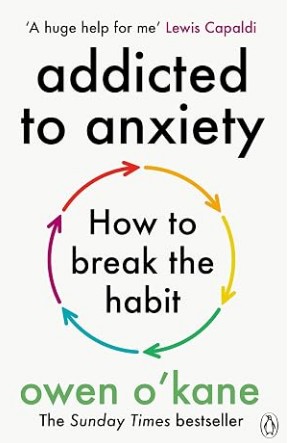
This is a review of a book to help those experiencing anxiety. The subtitle of this Sunday Times bestseller is “How to break the habit” – the author explains the nature of anxiety and offers a route to break the anxiety cycle and build healthier thinking habits. There’s a fair amount on emotional regulation. And everything is written in an accessible and warm style so it’s an excellent guide for self-help and psychoeducation. It can be used to supplement therapy (or even instead of therapy for those who want to try a self-help solution). Book Review: Addicted to Anxiety by Owen O’Kane
About the author of Addicted to anxiety – Owen O’Kane
Owen O’Kane is a psychotherapist and one of the UK’s leading mental health experts with over 25 years’ experience. He is a former NHS mental health clinical lead specialising in anxiety and trauma.
As a Sunday Times bestselling author, he excels at making complex information accessible and understandable. He’s also a resident expert on BBC Radio 5 Live.
He describes himself as “Irish, Catholic and gay”. He grew up in Northern Ireland – in a culture of fear where he learned to be anxious. He shares that he used to play piano to help soothe himself as a “sensitive gay kid”.
Overview of Addicted to Anxiety
This 2025 book (300 pages) is clear and warm throughout. It has numerous celebrity endorsements (e.g. Lewis Capaldi and Davina McCall). The author shares stories, examples and specific tools that might help with anxiety. And he writes in a simple, clear style that is reassuring – it is almost hypnotic. And he regularly summarises the points made to help readers and to prompt them to reflect on their own experiences.
Like myself, as a therapist he adopts an integrative approach – and includes psychology, neuroscience, humanity, physiology and a degree of spirituality in his approach. He is realistic – he explains that anxiety will not disappear but that you will recover and reclaim your life. He also assures readers that they are not unusual in suffering from anxiety – it is part of the human condition.
Like several other prominent anxiety experts – he suggests that rather than avoid anxious thoughts you acknowledge them, observe them, welcome them, be curious about them and then let them go.
Using the ideas and techniques in this and the other books mentioned – as well as those methods taught during psychotherapy training – I have helped many clients relieve the anxiety they experience. Whether it is anxiety relating to work, health, relationships or anything else.
Individuals need different approaches to tackling their anxiety, other book reviews relating to anxiety include:
Stop letting everything affect you by Daniel Chidiac (Overthinking
Book review: The Gift of Anxiety – Harnessing the EASE method
Book review – Feel the fear and do it anyway by Susan Jeffers
CONTENTS of Addicted to anxiety
Section 1 – The root of the problem
- Meeting your anxious self
- Understanding anxiety addiction
- You
Section 2 – Breaking the habit
- Deactivating the state of alarm: the body
- Anxiety: It’s emotional
- Detaching from anxious thoughts
- The Rascal: Addictive Anxiety Behaviours
- Addicted to controlling energy
Section 3 – Reclaiming your life and relapse prevention
- Unaddicted to anxiety: Preparing for the road ahead
- Hope and the future
Epilogue: A letter to your anxious self
Introduction
We’ve become the anxious generation. (Note: in the book “The Anxious Generation”, Jonathan Haidt argues that the shift from a “play-based childhood” to a “phone-based childhood” has triggered a global mental health crisis among youth. He asserts that essentially, the use of digital devices and over-protective carers are the cause). Workplaces are struggling to cope with levels of illness linked to anxiety – following the pandemic, economic challenges, wars, political instability and climate change – the world feels increasingly scary.
He observes that many anxious people feel anxious about the prospect of not being anxious – some suggesting that it is harder than weaning yourself off cocaine. Because the chemicals produced in the body during an episode of anxiety are comparable to those produced when excited – so we develop an unconscious dependence on this reaction (e.g. “if I feel anxious, it will keep me safe”). The anxiety process temporarily helps us deal with not feeling safe or certain.
Our nervous system is hard-wired for threat. So we have to actively let go of the many patterns you we are addicted to – to stop fuelling the fire that keeps it going. Anxiety gives a shot term sense of safety but a lifetime of suffering.
He explains that you can’t recover from anxiety in one day – it is a combination of breaking patterns of mind, body, emotions, behaviours and energy.
Section 1 – The root of the problem
Meeting your anxious self
Anxiety rarely comes alone when you suspect that a new task could present risk or threat, it brings self-doubt, catastrophising, dread and fear. Our body and breathing changes at the alarm. And we overthink. Anxiety serves the function of protecting us. We need to talk to anxiety with facts.
Your anxious self is a part of you on which you may have developed an unhealthy dependence. Anxiety is something happening to you, it is a humane part of you – its aim is to help you, but often it creates significant distress.
Recognise your anxious self: body, mind, feeling, behaviour and energy aspects. There’s clarification on the difference between anxiety and stress. In your body, anxiety is a state of alarm that prepares you for a threat – the fight, flight, freeze or fawn response.
Within the 60,000 to 80,000 thoughts per day, your mind may overthink and ask “what if?” questions. Feelings might include emotional arousal of fear, dread, doom, anger, protestation and powerlessness. He notes that anger is an easier emotion to access and submit to than anxiety or sadness.
Behaviours include avoidance, seeking reassurance, numbing and distracting or hypervigilance, catastrophising. OCD is where a person may feel a compulsion to behave in a certain way as they believe that if they don’t do something then something awful might happen. Anxiety has an energetic force – highly charged or lower emotionally charged. Anxiety is living in a state of fear. Anxiety is an ally, not an enemy (see Book review: The Gift of Anxiety – Harnessing the EASE method). Be curious and open to the lessons your anxiety might have.
Understanding anxiety addiction
He explores various theories of addiction but explains that it is a dependency. Often to escape pain. And compassion aids recovery. He explores the psychological addictive processes of anxiety. Anxiety adjusts your state of being. You move to a heightened state of alert and the promise is safety. A person with anxiety may be in an internal state of chaos but still highly functioning in everyday life.
In some families, love and fear co-exist. Neurological hardwiring of anxious patterns begins early, even in what at first appears to a happy family – if emotions are suppressed. We now all live in stressful worlds. We can move from recognising anxious patterns to recovery. He frames anxiety as an addiction and habit where the cycle is hard to break. You can only start to recover when you recognise you have a problem. There’s a short anxiety assessment here.
You
The author shares some psychoeducation on the various approaches to anxiety. You may feel frustration when you learn that you are both part of the problem and the solution. In therapy we hold up a mirror to others. As we need people to take responsibility for their anxiety.
The six foundations of his approach:
- Acknowledgement and acceptance of the addictive components of your anxious self
- Taking responsibility for your part in recovery
- Amendments to lifestyle that support recovery
- Relating to your anxious self with compassion and non-judgement
- Accepting that you are not powerless
- Accepting anxiety as a temporary state
“Anxiety can be like a stubborn child having a tantrum”. You have to acknowledge and reassure your child – the same as with your anxiety. Your anxiety has a role to play – to protect you.
Section 2 – Breaking the habit
Deactivating the state of alarm: the body
This explains the physical symptoms of anxiety and the mind-body link. The chemicals released in anxiety create a chemical high – similar to when we feel excited. Anxiety reactions can bring a feeling of familiarity and safety. And some people are reluctant to let them go – thus the framing as addiction. The author suggests exploring where you are feeling anxiety in your body. It requires new habits to be installed – reprogramming neuropathy communication in your brain.
Physical sensations often associated with anxiety:
- Rapid heartbeat
- Rapid breathing
- Dry mouth
- Pins and needles
- Trembling
- Dizziness
- Sweating
- Tummy churning
- Headache
There are also less obvious symptoms such as: chest tightness, jelly legs, heat, lump in throat and hypersensitive skin. There’s a six-step process (SIMPLY) to deactivate physical anxiety:
- Space – step out to look in (be present and in the moment)
- Identify – assess what’s going on
- Meet, greet and enquire – explain you are here and be curious about your anxiety
- Pacify – quieten the body
- Let go – release the symptoms
- You – you are always the solution
On regulating your emotions, there are mentions of grounding and breathing techniques (see Grounding tools (support for emotional regulation) – Kim Tasso) and the need to create a new “head scape” and to give it a name. He also talks about tapping (bilateral stimulation) to help you achieve immediate relief from the physical symptoms of anxiety.
Anxiety: It’s emotional
This chapter digs deeper into the importance of anxiety as an emotion and your addictive relationship with it. And the author shares a simple method to changing your relationship with your emotionally anxious self.
To understand anxiety as an emotion – consider the thought-feeling dichotomy. There’s an exploration of what emotions are – and that they have a beginning, middle and end. Some argue that there are six or eight primary emotions – other as many as 34,000. (there’s more information on emotions here (How to manage your emotions so they don’t manage you).
Anxiety can be emotionally triggered in everyday life. When feeling anxious, we are experiencing anxiety as a broad emotion. However, we also feel related feelings: dread, doom, worry. Anxiety can never be considered as a singular emotional state – other emotions will always be present.
Anxiety is a multifaceted signposting process aiming to support you. Curiosity and openness to its message can be life changing.
The emotional state of anxiety has evolved – it has become a highly charged, vigilant, persistent and powerful emotion that aims to keep you safe in a world where you are constantly faced with threat. Anxiety is related to life experiences in the past – threat, abandonment and attachment issues.
The purpose of the emotional anxious self is to prompt you to consider who can comfort, reassure, calm or look after you. It’s an energy state – think of it as traffic lights.
We can develop an addiction to blocking and clinging to emotions. This is known as avoidance or overidentification/reliance. Some people block emotions (i.e. avoid, deny, repress, numb, run etc) and other over-rely on them. If you aren’t dealing with emotions, you aren’t allowing them their rite of passage.
Letting the emotion through is the beginning of freedom. He offers the HEART technique:
- Help – Emotional states are usually linked to unmet needs or unresolved issue – so respond: “I am willing to help”
- Embrace – Embrace emotions and feelings as welcomed guests. Visualise them if necessary
- Accept – Accept that the emotion has a right to be there
- Respond – Be curious and open about the emotion – ask what it needs
- Trust and let go – Having allowed time to process the emotion, let it go
Detaching from anxious thoughts
He explains how the mind works and how attachment to thoughts occurs so it becomes overthinking or addictive thinking. This primarily involves the amygdala which is activated in fear situations. He describes the four qualities of anxious thoughts – drama, detail, distraction and (secondary) gain.
He explores the common themes of anxious thoughts. He offers two tools to circuit break habits: a new relationship with your thoughts and the art of letting go. He reminds us to notice that you are not your thoughts. The author refers to the massive turning point in his life by reading Book Review: The Power of Now by Eckhart Tolle
Anxious people need to recognise that everyone has negative thoughts – so don’t hold onto them and don’t judge yourself for them. There’s reassurance from research that 90% of our worries come to nothing. To help you let go of anxious thoughts he suggests a tool called AWOL (four steps to disengagement):
- Acknowledge
- Watch (for old habits)
- Observe
- Let go
He acknowledges that the part of your brain responsible for habits (basal ganglia) may react to new approaches.
The rascal: Addictive Anxiety behaviours
The three behavioural aspects of the anxiety “rascal”:
- Battling life – demanding certainty, self-sabotage (fight)
- Running for the hills (flight)
- Burying your head in the sand (freeze)
Fighting, resisting and battling with anxiety behaviour, in an attempt at moving them on, in fact maintains them. Your anxious self actually needs a sense of flow and ease. Anxiety isn’t a battle to be fought. It’s a part of the human condition to be embraced and nurtured.
Flight behaviours include escaping, obsessing, compulsivity, hyperactivity, busyness, hypervigilance, excessive talking, excessive stimulus, overcompensating and exhaustion.
Freeze behaviours include: avoiding, denying, repressing, delaying, neutralising, anaesthetising, burying, pretending and isolating.
These are all safety behaviours – which we use to feel better quickly. They tend to create relief in the short term – but in the longer term they maintain the anxiety. So it becomes an automated addictive response. These responses need disrupting or they become an addictive entrapment and become a “stuckness”.
There’s a dual role for these behaviours – to soothe or to save. The author recognises that it is hard to change behaviours. He suggests making an agreement with yourself: “If I want my anxiety to improve, I need to disrupt the unhealthy behaviours that keep it going”.
He identifies four categories of obstructive behaviour:
- Cold turkey – complete withdrawal from old behaviours
- Dependency and craving – missing and needing the old behaviour
- Intolerance of and impatience with short term discomfort
- Need for control
How to disturb behaviours – you need a plan:
- Understand why and keep in mind WHY you are altering that behaviour
- Commit to repeating the new behaviour (you are rewiring your brain) – and take accountability
- Plan the disruption – know what you will do instead
- Gradual but consistent – be gradual and phased in your changed behaviour. Never take yourself beyond a tolerance threshold that feels manageable
Keep notes on your progress – practice a form of anxiety journaling.
Addicted to controlling energy
The author believes you may be addicted to trying to control the flow of energy in your life, which is resulting in greater anxiety. Anxiety lessened when a person was able to stop blocking the energy they were resisting – when they allowed life to be as it was. It’s well documented that a belief in a higher power is helpful in reducing anxiety.
Energy is a combination of science, spirituality and human factors.
We need to notice energy shifts and our need to control them. Our quest for control of energy is the cause of resistance, which consequently creates an anxious state.
Five blocks to energy:
- Not accepting the one certainty: life is uncertain
- Hyper-attachment – the need for control
- Insisting how life should be – our preferences
- Turning everything inwards – ego
- Lack of trust – letting life be
Section 3 Reclaiming your life and relapse prevention
Unaddicted to anxiety: preparing for the road ahead
You can become unaddicted to anxiety but your anxious self will be a companion for the remainder of your life. There is a new relationship between two parts – wisdom and fear. He asserts that your way of life must change to support living a less anxious life. He lists some sensible, well-known lifestyle stabilisers including balance, food, exercise, sleep, moderation, reducing caffeine, relaxing, limiting screen time and connecting with people.
Four phases of recovery:
- The honeymoon period
- Relapses, triggers and set backs (so focus on staying on track today)
- Anxiety in new drag
- Making amends to the anxious self
He then addresses the most common questions he receives on recovery. Reminding us that relapses are not a problem or abnormal. He offers some wise words on whether or not to (re)take medications to help with anxiety – suggesting that it really depends on you and your situation.
He also suggests that recovering from an anxiety addiction may help relieve other mental health issues such as depression, OCD, PTSD and ADHD.
Hope and the future
There’s a lot of scientific research highlighting the benefits of hope. It strengthens your self-belief. There’s guidance on how to step into hope. And how not to hold on to rehearsed stories you may have about anxiety. He shares stories about clients who recovered from addiction to anxiety and had their lives transformed.
The author is brave and explains that even though he is an anxiety expert – he still feels vulnerable and anxious and struggles sometimes. Even with his dual psychology and medical background.
Favourite quotes from “Addicted to anxiety”
- The chemicals produced in the body during an episode of anxiety are comparable to those produced when excited
- My anxiety is serving the function of protecting me
- Keep in mind that anxiety is a state of alarm
- Anger is an easier emotion to access and admit to than, say, anxiety or sadness
- Anxiety adjusts your state of being. You move to a heightened state of alert. And the promise is safety.
- A person with anxiety may be in an internal state of chaos but still highly functioning in everyday life
- Your aim is to become the observer of the anxiety in your body. You are not identifying as the anxiety.
- It’s never an easy moment in therapy when you figuratively hold a mirror up to someone
- Anxiety can be like a stubborn child having a tantrum. It won’t give up until there is some acknowledgement or response to it
- Don’t worry, you’re not ‘losing it’, ‘going mad’ or ‘out of control’. You are in a high state of alert, nothing more
- Anxiety is an intolerance of uncertainty
- Anxiety is part of the human condition
- We have around sixty to eighty thousand thoughts per day…it is estimated that around 70% of these are negative in nature
- Research tells us that around 90% of our worries come to nothing. The other 10% are rarely as awful as imagined.
- Fighting, resisting and battling with anxiety behaviour, in an attempt at moving them on, in fact maintains them
- Burying your head in the sand will make you more anxious
- People get addicted to behaviours that they feel help them cope and survive.
- You already know that intolerance of uncertainty is a dominant characteristic of anxiety
- The problem is that we often carry our early ‘roles’ into our adult lives when they are no longer needed
- The reality is that your anxious self will be a companion for the remainder of your life
- You are the caretaker of your anxious self
- Most of the research confirms that anxiety tends to increase during stressful times in life
- Hope was knowing that morning always arrives. Nighttime is never permanent.
- The only person who can make the necessary changes to your anxiety is you
Related articles on anxiety, mental health and therapy topics
My therapy web site is: Tasso Talking Therapy (Please don’t hesitate to telephone or email for an informal and confidential chat about mental health or therapy)
Articles on mental health and therapy
All change? Mental health in the legal sector – Kim Tasso August 2026
Confidence – Does it increase as we get older and wiser? – Kim Tasso July 2026
Emotional Intelligence in legal practice (Globe’s Fundamental Skills July 2026
Grounding tools (support for emotional regulation) – Kim Tasso April 2026
Healthy boundaries at home and at work – how to set and maintain January 2026
Confidence – Radiators and Drains and the 90 second rule January 2026
The stress bucket, healthy coping mechanisms and resilience December 2025
What do I do if I’m feeling stuck? – Kim Tasso October 2025
Improve mental health at work, in marketing and for women September 2025
Assertiveness toolbox – Kim Tasso May 2025
What happens in therapy? – Kim Tasso April 2025
Confidence to overcome a fear of failure – Kim Tasso September 2024
my relationships like rollercoaster rides? Volatile relationships (kimtasso.com) August 2024
How do you choose a therapist? – Kim Tasso July 2024
Emotional Regulation – A key element of Emotional Intelligence (EQ) (kimtasso.com) August 2021
Psychology and business communication (kimtasso.com) January 2015 An introduction to Transactional Analysis (TA) and the Parent Adult Child model
10 tips to increase your resilience – Kim Tasso March 2013
Therapy and counselling self-help book reviews
How to manage your emotions so they don’t manage you June 2026
Stop letting everything affect you by Daniel Chidiac (Overthinking May 2026
Book Review – ADHD 2.0 by Edward M Hallowell MD March 2026
Book review: The Gift of Anxiety – Harnessing the EASE method December 2025
What happened to you? Conversations on trauma, resilience November 2025. Book review: What happened to you? Conversations on trauma, resilience and healing by Bruce D Perry (psychiatrist) and Oprah Winfrey
Introduction to Internal Family Systems (IFS) October 2025. An overview of the therapeutic approach IFS that seeks to explore your internal parts – the exiles, managers and firefighters – and develop a greater sense of self and calm.
Attached by Dr Amir Levine and Rachel Heller August 2025. How attachment theory can help you understand your relationship style – secure, avoidant and anxious.
Book review – Feel the fear and do it anyway by Susan Jeffers June 2024. Classic self-help book on managing anxiety
Book review – Counselling for toads May 2025. The modern classic explaining Transactional Analysis (TA) using a story by Robert de Board using Toad and other characters from “Wind in the Willows”
Book Review: The Power of Now by Eckhart Tolle March 2025 A best-selling guide to ceasing your incessant thoughts, focusing on the present “here and now”, spiritual enlightenment and finding inner peace.
Overcoming low self-esteem – a self help guide using cognitive behavioural techniques by Melanie Fennell January 2025
Book review: Taking charge of Adult ADHD by Russell A Barkley (kimtasso.com) October 2024
“Adult children of emotionally immature parents – how to heal (kimtasso.com) August 2024 An excellent book that has helped several clients suffering from anxiety, depression and “failed” relationships. How to recognise emotional, driven, passive and rejecting parenting styles and the coping mechanisms adopted (e.g. people pleasing, high independence etc).
Book reviews on stress and trauma – “When the body says No” (kimtasso.com) June 2024 Review of “When the body says no – The cost of hidden stress” by Gabor Mate and “The body keeps the score – mind, brain and body in the transformation of trauma” by Dr Bessel Van Der Kolk
Book review: The Thriving Lawyer by Traci Cipriano (resilience) (kimtasso.com) June 2024 A review of a book into the mental health and resilience of lawyers in law firm cultures. The author is a former practising attorney and clinical psychologist.
The Tools – Five life-changing techniques to unlock your potential (kimtasso.com) April 2024 A review of the book by psychiatrist Phil Stutz
Book review – Creating self-esteem by Lynda Field (kimtasso.com) March 2024 A classic book on realizing your true self worth
Book review: How to do the work (recognise your patterns (kimtasso.com) December 2023. Review of a book to support psychoeducation. Topics include: conscious self, theory of trauma, mind-body healing practices, inner child, boundaries, reparenting and emotional maturity.
Dr Julie Smith (Mental Health Guidance) (kimtasso.com) July 2023. Review of the book “Why has nobody told me this before?” that explores helpful ideas on low mood and depression, motivation, anxiety, emotional pain, grief, self-doubt, fear, stress and a meaningful life.
Overcoming clinical depression (2021) by Oliver Kamm (kimtasso.com) March 2023. A review of the book “Mending the Mind” which explores what it is like to suffer from depression and both the medical and psychological sources of help.
Lost connections – Why you’re depressed by Johann Hari (kimtasso.com) October 2019. A review of a popular book about the nine common reasons people suffer from depression.
Crazy busy – Book review – Dealing with stress (kimtasso.com) October 2009. This book examines modern life and offers practical advice to avoid stress and restore calm.
Book review: The psychology of successful women by Shona Rowan (kimtasso.com) June 2022. Topics include: confidence, assertiveness, boundaries, public speaking, impact, influence, visibility and bouncing back from setbacks.
Your personal transition – Endings, neutral zone and new beginnings (kimtasso.com) June 2020. Helps you navigate major changes in your life and prepares you for the emotional roller-coaster of change.
Short videos on therapy and mental health topics
Soft skills – Boost your self-confidence and confidence (Video) (kimtasso.com) October 2020
Business relationships – Using the drama triangle to resolve conflict (kimtasso.com) September 2020
How the parent, adult, child (PAC) model helps with difficult interactions (kimtasso.com) September 2020
Change process – Emotions when reacting to change (kimtasso.com) April 2020
Building Resilience – Regulation, Reframing, Relationships and Reflection (kimtasso.com) May 2020