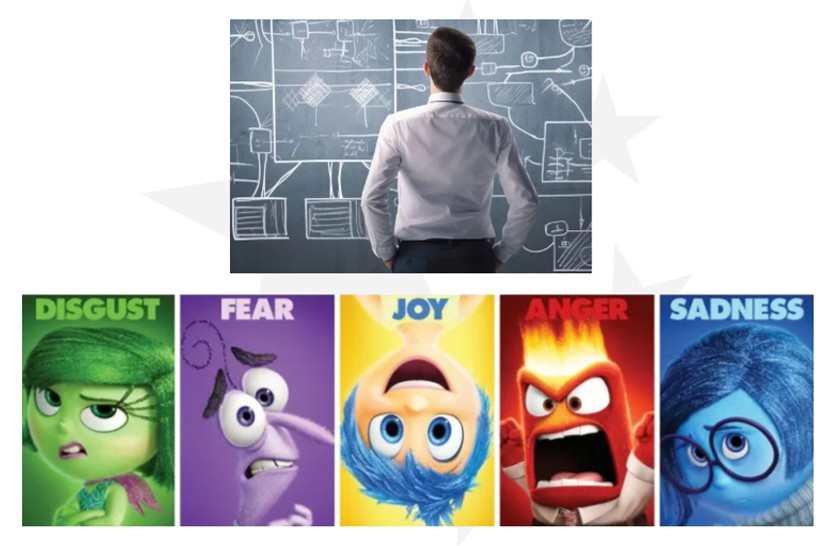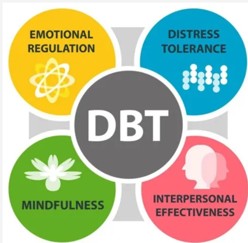

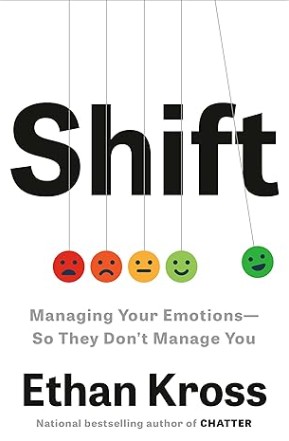
I’ve been asked several times recently to write and advise on emotional intelligence. Particularly with regards to how people can improve their management of emotions (emotional regulation). Most therapy clients want help in mastering their emotional life too. This 200 page, 2025 book by an American professor (who leads an Emotion and Self-Control Laboratory) is quite a long read. But it’s interesting, insightful and practical – there are multiple tools outlined. Key ideas are conveyed through engaging stories and psychology research for psychoeducation. Book review: Shift: How to manage your emotions so they don’t manage you by Ethan Kross.
Overview of “Shift: How to manage your emotions so they don’t manage you” by Ethan Kross
“As long as humans have walked this planet, we’ve struggled – mightily – with our emotions”.
This enjoyable book takes us from understanding what emotions are – both the positive and negative ones – to what they are, why they matter and how to harness and manage them in different situations. It considers the difference between emotions and feelings and how they interact with our thinking, cognitive abilities.
There are plenty of engaging stories of emotional regulation from happiness gurus, Holocaust survivors, Navy SEALs, military professionals, sports people, students, astronauts and ordinary folk. The stories are interspersed with lots of evidence and scientific studies.
It’s a fantastic resource for psychoeducation to help people achieve better emotional regulation – which is bread and butter work for therapists.
A key message is that there’s “no one size fits all” for emotional regulation. You need to find tools that work for you in different situations. And the book goes through many different tools, which I’ve summarised as follows:
- Be aware of your emotions
- Identify and label the emotion (affect labelling)
- Disrupt the emotion by distracting yourself
- De-sensitise yourself by facing your fears and building a sense of self-efficacy
- Use our senses
- Use music or calming sounds to shift mood
- Harness your senses of touch, taste, sight and smell
- Write a journal to reduce anxiety
- Confront negative emotions head-on at a time of choosing
- Compartmentalise difficult emotions and face them sporadically
- Use avoidance strategically
- Develop the ability to avoid and approach difficult feelings
- Examine and reframe your belief and thinking (CBT tools)
- Change your perspective
- Refer to yourself as “you” rather than “I” (distanced self-talk)
- Imagine accelerating yourself into the future (mental time travel)
- Practice mindfulness
- Find meaning in your life
- Change your environment
- Conduct a space audit
- Move to a different space
- Modify your space (e.g. to reduce distractions)
- Keep photos of people you love nearby
- Use relationships
- Associate with positive people Confidence – Radiators and Drains and the 90 second rule
- Reduce your consumption of negative news and social media
- Talk to people to gain a different perspective
- Prepare a list of your personal and work “emotional advisers”
- Use comparisons as a source of motivation (not envy)
- Find ways to give to other people
- Consider the impact of your culture
- Use the “respond don’t react” tool Confidence – Radiators and Drains and the 90 second rule
- Connect with other people
- Consider adopting a religious faith
- Create your own rituals
- Combine a positive vision and a realistic assessment of the obstacles
- Generate if:then plans
Some other resources on emotional regulation:
Emotional Regulation – A key element of Emotional Intelligence (EQ) August 2021
Grounding tools (support for emotional regulation) – Kim Tasso April 2026
Stop letting everything affect you by Daniel Chidiac (Overthinking May 2026
Confidence – Radiators and Drains and the 90 second rule January 2026
my relationships like rollercoaster rides? Volatile relationships August 2024
Research on leadership and emotional intelligence (EQ) September 2021
Book review – Emotional Intelligence 2.0 January 2014 (by psychiatrists Travis Bradberry and Jean Greaves)
Contents of Shift: How to manage your emotions so they don’t manage you
Part One – Welcome to your emotional life
- Why we feel
- Can you really control your emotions?
Part Two – Shifting form the inside out
- What a 1980s power ballad taught me about emotion: sensory shifters
- The myth of universal approach: Attention shifters
- “Easier f***ing said that done” perspective shifters
Part Three – Shifting from the outside in
- Hidden in plain sight: Space shifters
- Catching a feeling: Relationship shifters
- The master switch: Culture shifters
Part Four – Shifting by design
- From knowing to doing: Making shifting automatic
Introduction – Why is a crooked letter
The book opens with a story about the betrayal of his Jewish grandparents in Poland – and all the grief from loss and tough Holocaust memories which are contained for just one day of each year. He shares that his grandmother urged him not to ask “Why?” as it’s just a source of pain. Now, as Professor of Emotion and Self-Control Laboratory, the author specialises in asking “why” questions about emotions.
He delves into archaeology to mention surgically precise incisions in Inca skulls (trepanation) – an ancient practice thought to help people manage their emotions. Subsequent history demonstrates other ways people tried to manage emotions – leeches, exorcisms, witch burnings and lobotomies.
In the present day, college campuses offer emotional support services, Britian and Japan have ministers of loneliness and corporate investments address burn out. A 2020 report found that approximately one in eight adults in America took an antidepressant every day to manage emotions.
More than half a billion people worldwide suffer from some form of depression and anxiety, afflictions that cost the global economy a staggering one trillion dollars a year. (“Mental Disorders” World Health Organisation (2022) and Lancet Global Health “Mental Health Matters” (2020)
Both positive and negative emotions are tools we use to navigate the world. Neuroscience developments have increased our understanding. There are no one-size-fits-all solutions to our emotional problems. We need a wide range of tools or emotional “shifters” that we all have inside us. We can harness our senses and deploy our attention strategically to shift emotions. Our internal shifters can also be activated by forces outside us.
Part one – Welcome to your emotional life
Why do we feel emotions?
There’s a story from the US Navy’s Survival, Evasion, Resistance an Escape (SERE) School where part of the training involves being alone in a cell for two days. Success is not about turning emotions off, it’s about understanding how to use emotions skilfully without letting them completely take over.
In a 2015 study, participants reported experiencing one or more emotions more than 90% of the time. And sometimes we catch emotions from others (see Emotional contagion, delegation, coaching and team meetings).
Emotions are a great fulcrum of action. He refers to one of my favourite quotes from Maya Angelou “People may forget what you said, people may forget what you did – but they will never forget how you made them feel”
“Another 2015 study had participants reporting experiencing a mixture of positive and negative emotions at the same time around 33% of the time”
“Emotions are responses to experiences you have in the world. Or that you imagine happening, that are meaningful to you: they’re instruments to help you respond to the situation”
What is an emotion?
Emotion is an umbrella term that describes a loosely co-ordinated response that includes what we feel, think and experience in our bodies in response to events we judge to be meaningful. As a response there are conscious and unconscious elements:
- Physiological reactions – involving your nervous system and other bodily processes
- Cognitive appraisals – which reflect how you think and make sense of what is happening
- Outward-facing motor behaviour – that communicate how you’re feeling to others such as facial expressions and vocal tone (see Non-Verbal Communication (NVC) – the basics (Video))
Some scientists say emotions come in discrete categories, six or fifteen or 27 emotions such as love, anger, disgust and sadness. Others comment that our emotions come in a nearly infinite variety of colours, textures and blends. Others suggest they are an emergent property of how the brain responds to different circumstances.
Despite the cultural trope depicting emotions as the antithesis of rational thought and cognition – what we colloquially refer to as thinking – is a key building block of emotion. How we think about our circumstances shapes the emotions we experience: then those emotions reverberate back to influence how we think.
Then there’s the relationship between feelings and emotions. Feelings are simply the part of an emotional experience that we are aware of. Feelings are also a unique expression of our emotional experience, which is why no two people “feel” an emotion the same way.
“Emotions aren’t good or bad, they are just information”. All emotions are functional – even the ones we don’t like.
On the positivity culture, a 2013 study scrutinised the common practice of positive reframing. When the problems concerning you aren’t something you can control – it helps to reframe positively. But when the sources of your stress are within your control – looking for the silver lining is harmful and predicts greater levels of depression.
Anxiety is an elegantly adaptive solution for helping us deal with countless challenges. It helps us marshal a helpful response to either approach or avoid the threat we’re dealing with.
Sadness is what we experience in response to a loss we feel we can’t replace. Yet it is helpful as it slows us down physiologically in moments when we need to reflect. Research shows that when people display facial expressions that convey sadness, others are more likely to help them than if they display an angry or neutral facial expression.
He mentions an experiment where people had no problem invoking positive emotions, but they were highly resistant to intentionally feeling negative emotions. And he explains that we need to understand that both good and bad vibes are part of a healthy emotional life – giving us the capacity to accept and embrace our bad vibes with respect instead of trying to shove them away in panic.
A 1972 New Zealand study (Dunedin) explored the connection between birth circumstances and problems in child health and development. It meticulously measured the participants’ ability to manage their emotions throughout childhood. They were able to assess how skilled these children were at regulating themselves. They discovered that participants’ ability to manage their emotions predicted a lot about their lives: they advanced further in their careers, saved more money, planned more conscientiously for retirement and were physically healthier. And they aged more slowly. Another discovery was that we all possess the capacity to improve. Our ability to regulate our emotions isn’t fixed – it’s malleable.
The problem is not that we feel hurt or anger; it’s that we feel them too intensely and sometimes can’t stop feeling those emotions long after we’ve got the message. There are two indicators of emotion – intensity and duration.
Sadness and hatred tend to be sticky, while shame passes away more quickly. A 2015 study found sadness lasted 240 times longer than shame. How long our emotions last is also influenced by how we think about our experiences. No single factor determines how long our emotions last or how intense they will be.
He returns to the earlier story where the Navy Seal excelled not because he suppressed his emotions – but because he understood them as a signal not noise. Being able to alter the trajectory of your emotional response by speeding it up, slowing it down or changing its intensity is called emotional regulation. Skilfully using all our emotions as critical guides through life’s most consequential moments leads to some of our most inspired decisions.
The goal is not to run from negative emotions, or pursue only the feel-good ones, but to be able to shift: to experience all of them, learn from all of them and, when needed, move easily from one emotional state into another. He uses the metaphor of a Stradivarius violin.
Can you really control your emotions?
He starts with a peanut allergy story on an aeroplane where fear sensitised a mother to all the other ways it is possible to lose a child. She researched constantly to explore dangerous situations. In the moment, the research made her feel better. As if she were actually doing something. But the relief never lasted – the worry, guilt and helplessness would surge up again.
In a 2000 study of 437 students facing the transition from high school to college, 40% of respondents believed that people cannot control their emotions. We have hardwired reflexes for survival. We also develop learned responses. We can be at the mercy of automatic thoughts.
A 2014 study found that 94% experienced at least one unwanted thought in the prior three months. Scientists call these intrusive thoughts. One idea is that they are the brain’s way of simulating worst case scenarios to help us prepare for them. If the emotions they stoke – panic, fear, worry, shame – feedback into a loop or intrusive thoughts, over time, that can contribute to impairments. The trigger is the event that sets off our emotional reaction. Triggers happen coupled immediately with our automatic emotional response. But we can control the trajectory of such thoughts. The appearance of an emotion is merely the beginning. What we do or say or think affects the ongoing nature and time of the emotional reaction. (This book explores this topic further: Stop letting everything affect you by Daniel Chidiac (Overthinking).
Another story is about someone feeling stressed about the possibility of bringing back bed bugs from a hotel room. Then they did gardening and experienced an itchy reaction. It wasn’t the bugs but poison ivy causing the itch. An animal’s cognitive control (in the pre-frontal cortex) allows us to modulate automatic responses. There are two explanations for our remarkable capacity to control ourselves:
- social intelligence hypothesis – we evolved brains to help us navigate the challenges of social life
- Ecological intelligence hypothesis – this has to do with food: survival demands we remain flexible in environments that changed
When we have a mental image of a potentially horrible situation – we can “stop the video”. You can disrupt the cycle by intentionally distracting yourself. Disrupting a cascade of negative emotions by distraction is only one way you can use your cognitive control system. fMRI studies show how we can flexibly use cognitive control to not only diminish our emotions but also to amplify them.
There’s a story about Albert Bandura’s experiment. where people who feared snakes were encouraged to get closer and closer to the creatures. After four hours of exposure, years of crippling phobia evaporated. The newfound self-confidence rippled out affecting other parts of their lives as well. This was not about changing the way these people thought about snakes but their discovery of the mastery they had over their own emotions. Bandura’s research uncovered the power of a concept he would call “self-efficacy” – the idea that if you believe you’re capable of reaching a goal that very belief helps you achieve it. The perception of our own self-efficacy is a master belief. In the research, self-efficacy was linked with a 28 percent increase in performance.
Simply learning about what you can’t control (automatically triggered emotions) and what you can control (the trajectory of those emotions once triggered) is critical for building your sense of self-efficacy. We are all born with the capacity to manage our emotions, but most of us were never taught the specific strategies that allow us to step in the trajectory of our emotional responses.
Part Two – Shifting from the Inside Out
Use your senses to regulate your emotions
There’s a delightful story of when he was driving his daughter to a soccer game. She was low and her mood was contagious. Then the car radio played a 1980s power ballad – Journey’s song “Don’t stop believing” – they sang along and everyone’s mood was lifted. A 2011 study titled “Why do we listen to music?” found it helps express emotions and control mood.
Calming sounds are effective at temporarily reducing blood pressure and hearing birds twitter is linked with reductions in anxiety and paranoia. Rats with their sense of smell removed show classic signs of depression.
Our ability to see, taste, touch, hear and smell act as emotional levers. Our senses are primitive pathways. The sensory cortex is one of the oldest parts of the brain. Brain matter is responsible for integrating information across our five different sensory modalities.
There is an evolutionary reason for this: Emotions supercharge the meaning behind certain sensations we perceive to drive our behaviour. Your senses and emotions work together. In order to learn from the sensory information that we gather, we have to remember it. We developed a capacity that linked senses and emotions with memory.
While countless sensations a day don’t activate strong emotional response, many do. Essential oils and aromatherapy have been around for centuries. Pleasant smells (e.g. in a hotel lobby, baking bread) can be harnessed to proactively shift our emotional landscape. Providing postoperative hospital patients with a view of nature hastened the pace at which they healed.
When smells or tastes trigger a negative reaction, this is known as the Garcia effect. Sensory learned aversion can be developed after a single learning experience. This contrasts with most learning, which typically requires many experiences
Parts of the brain that code for physically painful sensations in the body were also activated by social rejection memory. Coupling sensation with emotion just comes naturally to us.
The law of least work means humans tend to choose the path of least physical and mental effort – we are “cognitive misers”.
Touch is the first sense to be developed. Person-to-person touch affects emotion within seconds, as does soothing self-touch. Our neurobiology is almost instantly changed by touch, bathing our brain in feel-good chemicals such as oxytocin and dopamine. Food is one of life’s greatest pleasures. This underscores the need for us to intentionally harness our senses to turn the dial on our emotional ups and downs.
What sets sensory tools apart from many other emotion regulation tools is that they can change emotions even when you’re distracted or under stress. A 2020 study on coping with anxiety during COVID found that journalling was one of the most effective strategies.
Research shows that when people are feeling bad they lean into the sensory experience that perpetuates the negative – a phenomenon called the emotional congruency effect.
A study on how people cope with loneliness indicated they use senses – remembering ice cream shops and smell of waffle cones baking, feeling their toes in the surf at the beach and looking at birds in the sky.
Shift your attention (avoid or approach)
Therapists say that to deal with negative emotions we must face them head on. Avoidance, we think, is unhealthy. But when hard emotions surface – what should you do with your attention?
A significant part of our emotional lives isn’t about what we’re currently facing – it’s about the aftermath of an event or anticipation of the future.
Edna fox and Michael Kozak’s classic paper “Emotional processing of fear” found fear occurs when you activate a mental representation of something that you’ve interpreted as a threat. Our brain is telling us to stop and fix this, and it won’t rest until we do. These representations will stick around until you intervene to revoke them. So do the oppositive – feel what you’re scared of and when you do you’ll see it’s not as bad as you think.
There’s a story about Chicago Bulls in the 1998 NBA finals with one player not practising but strategically using distraction and avoidance to regulate emotions. He built a healthy dose of avoidance into his demanding high-profile career. People develop their ability to flexibly deploy attention – for example, compartmentalising grief and facing it sporadically.
It’s a myth that you should confront emotions all the time. This “universal approach” was first suggested by Aristotle and Freud popularized it later. Avoidance can be damaging long term – chronic avoidance is bad. But turning way from a distressing situation is a core feature of an evolutionary gift we all have – the psychological immune system.
The most import element is time – our emotions follow a natural time course. Most experiences have an emotional peak that slows downwards over time allowing us to gain distance from it. Studies show that on average, if you are a person who tends toward avoidance after a stressful or traumatic event, you tend to do worse. But those studies ignore those who use avoidance strategically.
George Bonanno, a leading expert on resilience, researched what might help people manage difficult emotions. An experiment showed that students who were able to express or suppress their feelings, were able to cope in the wake of 9/11 18 months later. A person’s capacity to flexibly deploy their attention – both avoiding and approaching – was the best predictor of resilience
When an approach isn’t working the biggest warning sign is chatter – getting stuck in a negative thought loop (see also Stop letting everything affect you by Daniel Chidiac (Overthinking))
Shift your perspective
American astronaut Jerry Lineger had a fire on a spaceship. He had to rely on his training and rapidly shift through any emotional reactions that might impede his ability to survive. When we can’t turn our attention away from an overwhelming emotional hot spot, we need a different strategy:
A – Adverse event (for example, scary health diagnosis)
B – Belief (e.g. “It’s over, my kids won’t have a father”)
C – Consequence (e.g. anxiety, stomach churning nausea, sadness)
If you can change B, then you change C – because negative thoughts drive negative emotion. This approach known as reframing (or reappraisal, reconstrual and cognitive change) is the basis for CBT therapy.
The filter you apply changes the way the object looks – change the filter, change the way you feel about what’s unfolding. This uses the prefrontal cortex to change the filter on what has already happened or on things that could happen in the future.
There is a reframing paradox – when we try to look at things more positively, many fail and fall into the trap of reframing negatively – that can get you stuck in a negativity loop. So try to find the silver lining.
Clinical neuroscientist Jason Moser found that the more prone participants were to worrying, the more difficulty they experienced positively reframing how they felt. To reframe a situation, we often need to look at it from a different vantage point so we can shift our thoughts about it.
Another study analysed social media posts about break ups – and could predict with precision when a person was going to experience a breakup based on their increasing use of the first person singular pronouns in their writing. Another study could predict a person’s likelihood of being diagnosed with depression based, in part, of the amount of first-person singular pronouns in their Facebook posts.
Swimming with small children who are struggling in the water is a lot like being in the thick of negative emotions. You need to gain distance from your emotions.
Research shows that a link exists between our native language and emotion. Studies show that thinking in a foreign language leads people to reason more objectively and be less biased in decision-making – a phenomenon dubbed the foreign language effect.
There’s a story about how tennis player Novak Djokovic doesn’t say “I can do it” but “you can do it”. This shows it’s easier for us to give advice to other people than ourselves. Separate the part of you that’s having the emotions and the part that’s coaching you through them – this phenomenon (distanced self-talk) is called Solomon’s paradox. There’s an anecdote about a US navy flight surgeon who had a “rational survivor mode” track of thought and the other track of thought was the wild card. Distanced self-talk improves how wisely people reasoned about social conflict.
Another tool is rather than remaining in the moment, we transport ourselves past it as fast as we can. Most people consider mindfulness – focusing on the present moment – a useful tool for managing emotions. The author says that our minds are like time travel machines – and it’s a superpower to be able to look back to the past or into the future.
Looking at the past you might search for situations in your life where you have gone through something similar or worse in the past. Similarly, ask yourself how you might feel about the situation a week, month or year into the future. Use mental time travel as a tool to be deliberate about bringing the concept of impermanence into awareness. Remember the wisdom of “this too will pass”.
Changing your perspective offers the possibility of downshifting your emotional response. There’s a story about a dad who lost his daughter and fought to regain his purpose. And others who faced a terminal diagnosis. You need to have a life that is fundamentally defined by meaning. Changing the filter doesn’t mean denying the pain we feel – but we make sense of it as part of the longer story of our life. The author mentions the great book “Man’s Search for Meaning” by Viktor Frankl where it says “Everything can be taken from a man but one thing: the last of the human freedoms – to choose one’s attitude in any given set of circumstances, to choose one’s own way”.
Part Three – Shifting from the outside in
The impact of our environment on emotions
There’s a story about a female psychology professor who ran a popular class on living a good life (which extended to “The Happiness Lab” podcast and online classes) who declined an invite to an event at the Vatican as she had been taking on too much. Despite having a therapist and advocating taking time for yourself to find the silver lining. She quit her job and moved. Recognising that place and context have direct and indirect impacts on our emotions.
The author notes regional variations within countries that are influenced by landscape. The example cited is that in China in rice growing areas there is functional interdependence because you need other people to farm. Yet in wheat growing areas, where you work alone, you are not reliant on others so there’s less need for social relationships.
To use the space around us to manage our emotions we have two options – switch your space or modify your space. There’s a story about an army commander returning home from deployment and having his wife hand over two young children and walking away. So he returned to his childhood home. He later reflected on the experience and found it a turning point – it was a necessary sanctuary (a place attachment) allowing him to find the psychological safety to find a path forward.
Locations of epiphany are referred to as “green spaces” – but they don’t have to be green. It depends on how it feels to be there. The change of environment shifts perception and this shifts emotions. When we change spaces, we change the information that’s coming in.
If the environment is driving an unwanted emotional response, you can often change it by using a tool called situation modification. For example, studies show that successful students often change their spaces to accommodate their learning needs, cutting down on distraction temptations and boosting their focus.
Goal achievement is tightly intertwined with our emotional lives. Referring to the story of Adam and Eve, the author suggests removing triggers, temptations and distractions. Or adding things. In an experiment to help manage emotional pain – a photo of someone with whom we have bonded doesn’t buffer the effect of a distressing situation but the restorative effect was substantial. Just glancing at a photo of someone you love improved people’s ability to manage their emotions.
On emotional refuelling, the author notes that many of us have homes that are also our workplaces. He suggests we do a space audit and add or remove things that create an emotional oasis. Interestingly, he notes that proximity is one of the most influential factors determining whom we marry and are friends with (the propinquity effect).
Catch a feeling by using relationships
You can quickly see the impact on emotions of an entire group depending on whether they are led by a positive or negative person.
The author refers to emotional contagion – how emotions are rapidly transmitted like a virus. And he explains the psychological and neurobiological basis for this (both mimicry and mirroring). This also relates to how we feel about work, our susceptibility to burnout and shapes how we handle conflict and negotiations. The author considers how emotions spread through social media (citing the Geoge Floyd murder). “Emotions from the inside flow out and emotions for the outside flow in”.
We are a deeply social species. There are three particular ways we interact with others that have an impact on emotional regulation.
Talking to other people can play a role when we get stuck ruminating and locked into a cycle of negative self-talk (see also Stop letting everything affect you by Daniel Chidiac (Overthinking). Research shows that in moments of distress cross-culturally people seek support from other people. Other people satisfy our core need for empathy and validation and can help us shift perspective. In 2012, Harvard social neuroscientists Diana Tamir and Jason Mitchell published a paper showing that people value disclosing their thoughts and feelings – it activated the brain’s reward circuitry.
But just venting and co-ruminating doesn’t help. You need to get it out and then talk about the problem in a way that helps you put it in perspective, making use of the other person’s fresh point of view. “When people are upset, they want to feel heard, understood and validated”. A healthy perspective shift happens only if you add in the cognitive support as well. The key is to both empathise and help them think through their issue from a broader perspective.
If you are in an emotional adviser role try listening, empathising, validating and normalising such as asking “Tell me more about that. That sounds hard. What do you think about that?”. When they are ready, attempt to zoom out. To identify your own emotional advisers, draw two columns on paper and label them personal and work. Then think about the balance between venting and zooming out. Emotional advisers are those who both listen and broaden your perspective.
Comparisons are the thief of joy. The more people used Facebook, the more their positive mood declined over time. They felt more envious. In a study of over 37,000 participants more than 22% said that they had compared themselves to others on Facebook. More than a third of the 22% said those negative feelings lasted for a day or more.
A universal feature of human psychology is that we can’t help but compare ourselves with other people because they help us make sense of ourselves. But we can convert this into a powerful tool – when faced with a difficult problem, by considering someone they knew who was faring worse.
If you compare yourself with someone who is outperforming, you could lead to feelings of envy and dejection – or energising and inspiring if you use these comparisons as a source of motivation. It’s like mental time travel – how we feel about ourselves hinges not just on who we compare ourselves with but how we think about that comparison.
In a fun psychology experiment, researcher Liz Dunn walked around campuses giving people envelopes of cash ($5 or $20). Before looking inside, she asked participants to rate their levels of happiness. She allocated recipients into two groups – to use the money for personal spending or on someone else. The researchers thought that spending money on ourselves feels better than giving it to others – but they found exactly the opposite: spending money on others boosted how happy people felt. Other experiments also showed what a powerful force for happiness giving really is. Study after study backs up the phenomenon of feeling better by doing good for others. When participating in mutualism, we benefit from relying on each other.
Culture is a master switch for emotions
“Culture has often been called the air we breathe. And in many ways it’s the most profound and foundational force in our emotional lives”
“Culture’s impact on our emotional experience can split hard in two opposite directions – it can be either the foundation for emotional wellness or the reason for ongoing distress”
(If you are interested in impact of different cultures – I recommend this: Book Review: The Culture Map by Erin Meyer)
There’s story explaining the “respond don’t react” tool (see Confidence – Radiators and Drains and the 90 second rule. A response is intentional and constructive, while a reaction is knee-jerk and emotionally driven.
How does culture affect our emotions?
Culture comprises beliefs and behaviours adopted from our family of origin, religion, ethnic and national particularities, school culture, sports and college culture, friendship groups and workplace cultures.
A lot of us try to get our emotions under control by supressing or avoiding them. In collectivist cultures (like Japan), where social harmony is highly prized, individuals are more likely to suppress their emotions. In individualistic cultures (e.g. UK and America), social harmony is lower on the priority list so people are more apt to express themselves. Anger is not acceptable in some cultures.
So culture can derive from large (e.g. a country) or small (e.g. a friendship group) sources and can be considered “the embodiment of ideas and practices that have been passed down over time through different pathways that give us the best chance at thriving in within our particular context”.
Beliefs and values are what people in each group care about – in some cultures we don’t back down and in others we never fight back. They are norms (implicit understandings) – and these effective in part because they are linked with something primal – our desire to belong. Social exclusion occurs if we break the rules and social inclusion when we follow the rules.
Practices are behaviours – like rituals, exercises and teachings – that help groups actualise their beliefs and norms. “Religion is the “big kahuna of culture”. More than 84% of the people on the planet are members of religious groups. Research shows that people who are religious enjoy better cardiovascular health, less depression and anxiety and a greater sense of their lives having meaning.
Religion provides belief. Acceptance, gratitude, love and compassion are central religious experiences. And this allows people to reduce their focus on the self, helping us feel more connected and less immersed in our problems.
But you can create your own rituals – they provide a sense of order and predictability (compensatory control). They also act as social glue. Alcoholics Anonymous is a culture that deeply values personal accountability and acceptance – there are norms (suggestions) and practices (e.g. sponsors, steps) and an emphasis on fellowship (“Let us love you until you can love yourself”).
People opt out of toxic cultures everyday – they quit jobs, change careers, leave bad relationships.
There’s a story about an agent of change in England’s Football Association. The goal was to create a high performance culture and psychological resilience across all men’s and women’s national teams. They employed a seasoned psychologist to help. She achieved the turnaround by building care and intimacy within the team with small group conversations that:
- Check the foundation – look at the beliefs and values that are driving the organisation
- Rethink norms – Google investigated what made it teams succeed or fail. They found a key igniting agent for groups was the norm surrounding social interaction – those that promoted psychological safety
- Customise your practices – Ask what would help people cope with their emotions within this culture
(For those that are interested – this book contains an interesting story about how culture change and team building was achieved in rugby – Book review: Legacy – What the All Blacks can teach us)
We often find ourselves in situations where the master switch is there but we just don’t press it – this is the difference between knowing and doing
From knowing to doing – make shifting automatic
There’s another military story from Iraq. Mission leaders drill each possible scenario into the heads of Navy Seals using Socratic style (see What is Socratic questioning? (Questioning skills)) which meant they were able to respond appropriately even when unanticipated situations occurred. They learned to shift into a more positive state or out of a painful one smoothly, intentionally and swiftly.
Gabriele Oettingen investigated day dreams and found that cueing people to fantasise about things they wanted actually decreased the likelihood that they achieved their goals. Fixating on the obstacle wasn’t helpful either. But they were great if you linked them together (for more on mental contrasting and the WOOP method see Building Resilience – Regulation, Reframing, Relationships)
Independently, another research Peter Gollwitzer found that to make plans stickier you create “implementation intentions”. This requires you to create an if-then plan. (e.g. “if the alarm goes off and its 6am then I’ll grab my duffle bag and go to the gym”). This both forces people to think through high emotion scenarios ahead of time, and also makes exercising goal pursuit as automatic as a handshake. Because humans follow the “law of least effort”, when we rehearse situations in our minds, we are creating psychological links between specific situations and specific actions.
There are no one-size-fits-all solutions. There was wild diversity across participants in the tools that benefitted them most. The goal is to listen to our emotions and respond to them in a healthy way.
Related articles on mental health and therapy topics
My therapy web site is: Tasso Talking Therapy (Please don’t hesitate to telephone or email for an informal and confidential chat about your mental health)
Articles on mental health and therapy
Grounding tools (support for emotional regulation) – Kim Tasso April 2026
Healthy boundaries at home and at work – how to set and maintain January 2026
Confidence – Radiators and Drains and the 90 second rule January 2026
The stress bucket, healthy coping mechanisms and resilience December 2025
What do I do if I’m feeling stuck? – Kim Tasso October 2025
Improve mental health at work, in marketing and for women September 2025
Assertiveness toolbox – Kim Tasso May 2025
What happens in therapy? – Kim Tasso April 2025
Confidence to overcome a fear of failure – Kim Tasso September 2024
my relationships like rollercoaster rides? Volatile relationships (kimtasso.com) August 2024
How do you choose a therapist? – Kim Tasso July 2024
Emotional Regulation – A key element of Emotional Intelligence (EQ) (kimtasso.com) August 2021
Psychology and business communication (kimtasso.com) January 2015 An introduction to Transactional Analysis (TA) and the Parent Adult Child model
10 tips to increase your resilience – Kim Tasso March 2013
Therapy and counselling self-help book reviews
Stop letting everything affect you by Daniel Chidiac (Overthinking May 2026
Book Review – ADHD 2.0 by Edward M Hallowell MD March 2026
Book review: The Gift of Anxiety – Harnessing the EASE method December 2025
What happened to you? Conversations on trauma, resilience November 2025. Book review: What happened to you? Conversations on trauma, resilience and healing by Bruce D Perry (psychiatrist) and Oprah Winfrey
Introduction to Internal Family Systems (IFS) October 2025. An overview of the therapeutic approach IFS that seeks to explore your internal parts – the exiles, managers and firefighters – and develop a greater sense of self and calm.
Attached by Dr Amir Levine and Rachel Heller August 2025. How attachment theory can help you understand your relationship style – secure, avoidant and anxious.
Book review – Feel the fear and do it anyway by Susan Jeffers June 2024. Classic self-help book on managing anxiety
Book review – Counselling for toads May 2025. The modern classic explaining Transactional Analysis (TA) using a story by Robert de Board using Toad and other characters from “Wind in the Willows”
Book Review: The Power of Now by Eckhart Tolle March 2025 A best-selling guide to ceasing your incessant thoughts, focusing on the present “here and now”, spiritual enlightenment and finding inner peace.
Overcoming low self-esteem – a self help guide using cognitive behavioural techniques by Melanie Fennell January 2025
Book review: Taking charge of Adult ADHD by Russell A Barkley (kimtasso.com) October 2024
“Adult children of emotionally immature parents – how to heal (kimtasso.com) August 2024 An excellent book that has helped several clients suffering from anxiety, depression and “failed” relationships. How to recognise emotional, driven, passive and rejecting parenting styles and the coping mechanisms adopted (e.g. people pleasing, high independence etc).
Book reviews on stress and trauma – “When the body says No” (kimtasso.com) June 2024 Review of “When the body says no – The cost of hidden stress” by Gabor Mate and “The body keeps the score – mind, brain and body in the transformation of trauma” by Dr Bessel Van Der Kolk
Book review: The Thriving Lawyer by Traci Cipriano (resilience) (kimtasso.com) June 2024 A review of a book into the mental health and resilience of lawyers in law firm cultures. The author is a former practising attorney and clinical psychologist.
The Tools – Five life-changing techniques to unlock your potential (kimtasso.com) April 2024 A review of the book by psychiatrist Phil Stutz
Book review – Creating self-esteem by Lynda Field (kimtasso.com) March 2024 A classic book on realizing your true self worth
Book review: How to do the work (recognise your patterns (kimtasso.com) December 2023. Review of a book to support psychoeducation. Topics include: conscious self, theory of trauma, mind-body healing practices, inner child, boundaries, reparenting and emotional maturity.
Dr Julie Smith (Mental Health Guidance) (kimtasso.com) July 2023. Review of the book “Why has nobody told me this before?” that explores helpful ideas on low mood and depression, motivation, anxiety, emotional pain, grief, self-doubt, fear, stress and a meaningful life.
Overcoming clinical depression (2021) by Oliver Kamm (kimtasso.com) March 2023. A review of the book “Mending the Mind” which explores what it is like to suffer from depression and both the medical and psychological sources of help.
Lost connections – Why you’re depressed by Johann Hari (kimtasso.com) October 2019. A review of a popular book about the nine common reasons people suffer from depression.
Crazy busy – Book review – Dealing with stress (kimtasso.com) October 2009. This book examines modern life and offers practical advice to avoid stress and restore calm.
Book review: The psychology of successful women by Shona Rowan (kimtasso.com) June 2022. Topics include: confidence, assertiveness, boundaries, public speaking, impact, influence, visibility and bouncing back from setbacks.
Your personal transition – Endings, neutral zone and new beginnings (kimtasso.com) June 2020. Helps you navigate major changes in your life and prepares you for the emotional roller-coaster of change.
Short videos on therapy and mental health topics
Soft skills – Boost your self-confidence and confidence (Video) (kimtasso.com) October 2020
Business relationships – Using the drama triangle to resolve conflict (kimtasso.com) September 2020
How the parent, adult, child (PAC) model helps with difficult interactions (kimtasso.com) September 2020
Change process – Emotions when reacting to change (kimtasso.com) April 2020
Building Resilience – Regulation, Reframing, Relationships and Reflection (kimtasso.com) May 2020