

At the recent MBL session on “Boost Your Confidence at Work – A toolbox for professionals” we explored confidence in the workplace. Both what affects how we feel inside (self-confidence) and what we convey to others (confidence). Nearly 20 delegates joined us, predominantly from law firms across the country, but also some from accountancy, financial services and corporate organisations. Some were at associate level and others were trainees, several were in support functions (e.g. human resources, learning and development, accounts). A key question was whether confidence increases with age and experience. As a psychotherapist, I have many clients who experience Imposter Syndrome and feel low when their inner critic beats them down. Confidence – Does it increase as we get older and wiser?
Does confidence increase with age?
Many think that as we get older – and more experienced – we get wiser. That as we age we will feel more confident. There were a few experienced people at this session who felt disappointed that they still lack confidence and even felt anxious at times. However, they were reassured that feelings of low confidence and Imposter Syndrome are common – even for very experienced and mature people.
What does the research say about confidence increasing with age?
In June 2019, Regain your confidence – Harvard Health reported:
- A person’s level of confidence and self-esteem typically follows a bell curve (the bell curve of confidence). It gradually rises during the late teen years, peaks during middle age, and tends to decline after age 60, according to a 2010 study of people aged 25 to 104 in the Journal of Personality and Social Psychology.
- Tips to improve confidence:
- Look good. When you look good, you feel good, so take pride in your appearance
- Learn something. Activities like learning to paint or play an instrument, studying a foreign language, or taking dance lessons or writing classes help tap into the natural desire to learn and master a new skill
- Challenge yourself physically. Find a physical challenge that you can realistically complete, create a plan of execution, and then work to meet that goal
- Stay connected. It’s not as easy to venture out and interact with people as you age, and this is even harder when you feel less confident. Yet studies show that personal connections help reduce the risks for depression and anxiety often associated with feelings of low self-esteem.
In February 2024, this article Study Reveals Peak Happiness and Self-Confidence Age says
“Research shows that the older you get, the more self-assured and content you are. In fact, those in their 60s are more likely to be happier and, according to a recent study, they’re also more self-confident overall than most of those in their younger decades”.
- Older people have better mental health – in a 2016 study, researchers surveyed more than 1,500 people of all different ages on their physical, cognitive and mental health. They found that those in their 20s and 30s reported the highest levels of depression, anxiety and stress and lower levels of happiness compared with those in older decades
- Your life is likely more stable the older you get – A 2018 paper published in the journal Psychology Bulletin found that self-confidence peaks around age 60
- When you’re older, happiness means being content with what you have
- Your brain might be wired for fewer negative emotional responses as you age – Brain imaging research published in 2004 found that older individuals displayed reduced activity in their amygdala, the area of the brain associated with stress and emotional responses, when they were shown negative images
- When it comes to happiness, a lot of research that’s been conducted over time suggests that it generally follows a U-shaped curve, meaning that happiness is at a high when you’re in your 20s, before it dips in middle age and then shoots back up again in your late 60s.
Some other articles about confidence in later life:
- The Confidence Curve at 50: Why Self-Worth Rises Again | Thought Thinkers
- How to Build Confidence in Your 40’s, 50’s and Beyond. — Sarah J Snape
The U-shape curve of confidence
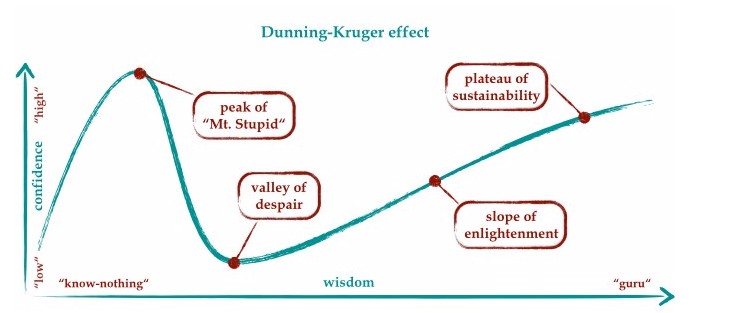
During the session, we considered the Dunning-Kruger effect. The Dunning-Kruger effect is a cognitive bias where people with limited knowledge or competence in a specific domain overestimate their own skills. So there is typically overconfidence in low performers and underestimation by experts because they understand how complex a subject is, they assume that others find the tasks just as difficult.
This suggests that we have high confidence when we start – then we decline into a “valley of despair” during the middle years – before growing in confidence again as we mature.
Dunning-Kruger Effect | Psychology Today United Kingdom
And let’s be honest, the current business climate is worrying. Global wars. The huge number of young people without work. The cost-of-living crisis. Increasing levels of mental illness. The constant media noise that artificial intelligence will take everyone’s jobs. It’s hardly conducive to us feeling safe, secure and confident!
Reframe your confidence in later years
If we are not stepping out of our comfort zone and learning new things then we aren’t developing. If we don’t tackle new things, then we aren’t pushing ourselves to evolve and reach our full potential.
We need a growth mindset. And growth means change. And change – for all humans – is uncertain and scary. So your confidence naturally dips during change.
Try to look at things differently. As we spend longer in a career and gain more experience under our belt we are likely to take on more complex and difficult tasks. So we might still feel a lack of confidence when faced with a new and challenging task that is intrinsically more challenging.
Furthermore, although professional services is an environment where there’s a cultural distaste for mistakes – we learn by mistakes. To excel at something we have to try new things and practice – and this may involve some small failures along the way. So it’s not surprising that we may fear failure.
Our internal critics can contribute too. You may have a harsh internal voice that says “Come on, you have 15 years’ experience – you should be able to tackle this without lacking confidence”. That internal voice may also say “Consider what others may think – you’ve been in this role for 15 years – how will they react if you are seen to struggle or fail?”. The threat of loss of reputation and feelings of shame. That really isn’t a helpful internal dialogue. You need a kinder internal voice – an internal coach.
Bolster your self-esteem and challenge your Imposter Syndrome
Several delegates mentioned that they had low self-esteem and they felt dominated at times by feelings of Imposter Syndrome. Some adopted a “fake it til you make it” approach.
We considered several examples of high profile and high achieving people who also still experience Imposter Syndrome. And I shared examples (without breaching confidentiality) from coaching and therapy clients who were business superheroes (extraordinary financial results, growing great businesses and being admired by their peers and employees alike) who STILL sometimes lack confidence at relatively simple tasks like chairing a meeting or making a presentation.
So do an audit of all your strengths and achievements. Write them down – with examples and evidence. Note down all the times you overcame a significant challenge or obstacle. Record what happened and what you did and the ultimate outcome. Remind yourself of just how much you have achieved. And just how good you are. And refer to that note whenever you feel your confidence waning or anxiety growing.
Change your internal conversation from “Why am I lacking confidence in tackling this task?” to “Hey – I’m feeling some tension about tackling this task which shows that I am still learning and growing”.
Resources to help with self-esteem:
Book review – Creating self-esteem by Lynda Field March 2024
Overcoming low self-esteem – a self help guide using cognitive January 2025
If you are experiencing significant difficulties with confidence, please check out the resources on my therapy web site Tasso Talking Therapy – where emergency numbers are also provided
About the delegates
Delegate aims
- Personal and professional development
- Develop more self-belief
- I’ve had a tough personal time over the past 12 months and have lost my confidence. Need to look after myself and get back to feeling on top of my game
- I am right at the start of my career and want to start in the way that I mean to go on – with confidence
- I’ve always struggled with confidence issues in the workplace particularly with imposter syndrome
- Want to gain more confidence in dealing with clients
- Want to gain confidence as I progress to qualification in October
- I am qualifying in September so want to feel prepared
- I am hoping to learn a bit more about what causes that confidence deficit
- I hope to gain new techniques and professional judgement that I can bring to my day to day communication
- Useful webinar as part of my PSC to gain some valuable skills in enhancing my confidence in meetings and taking ownership of work
- I struggle with imposter syndrome and second guessing myself and so I’d like to gain confidence in my own ability
- I feel like my confidence has dropped since moving into law, a lot of Imposter syndrome going on
- I struggle with my own abilities which seems to have got worse as I’ve got older and now working alongside some very educated people
- Feeling intimidated sometimes with my lack of university education
- The main reason for being here today is to gain more knowledge on how to manage imposter syndrome in the workplace
Break out discussion on how to appear more confident
- Maintain good posture
- Use gestures (but not to the extent it would be considered fiddling)
- Maintain good eye contact
- Smile at people
- Speak in a clear manner without rushing
- Pace yourself
- Prepare
- Reflect back what is being discussed
- Adopt right tone and pace
- Consider other people
- Avoid looking at yourself on screen
- Talk clearly without rambling
Delegate key takeaways
At the end of the session, these were the ideas that resonated most with the delegates. Several delegates said that they felt reassured that they weren’t the only people who lacked confidence – there were many people at the session who felt the same.
(Internal) Emotional regulation tools:
- Grounding techniques Grounding tools (support for emotional regulation) – Kim Tasso
- Responding versus reacting Confidence – Radiators and Drains and the 90 second rule
- Cognitive reframing
- Recognising spotlight bias
- Mindfulness exercises when feeling overwhelmed
- Be mindful of internal dialogue and how you speak to yourself Building the confidence of young professionals – Four tools
- Different breathing techniques that I hadn’t previously heard of
(External) Appearance and presentation tools:
- Separating factual responses from irrational/emotional ones
- Taking the time to stop and think first before speaking
- Slowing down while speaking Be more confident – Slow down – Kim Tasso
- Making sure I’m aware of my NVC Non-Verbal Communication (NVC) – the basics (Video)
- Importance of non-verbal aspects
- Things that I can do/convey to show confidence in meetings etc
Concepts and ideas
- Personal development is not linear
- The graph on confidence over time
- Reframe – you said as you progress you do harder things and have more challenging tasks!
One delegate asked about standing up to “big characters”. Some material that might help:
- dog, cat and bear personalities – Better business relationships
- Dealing with “difficult” people – Nine strategies for dealing with arrogance
- What do you do when your boss is a micro-managing control freak?
- fixed views and closed to new ideas (dealing with stubbornness)
- Resources to help you deal with difficult interactions
- How do I deal with difficult partners? – Kim Tasso
- the parent, adult, child (PAC) model helps with difficult interactions
- What do you do when a male colleague doesn’t like women? (gender bias)
- Confidence – How to get a word in when people keep talking
Another delegate said that they struggled with how their accent is perceived (we noted much media debate on this topic with the future Prime Minister having a Manchurian accent)
Delegate poll results
Confidence levels
| At the start of session? | How would you like to feel at work? | At the end of the session? | |
| 1 | |||
| 2 | |||
| 3 | 6% | ||
| 4 | 6% | ||
| 5 | 35% | ||
| 6 | 29% | 14% | |
| 7 | 24% | 50% | |
| 8 | 19% | 14% | |
| 9 | 31% | 21% | |
| 10 | 50% |
How often do you experience Imposter Syndrome?
- 6% Never
- 35% Occasionally
- 47% Often
- 12% All the time
Which is the situation where you most lack confidence?
- 33% Presentations/public speaking
- 27% Conflict situations
- 20% Actual or virtual meetings
- 7% Social/conversations Book review: “Now we’re talking” by Sarah Rozenthuler
- 7% Day-to-day role within the team
- 0% Learning new things
- 0% Telephone calls
- 7% Other
Do you avoid things that make you feel nervous?
- 93% Sometimes
- 7% Never
(I mentioned that you should try not avoid the things that make you nervous. As this will usually increase your anxiety about it and make you feel more nervous Book review – Feel the fear and do it anyway by Susan Jeffers and Book review: The Gift of Anxiety – Harnessing the EASE method)
Are you mostly:
- 54% An optimist
- 46% A pessimist
How resilient do you think you are? Improve your resilience – tools to help you cope in difficult times (kimtasso.com)
- 15% Low
- 23% Average
- 46% High
- 15% Very high
What impact do you think clothes have on how confident you appear? (1=low, 10=high)
- 1
- 2
- 3
- 4
- 5 8%
- 6 8%
- 7 31%
- 8 8%
- 9 15%
- 10 31%
Where does most of your personal power come from? How do you make a personal impact – Make a difference (kimtasso.com)
- 43% Presence
- 14% Authority
- 43% Impact
Do you think you are: Assertiveness skills – getting what you want and saying “No” (kimtasso.com) and Assertiveness toolbox – Kim Tasso
- 62% Assertive
- 31% Passive
- 8% Passive-Aggressive
- 0% Aggressive
I think my boundaries are: Healthy boundaries at home and at work – how to set and maintain
- 31% Porous
- 62% Healthy
- 8% Rigid
Related articles on confidence, assertiveness and mental health
Emotional Intelligence in legal practice (Globe’s Fundamental Skills July 2026
How to manage your emotions so they don’t manage you June 2026
Stop letting everything affect you by Daniel Chidiac (Overthinking May 2026
Clarity, power and incisive questions May 2026
Grounding tools (support for emotional regulation) – Kim Tasso April 2026
Confidence – Radiators and Drains and the 90 second rule January 2026
Healthy boundaries at home and at work – how to set and maintain January 2026
Book review: The Gift of Anxiety – Harnessing the EASE method December 2025
The stress bucket, healthy coping mechanisms and resilience December 2025
Improve mental health at work, in marketing and for women September 2025
Building the confidence of young professionals – Four tools July 2025
Book review – Feel the fear and do it anyway by Susan Jeffers June 2025
Assertiveness toolbox – Kim Tasso May 2025
Towards leadership – Elevate your Presence, Influence and Impact April 2025
Overcoming low self-esteem – a self help guide using cognitive January 2025
Be more confident – Slow down – Kim Tasso January 2025
Book review: “Now we’re talking” by Sarah Rozenthuler January 2025
Confidence to overcome a fear of failure – Kim Tasso September 2024
Confidence – How to get a word in when people keep talking (kimtasso.com) July 2024
fixed views and closed to new ideas (dealing with stubbornness) (kimtasso.com) July 2024
we’re all in the same (stressed) boat (kimtasso.com) May 2024
How to create and promote your personal brand – Kim Tasso May 2024
Book review – Creating self-esteem by Lynda Field (kimtasso.com) March 2024
What do you do when your boss is a micro-managing control freak? (kimtasso.com) March 2024
Questions on confidence at work (kimtasso.com) January 2024
Book review: How to do the work (recognise your patterns (kimtasso.com) December 2023
The patterns of NLP applied to business interactions by Daryll Scott (kimtasso.com) December 2023
How to start conversations that get results (kimtasso.com) September 2023
Marketing and Business Development (M&BD) Assistants can shine (kimtasso.com) September 2023
Dr Julie Smith (Mental Health Guidance) (kimtasso.com) July 2023
Boosting Your Confidence at Work – A Toolbox for Success (kimtasso.com) July 2023
Assertive communication: The importance of voice (kimtasso.com) May 2023
Conversation skills book review (kimtasso.com) May 2023
Soft skills – Boost your self-confidence and confidence (Video) (kimtasso.com) October 2022
Telephone skills: Anxiety, voice, etiquette and the client experience (kimtasso.com) September 2022
Book review – Great networking by Alisa Grafton (kimtasso.com) July 2022
Book review: The psychology of successful women by Shona Rowan (kimtasso.com) June 2022
An introduction to presentation skills – Easy as ABC (Video) (kimtasso.com) March 2022
Non-Verbal Communication (NVC) – the basics (Video) (kimtasso.com) August 2021
Emotional Regulation – A key element of Emotional Intelligence (EQ) (kimtasso.com) August 2021
Book review: Digital Body Language – How to build trust by Erica Dhawan (kimtasso.com) June 2021
Dealing with “difficult” people – Nine strategies for dealing with arrogance (kimtasso.com) June 2021
Building rapport in the digital space (kimtasso.com) Jun2 2021
Improve your resilience – tools to help you cope in difficult times (kimtasso.com) November 2020
Insights into assertiveness, confidence and effectiveness (kimtasso.com) October 2020
Be more visible – the PVI model (kimtasso.com) September 2019
Be more confident and convey confidence – top tips (kimtasso.com) June 2019
assertiveness, impact and effectiveness (kimtasso.com) March 2018
How do you make a personal impact – Make a difference (kimtasso.com) March 2018
Winning pitch presentations – tips for competitive tendering (kimtasso.com) May 2017
Assertiveness skills – getting what you want and saying “No” (kimtasso.com) March 2017
Presentation skills – TED Talks Chris Anderson book review (kimtasso.com) October 2016
Book review – The presentation book by Emma Ledden (kimtasso.com) February 2014
Book review – Persuasive Presentations by Duarte (kimtasso.com) December 2012
11 tips for your first presentation – Kim Tasso June 2010
Crazy busy – Book review – Dealing with stress (kimtasso.com) October 2009