
Everyone has a view on and will have – at some point in their lives – personal experience of ageing. Generational challenges dominate our headlines at present as the Government grapples with issues around young people not in employment, education or training (NEET), pensions sustainability and how to provide social care for vulnerable older citizens. The difference across the generations appears to be polarising – even divisive at times. Yet it is relevant in therapy for two key reasons: a) therapy must be inclusive and reflect the needs of clients regardless of their age and b) sometimes clients consider the age of their prospective therapist as part of their selection process. Ageing and therapy.
Contents:
- Do you choose a younger or older therapist?
- Which factors contribute to successful therapeutic outcomes?
- Ageing in psychotherapy approaches
- Ageing as a counsellor – personal and professional perspectives
Do you choose a young or older therapist?
One of the things people may consider when seeking a therapist is whether they want a young therapist or an older therapist. Every therapy client needs to feel that they will be able to connect with and be understood and accepted by their therapist.
Some clients may feel that having a therapist of the same generation is important. Others may want someone from a different generation to help them gain insight into what that different generation looks and feels like to build their awareness.
You could argue that an older therapist has more experience, or that a younger therapist has had more recent training in more up-to-date approaches. Although all therapists will be committed to CPD (Continuing Professional Development) to remain part of their professional body.
At one extreme, I have young adult clients struggling to cope with our brave new world with an education and upbringing that equipped them for the way things were. And perhaps they face challenges with their families of a different generation that just doesn’t understand.
At the other extreme, I have older clients who feel shocked, disconnected and perhaps isolated by the way things are now – and anxious about what the future may hold. They may feel they want a therapist who can relate easily to their generation’s way of thinking and values.
Older clients may also grapple with issues where they want a therapist that has lived experience of things like – the collapse of relationships, menopause, ageing parents, family bereavement, empty nest syndrome, a changing workplace, loss of physical and mental capabilities, retirement, the transition to “old age” and the search for a new sense of purpose and meaning. Yet a younger therapist with little life experience is less likely to assume that their experience is what a client may be feeling. So they may explore the feelings and thoughts of an older client more thoroughly.
Most therapists adhere to three key principles when working with clients: empathy, congruence and unconditional positive regard (see A general law of interpersonal relationships). Which means that all therapists will be curious and ask questions to gain insight into what their client is experiencing – without making assumptions or judgements.
I consider other criteria and factors when people are choosing a therapist here: How do you choose a therapist? – Kim Tasso
Which factors contribute to therapeutic outcomes?
Having said that, it’s important to remind ourselves of what the research says about average contribution of therapeutic factors to therapy outcomes. The data from Norcross and Lambert (2019) suggests:
- 30% Client factors (that’s all about the client)
- 15% The therapeutic relationship (the relationship between therapist and client)
- 10% Orientation (whether the therapist is integrative, CBT, person-centred etc)
- 7% Therapist (e.g. age, background etc)
- 35% Other and unexplained factors
So remember that the therapist contribution to a successful therapy outcome (whatever their age) is just 7% – and the therapeutic relationship is 15%.
Ageing in psychotherapy approaches
Therapy can support older adults process life transitions, manage emotional health and achieve high recovery rates (e.g., a 61% recovery rate for the 65–74 age group in NHS Talking Therapies).
In the United States of America, Professional Geropsychology is a specialty that applies the knowledge and methods of psychology to understanding and helping older persons and their families.
There are many therapeutic schools of thought and approaches that might be useful for older clients. For example:
Erikson’s stages of psychosocial development – Wikipedia is a comprehensive psychoanalytic theory that identifies a series of eight stages that a healthy developing individual should pass through from infancy to late adulthood.
nhs-talking-therapies-older-people-positive-practice-guide-2024.pdf This is an excellent guide to NHS Talking Therapies for older people – and CBT (Cognitive Behavioural Therapy – CBT) is discussed – particularly where there might be early cognitive impairment or anxiety and depression
The Existential approach incorporates psychology and philosophy to help clients make sense of their place in their world: to find alignment between societal, cultural and individual expectations. It concentrates on the present moment and four universal human dilemmas (death, meaning, isolation and freedom) outlined by theorists like Irvin Yalom What is existential therapy? | Types of therapy
Pioneered by German Psychiatrist Fritz Perls, Gestalt therapy focuses on the “here and now” whole experience (mind, body and soul – but particularly of your bodily sensations) in the present even when reflecting on how you felt in the past – The Fertile Void – Gestalt coaching at work by John Leary-Joyce
Book Review: The Power of Now by Eckhart Tolle is similar to Gestalt in its focus on the “here and now” but also considers spirituality and purpose in life
Introduction to Internal Family Systems (IFS) IFS helps clients understand the impact of their past on their present thoughts, feelings and behaviour. It proposes that we see ourselves as a composite of parts – like members of a family – some from the past, some from the present and maybe some from the future.
Transactional analysis (TA) suggests we view ourselves and others through the lens of the Parent, Adult and Child states Book review – Counselling for toads
Your personal transition – Endings, neutral zone and new beginnings William Bridges wrote this classic book to help people of whatever age make sense of life’s changes
Acceptance and Commitment Therapy | Psychology Today United Kingdom In ACT, clients learn to stop avoiding, denying, and struggling with their inner emotions and, instead, accept that these deeper feelings are appropriate responses to certain situations that should not prevent them from moving forward in their lives.
Bereavement therapy and grief counselling use talking therapies – such as cognitive behavioural therapy (CBT) and interpersonal psychotherapy (IPT) to help process loss, manage difficult emotions and adjust to life.
Talking therapy can help people with early-to-middle stage dementia manage symptoms like depression, anxiety, apathy and low self-esteem. Cognitive behavioural therapy (CBT) and dementia | Alzheimer’s Society and Mild cognitive impairment (MCI) | Alzheimer’s Society
Ageing as a counsellor – personal and professional perspectives
The NCPS | National Counselling & Psychotherapy Society recently asked members to contribute to a special feature in the October 2026 edition of its magazine Counselling Matters. Although the magazine is reserved for NCPS members, you can see my full submission below. And I have permission to share the published extracts above.
Here’s the full article I submitted:
“I have a particular perspective on ageing as a counsellor. So you’ll need some context.
Early career decisions
From an early age I wanted to be a therapist. But life took me on a different journey so I spent 25 years running a successful management consultancy. During that time, I qualified and practised as a coach. But I constantly hit the professional boundaries between coaching and counselling. Reflecting back now, I saw my first 30 years as a time when I established my identity and career. But the therapy itch wouldn’t go away.
Family life and career transitions
The second part of my life was spent raising a family (as a single mum). And during that time I sought therapy myself – to help me leave a relationship. The wounds were deep and the recovery was slow. As my kids grew and flew, I entered the third stage of my life – with more focus back on myself – and I started studying to become a counsellor.
I was usually the oldest student in the class. That was uncomfortable sometimes when I wondered whether I had a more jaded view of life. I questioned my ability to really connect with younger people. I often questioned whether it was too late to change careers.
Lived experience
Obviously, being an older therapist means you have more lived experience to inform client work – unsuccessful relationships, marriage, divorce, parenthood, guiding troubled teens, travel and immersion in other cultures, career changes, bereavement and countless hardships. Just more life experience.
That grounds you. And broadens your mind and nudges you to be less judgemental than in your sometimes idealistic youth. It also makes you value the work of early therapists such as William Bridges and his fabulous work on transitions (Your personal transition – Endings, neutral zone and new beginnings) – particularly the material about endings and the disconcerting neutral zone you experience before a new beginning.
Reparenting
In deeper psychotherapy, being older supports the work you do with clients in reparenting (healing the inner child, addressing the inner critic, regulating the nervous system, healing complex PTSD etc).
I am sure some clients seek – perhaps subconsciously – the parent they “missed” in a more mature therapist. Reparenting is a vital part of much work on self-esteem, boundaries, assertiveness, attachment, Transactional Analysis, IFS and recovery from complex PTSD.
And as a therapist you gain insight from clients about what they expect and want from parents – helping you to be a better parent yourself.
Concerns about ageing
We all experience concerns about ageing. For some it occurs early, and for others it creeps up later. Unexpected changes in circumstances, ageing relatives, your own health issues, menopause and the frightening realisation that you have lived longer than you have left to live might accelerate the process.
For some people that can trigger disappointment, a sense of dissatisfaction or even anxiety and depression. For others it drives the pursuit of a sense of meaning, purpose and passion in life. I’ve trodden that road so I can be a credible companion.
Older therapists working with younger therapy clients
I relish working with younger clients. And those from other cultures. The world they inhabit is so different to one I grew up in. It makes me constantly re-examine my assumptions and challenges my values. It leads me to value the childhood that I had. And it fuels my sense of gratitude with life.
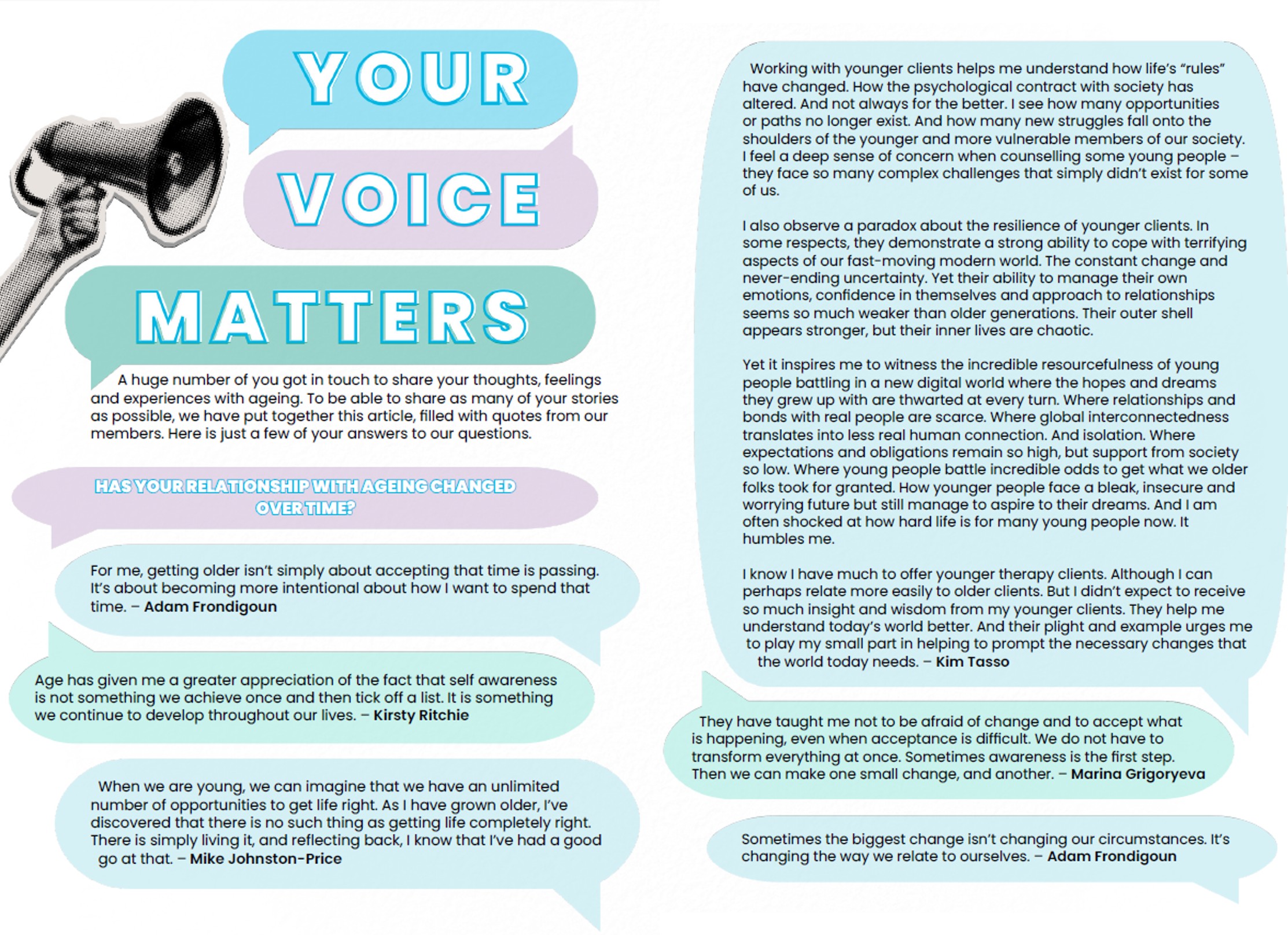
Working with younger clients helps me understand how life’s “rules” have changed. How the psychological contract with society has altered. And not always for the better.
I see how many opportunities or paths no longer exist. And how many new struggles fall onto the shoulders of the younger and more vulnerable members of our society. I feel a deep sense of concern when counselling some young people – they face so many complex challenges that simply didn’t exist for some of us.
I also observe a paradox about the resilience of younger clients. In some respects, they demonstrate a strong ability to cope with terrifying aspects of our fast-moving modern world. The constant change and never-ending uncertainty. Yet their ability to manage their own emotions, confidence in themselves and approach to relationships seems so much weaker than older generations. Their outer shell appears stronger, but their inner lives are often more chaotic.
Yet it inspires me to witness the incredible resourcefulness of young people battling in a new digital world where the hopes and dreams they grew up with are thwarted at every turn. Where relationships and bonds with real people are scarce. Where global interconnectedness translates into less real human connection. And isolation.
Where expectations and obligations remain so high, but support from society so low. Where young people battle incredible odds to get what we older folks took for granted. How younger people face a bleak, insecure and worrying future but still manage to aspire to their dreams. And I am often shocked at how hard life is for many young people now. It humbles me.
I know I have much to offer younger therapy clients. Although I can perhaps relate more easily to older clients. But I didn’t expect to receive so much insight and wisdom from my younger clients. They help me understand today’s world better. And their plight and example urge me to play my small part in helping to prompt the necessary changes that the world today needs”.
(Subsequently, I heard an interesting LBC broadcast on 10th October where they “exploded the snowflake theory”. Quoting Professor Peter Fonagy (the clinical psychologist who chaired a commission on the prevalence of mental health conditions ADHD and autism) “I am in awe of their courage. Young people are contending with more powerful forces than I ever faced. They are not fragile – they are outnumbered”).
Related articles on therapy
You can learn more about therapy and Tasso Talking Therapy at Counselling and Psychotherapy by Kim Tasso in Folkestone, Kent
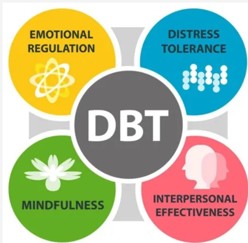
What is DBT therapy? Is DBT right for me? – Kim Tasso October 2026
All change? Mental health in the legal sector – Kim Tasso August 2026
Confidence – Does it increase as we get older and wiser? – Kim Tasso July 2026
Emotional Intelligence in legal practice (Globe’s Fundamental Skills July 2026
Grounding tools (support for emotional regulation) – Kim Tasso April 2026
Healthy boundaries at home and at work – how to set and maintain January 2026
Confidence – Radiators and Drains and the 90 second rule January 2026
The stress bucket, healthy coping mechanisms and resilience December 2025
What do I do if I’m feeling stuck? – Kim Tasso October 2025
Improve mental health at work, in marketing and for women September 2025
Assertiveness toolbox – Kim Tasso May 2025
What happens in therapy? – Kim Tasso April 2025
Confidence to overcome a fear of failure – Kim Tasso September 2024
my relationships like rollercoaster rides? Volatile relationships (kimtasso.com) August 2024
How do you choose a therapist? – Kim Tasso July 2024
Emotional Regulation – A key element of Emotional Intelligence (EQ) (kimtasso.com) August 2021
Psychology and business communication (kimtasso.com) January 2015 An introduction to Transactional Analysis (TA) and the Parent Adult Child model
10 tips to increase your resilience – Kim Tasso March 2013
Related posts on therapy, counselling and self-help book reviews
Book Review: Addicted to Anxiety by Owen O’Kane – Kim Tasso September 2026
How to manage your emotions so they don’t manage you June 2026
Stop letting everything affect you by Daniel Chidiac (Overthinking May 2026
Book Review – ADHD 2.0 by Edward M Hallowell MD March 2026
Book review: The Gift of Anxiety – Harnessing the EASE method December 2025
What happened to you? Conversations on trauma, resilience November 2025. Book review: What happened to you? Conversations on trauma, resilience and healing by Bruce D Perry (psychiatrist) and Oprah Winfrey
Introduction to Internal Family Systems (IFS) October 2025. An overview of the therapeutic approach IFS that seeks to explore your internal parts – the exiles, managers and firefighters – and develop a greater sense of self and calm.
Attached by Dr Amir Levine and Rachel Heller August 2025. How attachment theory can help you understand your relationship style – secure, avoidant and anxious.
Book review – Feel the fear and do it anyway by Susan Jeffers June 2024. Classic self-help book on managing anxiety
Book review – Counselling for toads May 2025. The modern classic explaining Transactional Analysis (TA) using a story by Robert de Board using Toad and other characters from “Wind in the willows”
Book Review: The Power of Now by Eckhart Tolle March 2025 A best-selling guide to ceasing your incessant thoughts, focusing on the present “here and now”, spiritual enlightenment and finding inner peace.
Overcoming low self-esteem – a self help guide using cognitive behavioural techniques by Melanie Fennell January 2025
Book review: Taking charge of Adult ADHD by Russell A Barkley (kimtasso.com) October 2024
“Adult children of emotionally immature parents – how to heal (kimtasso.com) August 2024 An excellent book that has helped several clients suffering from anxiety, depression and “failed” relationships. How to recognise emotional, driven, passive and rejecting parenting styles and the coping mechanisms adopted (e.g. people pleasing, high independence etc).
Book reviews on stress and trauma – “When the body says No” (kimtasso.com) June 2024 Review of “When the body says no – The cost of hidden stress” by Gabor Mate and “The body keeps the score – mind, brain and body in the transformation of trauma” by Dr Bessel Van Der Kolk
Book review: The Thriving Lawyer by Traci Cipriano (resilience) (kimtasso.com) June 2024 A review of a book into the mental health and resilience of lawyers in law firm cultures. The author is a former practising attorney and clinical psychologist.
The Tools – Five life-changing techniques to unlock your potential (kimtasso.com) April 2024 A review of the book by psychiatrist Phil Stutz
Book review – Creating self-esteem by Lynda Field (kimtasso.com) March 2024 A classic book on realizing your true self worth
Book review: How to do the work (recognise your patterns (kimtasso.com) December 2023. Review of a book to support psychoeducation. Topics include: conscious self, theory of trauma, mind-body healing practices, inner child, boundaries, reparenting and emotional maturity.
Dr Julie Smith (Mental Health Guidance) (kimtasso.com) July 2023. Review of the book “Why has nobody told me this before?” that explores helpful ideas on low mood and depression, motivation, anxiety, emotional pain, grief, self-doubt, fear, stress and a meaningful life.
Overcoming clinical depression (2021) by Oliver Kamm (kimtasso.com) March 2023. A review of the book “Mending the Mind” which explores what it is like to suffer from depression and both the medical and psychological sources of help.
Lost connections – Why you’re depressed by Johann Hari (kimtasso.com) October 2019. A review of a popular book about the nine common reasons people suffer from depression.
Crazy busy – Book review – Dealing with stress (kimtasso.com) October 2009. This book examines modern life and offers practical advice to avoid stress and restore calm.
Book review: The psychology of successful women by Shona Rowan (kimtasso.com) June 2022. Topics include: confidence, assertiveness, boundaries, public speaking, impact, influence, visibility and bouncing back from setbacks.
Your personal transition – Endings, neutral zone and new beginnings (kimtasso.com) June 2020. Helps you navigate major changes in your life and prepares you for the emotional roller-coaster of change.