
PM Forum introduced an “AI in marketing” workshop in September 2024 (see Key Insights from the AI in Marketing training by Optix at PM Forum) so I joined a session recently to see how things have changed. The session has been extensively updated – with the facilitator sharing updates from her recent experiences working with a variety of legal users (including The Law Society). Key topics emerging: changing use of AI in marketing, increasing cost of AI, from AI prompts to AI agents and from ideas to implementation. Artificial Intelligence (AI) in marketing – An update.
The session covered the following topics:
- Understanding AI concepts and capabilities
- Popular AI tools and their uses
- Beyond content creation – AI as a marketing team mate
- Identifying opportunities for AI integration
- An AI-enabled week in the life of a marketing professional
- Creating an AI implementation roadmap
Session leader Samantha Smith | LinkedIn (from Optix | Strategic Brand and Marketing Agency) is a strategist and consultant having spent 16 years in digital marketing.
PM Forum training courses for the remainder of 2026 and 2027 are shown here: PM Forum – PM Forum
Delegates were from all sectors of the legal profession, accountancy firms and property consultancies. Most were using AI for drafting content and checking tone of voice. Some had seen AI build new intranet sites, others were using AI with their CRM systems for data retrieval and meeting preparation and events professionals were using AI to slimline their processes. All were keen to know how to extend their adoption of AI – providing they could find the time and headspace. Many were CoPilot and Claude users. Everyone commented that AI was moving so fast that many training sessions rapidly became out of date.
Whilst there were lots of tips shared during the session, I’ve highlighted just a few themes.
How AI use in professional service marketing is changing
Sam offered an interesting way to consider how AI in marketing use was changing:
- Understand (2023)
- Apply (2024)
- Prioritise (2025)
- Collaborate (2026)
We were urged to think of AI like a super-smart intern. Someone with whom we can delegate and share work – but for whom we remain responsible for checking the accuracy of their work.
There was an overview of the most common AI tools and best use cases – including: ChatGPT, Microsoft 365 Copilot, Claude, Gemini, NotebookLM, Perplexity, Granola and HeyGen.
Sam shared the five checks to undertake before AI was used (i.e. confidential data, verifiable evidence, impact of bias, human approval and decision-making).
There’s increasing attention on the ethical use of AI to protect trust, fairness and professional integrity.
Increasing cost of AI
The session occurred in a week where the news headlines were full of the threats of AI to humanity (e.g. Why are there concerns AI could threaten humanity? – BBC News).
Whilst we all appreciate how much time AI can save us (e.g. data analysis tasks reduced from days to a few hours), the escalating cost of AI was a theme in this session.
Firms not only have to pay for licences but for token use – which is harder to track when AI is embedded in processes and agents. One major company spent its annual AI budget in four months. AI companies are going public and seek profits – so price rises are likely to continue. This suggests that we need to be more strategic and selective about where and how we use AI.
Being succinct in prompts was stressed – even the polite elements we sometimes use in AI can cost.
“Good strategy often comes from asking better questions, not finding faster answers”
Shift from AI prompts to AI agents
Previous AI sessions focused on prompting skills, and there were a few pointers here – for example, show sources, direct sources and flipped interactions. A clear process was outlined: Context > Task > Criteria > Output > Check.
But the focus in this session concerned improving efficiency through the use of agents to automate processes.
A related theme was helping AI to learn. So avoid starting from scratch with each task – allow AI tools to carry context from one task to the next: “Context is king”
Sam walked us through a thought-provoking scenario where she put an AI assistant on the organisation chart and showed us how to:
- Personalise the instructions to her AI assistant
- Set aside a workspace for the AI assistant
- Allocate a variety of research, analysis, content, administration, training, forecasting and documentation tasks to her AI assistant
- Personalise – with custom instructions – how you want your AI assistant to talk to you, manage the schedule of recurring prompts, set up the environment (e.g. voice commands on your phone), create a prompt library and compare models for checking
With an example of “it’s Monday morning and leads are down 25%” she showed how to provide the context information to the AI assistant and direct it to explore possible causes and compare solutions.
She summarised the agent process as: Assist – Repeat – Automate
From AI ideas to implementation
There were case studies showing the sorts of returns generated by AI for leading companies. And discussion about push back on “AI slop”.
The core considerations for any AI implementation policy are: What? Why? How? This requires firms to consider how many of their work processes are mapped and/or consistent.
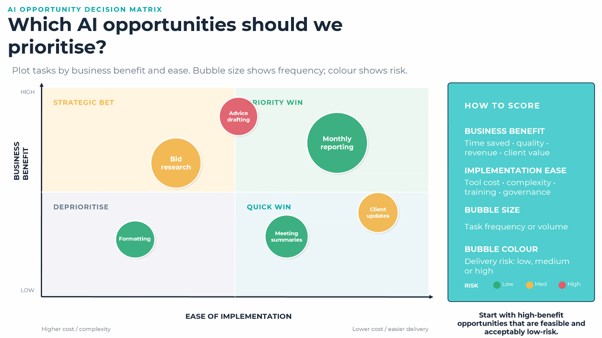
Sam provided a template and guidance on building an AI opportunity register. And then showed how to compare options in a decision matrix (using a bubble chart) considering business benefit against ease of implementation.
We also discussed how to explore risks such as: hallucinations, confirmation bias, Ai voice, lack of reasoning. And how your AI policy helps you stay compliant.
Summary
Sam finished with five key things to remember:
- Start with friction, not fascination
- Context beats clever prompting
- Ask AI for trade-offs, not decisions
- Assist – Repeat – Standardise – Automate
- You own the outcomes. AI helps do the work
Related posts on AI in marketing
AI’s impact on bids and pricing in professional services August 2026
Navigating towards your future digital marketing ecosystem – Kim Tasso July 2026
Profile event review : AI agents at GIA surveyors July 2026 (PM Forum members only) – also summarised here Profile Property Marketing Network – Roundup of past events – Kim Tasso
Thought leadership update: insights and tools – Kim Tasso June 2026
From Keywords to Conversations: Marketing Strategies for AI Search May 2026 (PM Forum members only)
System review – Referonix AI pitch automation system – Kim Tasso April 2026
Telephone skills – Provide the human touch (with AI assistance) – Kim Tasso April 2026
Annual Strategy and Marketing Benchmark Meridian West February 2026
client feedback playbook – How professional services firms January 2026
Tendering and pitching – Key ideas and actions – Kim Tasso November 2025
Arup and GHD pitch automation and AI October 2025
CIM’s hype-free guide to AI agents for marketers – Kim Tasso September 2025
Planning Digital Marketing Campaigns and Content Strategy November 2024
The rise and power of AI and automation November 2024
Analytics and Measurement for Digital Marketing – Kim Tasso November 2024
Key Insights from the AI in Marketing training by Optix at PM Forum September 2024
create a digital marketing strategy in a professional services firm September 2024
The future shape of a Proactive MBD Executive? May 2024
Marketing and BD case studies in legal, accountancy, consultancy April 2024 (BenAI)
questions from Proactive Marketing/BD Executives April 2024
System review: CogniClick for instant, personalised research October 2023
Lessons from digital marketing webinars (June 2023) June 2023 (Bidwells)